
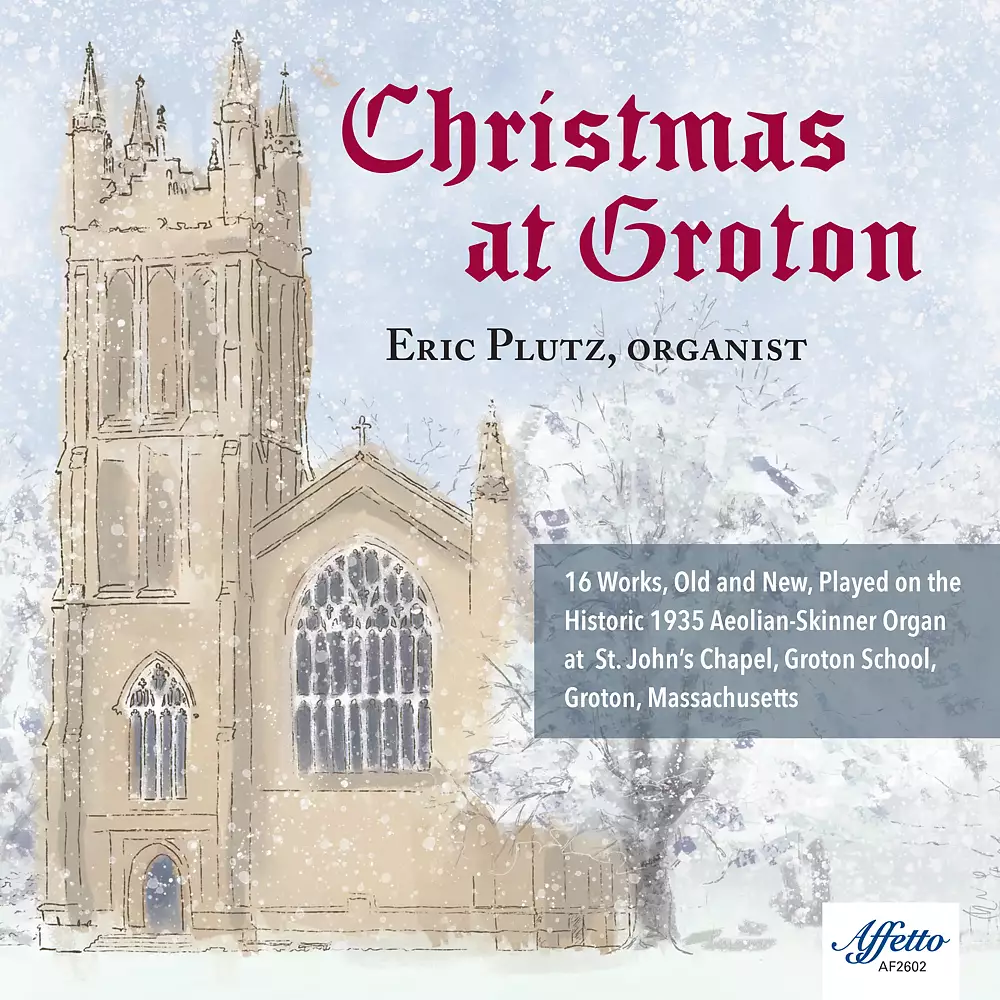
Christmas At Groton
Catalog Number: AF2602
A festive programme of chorale- and carol-based Christmas organ music played on the celebrated Aeolian-Skinner at Groton School, mixing familiar favourites with rarities and giving voice to Black composers and women composers.
Sample rate
48000 Hz
Christmas At Groton
CHRISTMAS AT GROTON
THE GROTON AEOLIAN-SKINNER
While seemingly simple, the task of choosing the repertoire for a Christmas recording of organ music is not. From the outset, I wanted to show the instrument in its best light by choosing compositions it would play well, but would also be attractive works to the listeners. The pieces should vary in length and complexity, offer a good balance between popular vs. unknown compositions, symphonic vs. crystalline textures, loud vs. soft, etc. Additionally, I wanted to include works by Black composers and Women composers, elevating their historically marginalized voices. Finally,
all these parameters were applied to music that was only chorale- (or carol!) based, for how else would the pieces be considered “Christmas?”
David Conte wrote the only legitimate ‘medley’ included here, Christmas Intrada. A festive opener for this celebratory album, he includes Ding, Dong, Merrily on High (Branle de l’Official), Angels from the Realms of Glory
(Regent Square), From Heaven Above to Earth I Come (Vom Himmel hoch), and On Christmas Night, All Christians Sing (Sussex Carol). One of the delightful crystalline pieces is David Gehrenbeck’s Carol Prelude on “Venite
Adoremus” (The Snow Lay on the Ground), as is Go, Tell it on the Mountain by Eugene W. Hancock. These highlight the clear flute stops of the Groton organ.
There are three sets of variations: June Nixon’s charming Variations on “Humility” (See, Amid the Winter’s Snow), the more substantial and classic Fleury Variations sur un Noël bourguinon (Variations on a Burgundian Noel), and the largest work on the album, Christmas, by Gaston Dethier, a set of variations on Adeste Fidelis (O Come, all ye Faithful). This symphonic piece calls on nearly every timbre of the organ over its seven variations.
There are two compositions from the Baroque era: Johann Pachelbel’s Chorale Prelude on “Vom Himmel hoch, da komm ich her” (From Heaven Above to Earth I Come), and Johann Sebastian Bach’s setting of “In dulci jubilo”
(Good Christian Friends, Rejoice). Each uses as its core sound the organ’s Principal Chorus, but in different ways. For the Pachelbel, I show how the instrument pays homage to its ancient predecessors by employing the full Great Principal Chorus, including the 5 1/3’ Große Quint. For the Bach, I begin with a similar, traditional Principal Chorus sound, but
ultimately add reeds to conclude.The symphonic abilities of the organ are covered in a general way with Gerald Near’s Carillon on a Ukrainian Carol,
and more explicitly in Edwin H. Lemare’s Joy to the World: Christmas Fantasia on “Antioch.” The Near asks for broad swaths of color to emerge, fade, and blend into each other much like the sections of an orchestra (brass, strings,
woodwinds, etc.), while the large Lemare work showcases specific colorful solo sounds from the Groton instrument. The Wexford Carol by Trent Johnson is one of the lesser-known carols but worthy of inclusion, as it is set uniquely, with fairly avant-garde chords in one section. I could not resist compiling a set of three for Go, Tell in on the Mountain. Each
is unique, including the jazzy one by Johannes Matthias Michel, and the Gospel-infused version by Norah Duncan, IV. Two settings draw our attention to that quiet joy of Christmas: Es ist ein’ Ros’ entsprungen (Lo, How a Rose e’er Blooming) by Mary Beth Bennett and O Little Town of Bethlehem by Brenda Portman. Bennett’s setting sounds as if a French improviser was, in the moment, rendering a work of instant composition, slightly pulling the tune
apart, and shrouded in mystery. Portman’s contribution is no less introspective and quiet, but she also uses both well nown tunes for the text, St. Louis, and Forest Green. The disc concludes with the dazzling Toccata on “God Rest Ye Merry” by Mark Miller. He surrounds the well-known, historic tune with harmonies from the new age of jazz in this tour-de-force showstopper. What began as a list of 100 pieces was whittled down to the 16 presented on this disc. All show the color, clarity, and character of this historically important instrument. There is fire when needed, soothing calm when needed, and everything in between. From whisper-quiet to thundering, the Aeolian-Skinner at Groton School is a masterpiece.
— Eric Plutz
Much like architecture, organ building vacillates between periods of exuberance and restraint. Also like architecture, some organs so fundamentally alter the tastes of a generation that they become prototypes, widely imitated. When any artwork is so seminal in impact, it can be hard to see it for the revolutionary example it once was. Sitting down to the Groton Aeolian-Skinner is just such an experience. Finished in late 1935, Groton instituted a new style for American organbuilding. In the first third of the 20th century, American builders were engrossed in suggesting the symphony, either through imitations of orchestral tonalities (Tubas, French and English horns) or in the broader sense of having the organ suggest the sweep and force of the modern symphony. In the late 1920s, taste began to shift, with organists rediscovering the works of Bach, and increasingly less satisfied
to play them on organs designed for Wagner. This movement found a champion in G. Donald Harrison (1889-1956). Born in England, Harrison was drawn to the organ early, but began his working life as a patent attorney alongside his
father. After World War I, Harrison chose his passion and joined Henry Willis & Sons, the venerable English builder who had furnished organs to the Cathedrals of London, Salisbury, Durham and Hereford. Bypassing the traditional apprenticeship, Harrison was soon involved in management and artistic tasks. In 1924, Harrison met Ernest Skinner, America’s great builder of the period. In 1927, Harrison accepted an offer to come to Boston and join the Skinner Organ Company. The official line was for Harrison to help Skinner re-instate traditional ensemble alongside the firm’s trademark orchestral tones. But Harrison was a lover of Bach and things “classical,” and
his ideas found resonance with a younger generation. In late 1931 the organ division of Aeolian merged with Skinner. Now “Aeolian-Skinner,” the re-christened company was ripe for an equally fresh artistic identity.
Slowly, organ by organ, Harrison introduced ideas in line with the new thinking. Tone became lighter and clearer, fewer stops for Wagner and more for Bach. But Harrison never lost sight of that quintessential flexibility American organs require: suitable to the Saturday recital and the Sunday service, weddings or funerals. By the time Groton came around, Harrison had gained enough experience to make several bold stylistic innovations in a single instrument. Groton was immediately hailed as a breakthrough, even by those opposed to emerging “classicism.” While Harrison would keep experimenting for two decades, Groton always remained his spiritual Opus One.
Groton was novel not merely from its sounds but its mildness. Coming off a period of high heroism, in which organs had become louder than ever, Groton was (and is) a study in mezzo, its intellectual and emotional content in equal check. As much as Harrison, the man who would refine Groton’s musical content was Edward B. Gammons (Harvard ’28). He came to the School in 1941, having been an enthusiast in student days. Over the next four decades, Gammons served as consultant to hundreds of organ projects nationally. At Groton, Gammons viewed the Aeolian-Skinner as a laboratory. Beginning in 1944, he started a campaign of incremental change, culminating in 1954 with a group of alterations under Harrison’s direction. A key improvement was relocating the console, in 1947, from directly beneath the case to the south alcove next to the pulpit, where one could hear far more directly.
After Harrison’s death in 1956, Gammons had a few last changes carried out, but nothing that altered the organ’s core sound. Revoicing and certain mechanical modifications occurred in the 1970s and 1980s under the curatorship of Kinzey-Angerstein, including a transition to solid-state technology, modernization of the console, and new five-stop enclosed Processional, placed in the original console location. Conservative cleaning and restoration by Foley-Baker and Jonathan Ambrosino in 2002 followed similar work to the building’s interior and exterior. In 2025, the console was re-renovated by Ortloff Organ Company, and a new Harmonic Flute added to the Processional. Today, Opus 936 is that peculiarly American pipe organ. Once novel, then widely copied, it is now hardly original and yet notable all the same: a quintessential American landmark. — Jonathan Ambosino
Published date
2026-11-06
Number of discs
1
Sample rate
48000 Hz
Channels
stereo:24:2.0
Made in Sweden since 1999. In collaboration with Textalk.
Cart
| Artikel | Antal | Beskrivning | a pris | Totalt |
Env.session:
NULL


Env.order NULL


string(2) "en"


collector.CheckoutUrl


collector.OrderItemCount
0

collector.CartUrl
NULL


collector.Order
NULL