
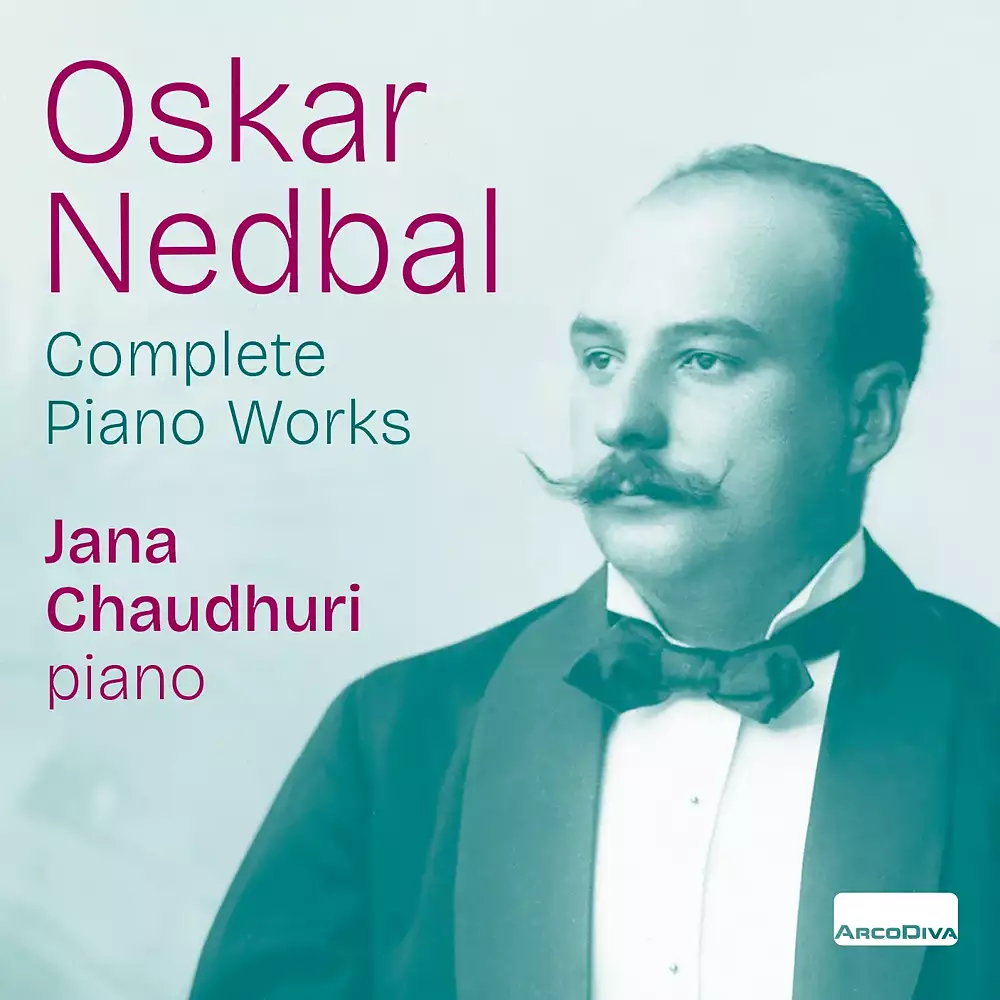
Oskar Nedbal Complete Piano Works, Jana Chaudhuri piano
Catalog Number: UP_0264
Oskar Nedbal Complete Piano Works, Jana Chaudhuri piano
Oskar Nedbal’s Piano Works
Although Oskar Nedbal’s compositional legacy is generally associated primarily with the genres of ballet and operetta, his largely unknown piano output is surprisingly extensive and diverse, comprising approximately forty published compositions. Within the context of Czech piano music of his generation, dominated by figures such as Vítězslav Novák and Josef Suk, Nedbal’s works offer a distinctive and often overlooked dimension. In many cases, they reflect an authentically refined and elegant style with a subtle salon character, frequently drawing upon stylized dance forms, above all the waltz.
The present recording, the first-ever complete survey of Oskar Nedbal’s piano music, presents the individual works in chronological order according to their dates of composition, thereby offe-ring listeners a unique opportunity to follow the artistic development of one of the most multi-faceted personalities of Czech music at the turn of the twentieth century.
CD I
The first disc contains works composed during the 1890s. Variations on a Theme by Antonín Dvořák, Op. 1, date from the spring of 1891. They were written as a composition assignment based on an original theme set by Dvořák himself. Oskar handled the variation form with remar-kable skill, while the pianistic writing points clearly towards a virtuoso conception. This substantial work, dedicated to his teacher, received an award from the Czech Academy in the following year and was published in Prague by F. A. Urbánek in 1895. The slow theme is followed by eight varia-tions, culminating in a final Furiant with a turbulent coda. Considering that the composer was on-ly seventeen years old at the time, this Opus One stands as compelling evidence of Oskar Ne-dbal’s exceptional compositional talent.
The three waltz stylizations of Op. 7, bearing the fashionable French title Lettres intimes (Intima-te Letters), were composed during the summer holidays of 1893 in his native Tábor as a counter-balance to the exhausting year-round schedule of European concert tours with the Bohemian Quartet. Particularly in the first piece (Allegretto), one may discern the beginnings of Nedbal’s fu-ture operetta style. Its salon-like character quickly gained popularity, prompting the composer to arrange it for string ensemble and dedicate it, under the title Valse noble, to the Ševčík Quartet. The remaining two pieces exhibit less affinity with the typical salon style. The third piece (Modera-to), especially, written in rondo form with hints of the furiant, reveals a more sophisticated and deeply developed conception. Lettres intimes was later orchestrated by the composer’s nephew, conductor and composer Karel Nedbal. The original piano version was published by F. A. Urbá-nek in Prague in 1895.
There can be little doubt about Nedbal’s considerable accomplishments as a pianist. The Bohe-mian Quartet frequently included chamber works with piano in its concert programmes, and it was usually Nedbal who took the keyboard part. He also toured as accompanist to the celebrated soprano Ema Destinnová. At the Prague Conservatory he studied piano with the distinguished pedagogue Josef Jiránek, one of Bedřich Smetana’s pupils. It was to Jiránek that Nedbal dedica-ted the third (Impromptu) and fourth (Valse caprice) pieces of Op. 8, Four Piano Pieces. This coll-ection was, in fact, the first of Nedbal’s compositions to be published as a complete volume (Pra-gue, F. A. Urbánek, 1894). The Barcarola, Valse petite (Little Waltz), and Valse caprice (Capricious Waltz) date from 1893, whereas the more substantial and technically demanding Impromptu dates from 1891, during his studies in Dvořák’s composition class.
Silhouette, Op. 10, and the Humoresque in G major are both brief occasional pieces, composed with the effortless melodic invention for which Dvořák regarded Nedbal as his most gifted pupil. At the beginning of 1895, the Bohemian Quartet performed in Riga. At the request of the local publisher Paul Neldner, who had organized the concert, Nedbal wrote Silhouette during his brief stay in the Latvian capital. In character, the piece anticipates the much later Valses Silhouettes, Op. 17. Neldner promptly published it in Riga, together with a humoresque by Nedbal’s quartet colleague Josef Suk. The circumstances surrounding the composition of the Humoresque in G major remain unknown. The piece was published in Prague by Jos. R. Vilímek in 1896 as part of the monthly magazine Hudební květy (Musical Blossoms), devoted to piano music and featuring short piano works by various composers.
The suite From Bygone Times (Z minulých dob), Op. 13, dates from 1896 and ranks among Ne-dbal’s finest piano compositions. Inspired by the model of the Baroque suite, it may be regarded as a parallel to Edvard Grieg’s Holberg Suite of 1884. Although the Baroque suite, consisting of contrasting dances (in Nedbal’s case a Sarabande, Minuet, and Gigue) as well as non-dance movements (Prelude and Air), was intended primarily for listening rather than dancing, it clearly reflects Nedbal’s strong affinity for dance forms. This inclination would later culminate in the composition of several ballets after the turn of the century and would also find notable expressi-on in his operettas.
The piano original was published the following year by Simrock in Berlin. In the same year (1897), seeking a richer palette of sound, Nedbal orchestrated the suite for large orchestra without trom-bones, with the exception of the Air, which he scored for strings alone. He conducted the premie-re with the Czech Philharmonic Orchestra in January 1898. The successful orchestral version was awarded third prize in the annual competition of the Czech Academy later that same year. The string arrangement of the Air was also performed in concert by the Bohemian Quartet.
CD II
The following two opuses display a strong autobiographical colouring, unusual in Nedbal’s out-put. In 1898, he married Josefina Setunská in Tábor, and in February 1901 their son Oskar was born. The cycle From a Child’s Life (Z dětského života), Op. 15, was composed in the period following his son’s birth and completed in the summer of 1902 in Tábor, after an exceptionally demanding concert season with the Bohemian Quartet and the Czech Philharmonic Orchestra. The cycle consists of seven miniature pieces reflecting the world of a child’s imagination and emotions. The opening piece, Lullaby, is dedicated “To My Little Oskar.” Although, with the ex-ception of the final movement, the work is technically less demanding for the performer, From a Child’s Life is a cycle of considerable charm and abundant inspiration.
In 1903, seeking a richer sonic palette, Nedbal orchestrated three contrasting movements from the cycle (Lullaby, March of the Toy Soldiers, and First Dance Steps) and published them in Prague through M. Urbánek under the title Suite mignonne (Little Suite or Charming Suite).
The happiness of family life proved short-lived. Josefina died in January 1903. Later, Oskar Nedbal found emotional refuge in the affection of Marie Hoffmannová, the wife of his colleague Karel Hoffmann, first violinist of the Bohemian Quartet. The cycle of ten pieces entitled A Tale of Sorrow and Happiness (Pohádka o smutku a štěstí), Op. 16, was conceived as a deeply perso-nal and intimate confession. It was composed between 1903 and the summer of 1905 and com-pleted, once again, in Tábor. The work reflects memories of happy love and the pain of its loss. The melancholy “bells” of the third movement (Poco andante) conceal the final breath of Josefina. The allusion to the romance from Donizetti’s L’elisir d’amore in the sixth movement (Andante) points towards a new emotional awakening. Yet only the woman to whom the work is dedicated, the “femme fatale” Marie Hoffmannová, knew of the secret longing and passion consumed by in-ner turmoil that inspired the music. The cycle was published in the autumn of 1905 in the cultural journal Zlatá Praha.
The new personal circumstances demanded a radical change. Nedbal left the Bohemian Quartet and travelled to the Orient with Marie. Inspired by the exotic countries he visited, including Egypt, Palestine, and Syria, he composed the piano cycle Pictures from Travels (Obrázky z cest) in 1906. Owing to its intensely personal nature, however, he never found the courage to publish it.
At the same time, between 1905 and 1907, Nedbal gradually composed a series of five occasional waltz stylizations. As Op. 17, these pieces were eventually published in 1914 by Bosworth in Leipzig under the title Valses Silhouettes. The French titles emphasize both the elegance of the miniatures and the individuality of their moods: Little Waltz, Viennese Flowers, Melancholy Waltz, Waltz of the Butterflies, and Two Memories.
Valse des papillons had already appeared separately in 1907, under the title Madame Butterfly, from the same publisher. Its origins are connected with the simultaneously composed ballet From Fairy Tale to Fairy Tale (Z pohádky do pohádky). In the fourth tableau, depicting the fantastic Kingdom of Time, the dance of the character The Year reveals a notable melodic resemblance to this waltz.
As Nedbal’s waltzes enjoyed considerable popularity during his lifetime, they were often issued separately. In some cases, however, these publications were arrangements derived from piano re-ductions of his operettas and ballets rather than original piano compositions. One example is the Biedermeier Waltz from the ballet The Devil’s Grandmother (Čertova babička), published by Bosworth in Leipzig in 1908.
By contrast, Weihnachtsstimmung (Christmas Mood) was conceived specifically for piano. It ap-peared in the December 1908 issue of the magazine Wiener Mode. Likewise, the waltz Les cloches des bois (The Bells of the Woods), published by M. Urbánek in 1909, is an original piano composi-tion. Although the title has often been translated as Bluebell or Forest Bells, a literal rendering would be The Bells of the Woods. Whether the inspiration truly lay in the charming flower is uncer-tain, especially since its French name is different.
A unique place within the entire oeuvre of Oskar Nedbal belongs to Valse triste (Sad Waltz). Alt-hough best known as the most celebrated number from the ballet The Tale of Honza (Pohádka o Honzovi), and published or performed in numerous arrangements, its piano version concludes this recording as a symbolic bonus track. Nedbal openly acknowledged that he maintained a pro-found and deeply personal attachment to this melody throughout his life. Three days before his death, he conducted for the last time, leading a performance of The Tale of Honza at the Natio-nal Theatre in Zagreb, featuring the celebrated Valse triste.
PhDr. Ludmila Peřinová, Ph.D.
Chairwoman of the International Oskar Nedbal Society
JANA CHAUDHURI
The pianism of Jana Chaudhuri is distinguished by exceptional energy, profound emotional depth, and a remarkably broad dynamic range. Through her vibrant and expressive performances, she has captivated audiences at numerous concert venues throughout the Czech Republic and across Europe, including appearances in England, Germany, Italy, Portugal, Lithuania, Slovakia, Slovenia, and Belgium, as well as in Asia and North America.
A native of České Budějovice, she began studying piano in early childhood with Marie Šimková Kotrčová, M.Mus., under whose guidance she also graduated from the České Budějovice Con-servatory. She subsequently continued her studies with Professor Alena Vlasáková at the Facul-ty of Music of the Janáček Academy of Performing Arts (JAMU) in Brno, where she earned her Master's degree. Her artistic development was further enriched through numerous consultati-ons and masterclasses with distinguished international pianists and pedagogues.
She is the winner of numerous international piano competitions in the Czech Republic and abroad and has received awards at more than twenty-five piano competitions. In recognition of her achievements, she was repeatedly awarded the title Talent of the South Bohemian Region, whi-le the Czech Music Fund Foundation included her on its Young Artists Register.
As the first Czech pianist to perform repeatedly in India both as a soloist and with orchestra, Jana Chaudhuri has played a pioneering role in fostering musical exchange between the Czech Repub-lic and India. In 2016 and 2018, she was invited as soloist on two concert tours with the Bohuslav Martinů Philharmonic Orchestra Zlín, which became the first Czech orchestra to perform in In-dia after an absence of fifty-seven years.
The renowned Czech piano manufacturer PETROF welcomed her into its circle of artists known as the PETROF Art Family. At the company’s invitation, she undertook concert tours of eleven Chinese cities in 2015 and 2018. In 2017, she also participated in the Prague Multicultural Music Project with the Stratus Chamber Orchestra (USA), an exceptional initiative bringing together musicians from many parts of the world. She has furthermore created unique artistic projects that combine Western piano music with the Indian classical dance traditions Bharata Natyam and Kathak.
Jana Chaudhuri is an enthusiastic chamber musician, regularly appears as a soloist with symphony orchestras, and is also active as an educator. Together with her husband, the Indian conductor Debashish Chaudhuri, she collaborates on a variety of original musical projects. Among their joint creations is the educational concert programme “Antonín Dvořák and His Influence on American Music.”
Since 2021, the artist has devoted herself to the systematic study of Oskar Nedbal’s piano works. In recent years, she has also performed at a number of lectures on this subject presented by PhDr. Ludmila Peřinová, Ph.D., Chairwoman of the International Oskar Nedbal Society. This long-term engagement ultimately led to her preparation of the complete published piano oeuvre of Oskar Nedbal. In 2026, Jana Chaudhuri recorded the entire cycle at the Oskar Nedbal Theatre in Tábor, and that recording forms the basis of the present release.
Although at first glance Oskar Nedbal’s music may seem to lean towards a lighter or salon-like cha-racter, beneath its surface lies an unexpected richness. His forty piano pieces reveal a remarkably di-verse spectrum of musical and expressive means, encompassing profound emotions in all their bre-adth.
They guide us from charming lyricism and graceful melodies through captivating elegance, dance-like vitality, and effortless fluidity, to simple, clear lines and intricate polyphonic passages.
They range from pure, unrestrained joy, soaring happiness, exuberant vitality, playful merriment, and childlike carefree spirit, through refined nobility and elegance, heartfelt warmth and tender delicacy, to deep love, passionate longing, fiery wildness, and intense anger.
They move from transparent simplicity and peaceful contemplation through poetic melancholy to despair, complete inner turmoil, and profound, abyssal sorrow.
As a performer, undertaking the entire body of works required me to immerse myself fully in this colourful kaleidoscope and to experience all its diverse layers. It was both refreshing and immensely demanding, as well as deeply absorbing. These forty piano pieces form a kind of miniature microcosm of human emotions in all their richness and diversity.
It was precisely because Oskar Nedbal was able to encompass such an extraordinarily colourful ex-pressive palette that he became the exceptional artist he was. Combined with his outstanding com-positional talent, refined craftsmanship, and creative originality, he succeeded in turning each indivi-dual musical piece into a small masterpiece.
Jana Chaudhuri
Published date
2026-11-10
Number of discs
2
Channels
stereo:24:2.0
Made in Sweden since 1999. In collaboration with Textalk.
Cart
| Artikel | Antal | Beskrivning | a pris | Totalt |
Env.session:
NULL


Env.order NULL


string(2) "en"


collector.CheckoutUrl


collector.OrderItemCount
0

collector.CartUrl
NULL


collector.Order
NULL