
Alan Bush - Violin Concerto - Six Short Pieces - Dialectic
Catalog Number: CB5151
Alan Bush - Violin Concerto - Six Short Pieces - Dialectic
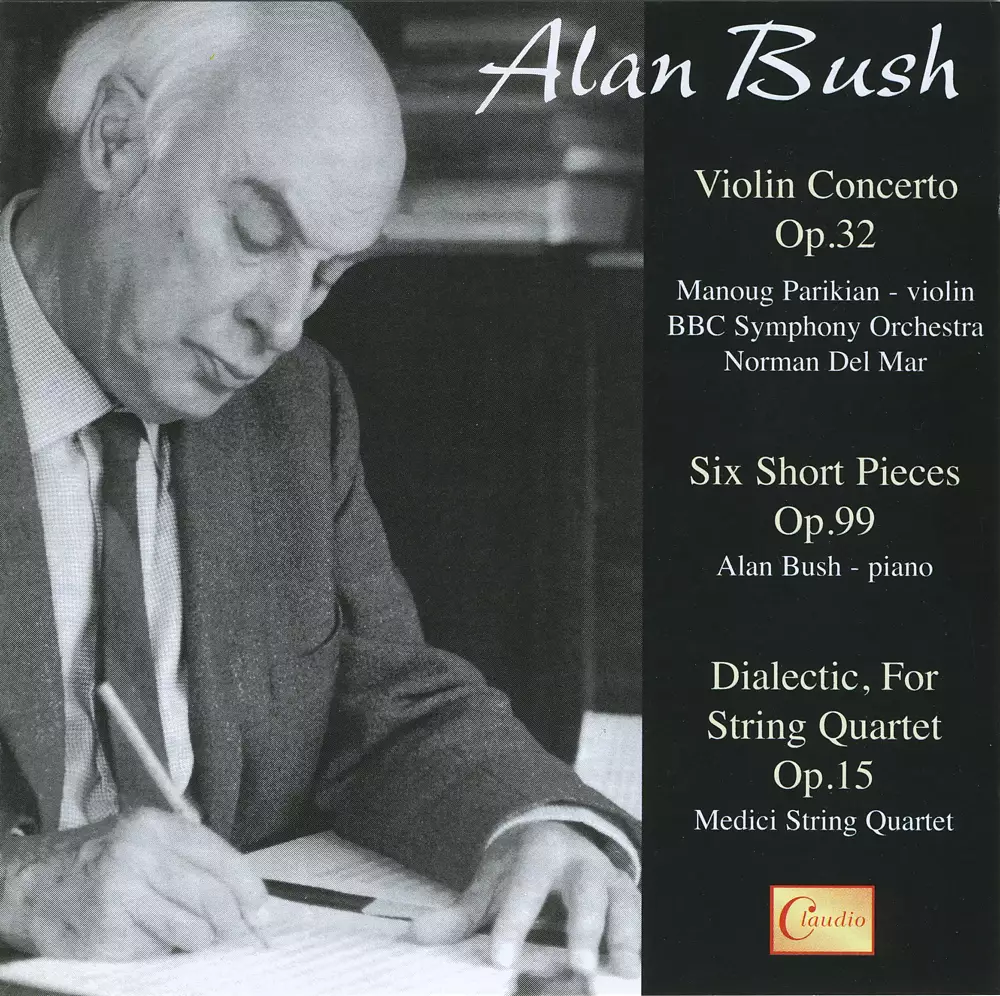
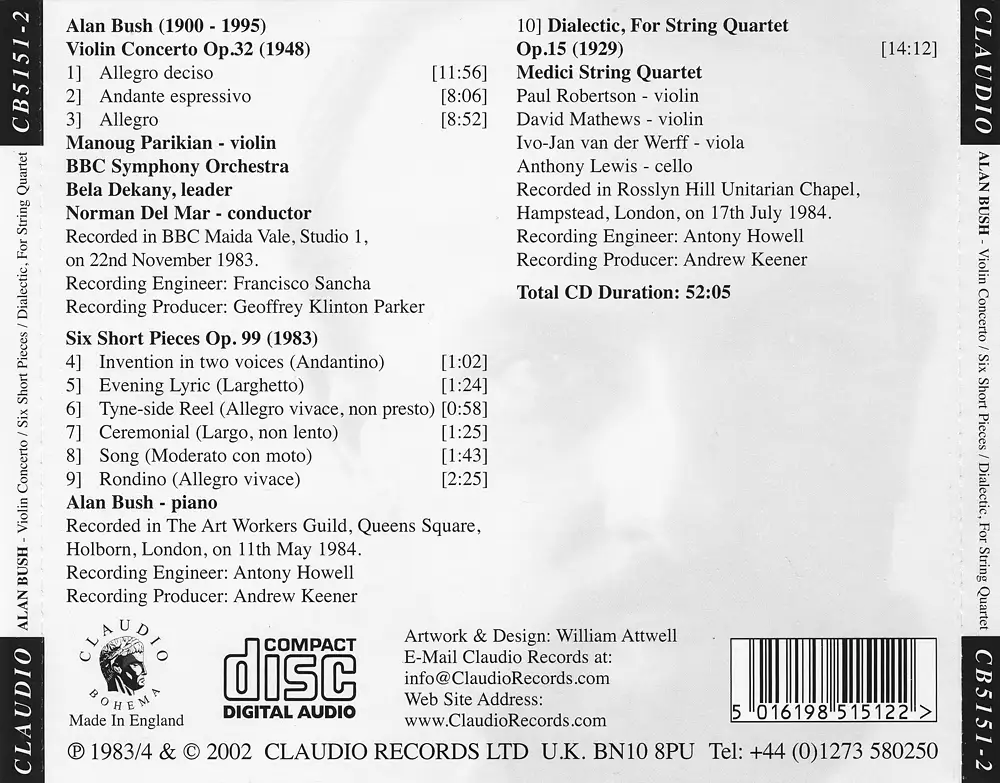


It has been the fate of a number of major composers to be largely ignored in their lifetime through reasons that have little to do with their intrinsic worth as creative artists. So it has been with Alan Bush, whose political convictions were out of step with the establishment at a time when his artistic merit would have brought him justifiable fame.
Some works proclaim the composer’s Marxist views in the choice of texts he set, and in ‘programmes’ such as that applied to the C major Symphony, which purports to represent social greed, frustration and liberation. At first, however, Bush made no attempt to adopt an ideological ‘popular’ style, but after the second world war, following internal criticism of Soviet composers, his style became more sensuous and directly harmonic. His use of mild dissonances, which to modem ears are almost consonant in effect, is both masterly and original, as is his juxtaposing of real consonances - an achievement equalled only by Benjamin Britten. It is interesting to recall that some of Britten’s works were also received with suspicion on ‘political’ grounds. It is also ironical that many Soviet composers with similar political or ideological convictions to Bush are constantly performed in the West. This view is underlined by the fact that Bush’s ‘Nottingham’ Symphony, though perhaps uneven in inspiration, is a superior composition to Shostakovich’s ‘Leningrad’ Symphony yet the former is almost unknown and the latter has been frequently performed. This sad imbalance will, it is hoped, be in some small measure redressed by the issue of this recording which includes works from Bush’s early, middle and late periods.
The Quartet in A minor, written in 1924, was the first of Bush’s compositions to meet with success, but it was another work in this medium, the ‘Dialectic’ of 1929, which established his reputation abroad following its performance at the ISCM Festival in Prague in 1935. It was recorded a few years later under the auspices of the British Arts Council and was accepted as a masterpiece.
The afore-mentioned stylistic change in Bush’s work which became apparent after the second world war is referred to in an article the composer wrote entitled ‘The Crisis of Modem Music’. This appeared in 1946 and in it Bush explained his so- called ‘thematic’ method of composition which involved the thematic significance of every note written. The common ground this shares with Schonberg’s twelve-note method hardly needs stressing. Indeed, some sort of serial melodic structure can be discerned in many of Bush’s works, for example the Violin Concerto of 1948, which employs twelve-note themes, although in a tonal context. In the slow movement of this work the order of the note series is adhered to quite strictly, but common chords are clearly implied. Thus near the beginning of the slow movement a succession of third, G minor, E major, C minor, B minor and F major appear. There are other, similar common chord forms, a variant of one of which occurs in the first movement in a fanfare-like sequence (D major, B flat minor, E minor and A flat major triads). This sequence is then extensively developed. Such writing is typical of the composer’s movement away from his earlier ‘central-European’ style.
There can be no doubt that the Violin Concerto is a major achievement in a notoriously difficult genre. Though the music is continuous, the work is cast in three sections and is quite devoid of ‘padding’ or orchestral ‘wizardry’. The solo part is indeed taxing, but the complexities arise out of the musical discourse and are not imposed on it for virtuoso effect whilst the orchestral body is used sparingly, with telling and sensitive restraint.
A short, cadenza-like introduction from the solo violin precedes an interestingly scored orchestral section of pulsating energy. The soloist joins in this exciting episode before introducing an appealing, lyrical section more serious in mood. Over sustained chords the violin soars upwards in a series of rhapsodic passages before a return is made to the pulsating rhythms of the first main section. The slow movement is remarkable for the soloist’s cadenza-like passages with orchestral interjections and accompanying figures of subtle significance. The third movement, which imaginatively emerges from the slow movement, uses material related to the first movement. The music in the finale thus provides a formally satisfying link with what has gone before, helping to create an overall design that is typical of the composer’s musical thinking.
The Six Short Pieces for piano were composed in 1983 and represent an extraordinary late- flowering of inspiration. Masterfully conceived for the keyboard the pieces are well contrasted and pay no lip-service to whims of fashion. They at once underline both the individuality of Alan Bush’s musical style and his artistic integrity.
The Dialectic is an undoubted masterpiece. Written over half a century ago it retains its powerful impact as surely today as it did at its first performance. Little wonder that the pre-war musical world accorded it the acclaim it so richly deserved. Since its inception in 1929 it has few peers in the repertoire of the string quartet. The driving intensity of its expression and its extraordinary power of communication reveal a musical intelligence of the highest order, able to sustain a musical argument of real depth in a great arch of inspired construction.
In our age of instant communications even the most bizarre are often accorded some sort of fame, however ephemeral. We need today the stability and integrity of a composer of the stature of Alan Bush. His music will stand the test of time long after many of the more exotic experiments of our tempestuous times. This is not to try to deny the right of artists to experiment (God forbid!), nor to denigrate many exciting and colourful works that have proceeded from such experiments, but neither should we under-value music which is expressed in a style that is not radical, or in a language with which we are broadly familiar.
Wisdom is wisdom whatever the tongue in which it is spoken. PETER LAMB. ©1985
**Composers Website
Alan Bush (1900-1995) A Biographical Note
Dr. Alan Bush was born in London on 22 December 1900. He was educated at Highgate School and entered the Royal Academy of Music, London, as a young student in 1918, studying piano, organ and composition under Tobias Matthay, Reginald Steggal and Frederick Corder respectively until the summer, 1922. His brilliance as a musician led to his appointment as Professor of Composition in 1925 and he remained in this position until his retirement in 1978. His compositional studies were continued with John Ireland from 1922 to 1927, in addition to piano studies with Benno Moiseiwitsch and Artur Schnabel. From 1929 to 1931, he completed his training at the University of Berlin where he studied philosophy and musicology. In 1931, he married Nancy Head, sister of the British composer and singer, Michael Head. When she died in 1991, they had been happily married for 60 years. Nancy Bush wrote the lyrics of many of Alan Bush’s songs and song-cycles, the libretti of three of his four full-length operas, and all of his three children's operas. They had three daughters (one died in a traffic accident in 1944).
Throughout his life, Alan Bush was concerned with improving the human condition. This was reflected in his compositions, which numbered more than 120 works by the time of his death in 1995. He responded deeply to world events - the First World War, in which his eldest brother Alfred was killed at 21 years of age, the Depression and mass unemployment. This led him in the 1920s to become involved in labour politics - he joined the Independent Labour Party in 1924, then the Labour Party in 1929. In 1935 he joined the Communist Party and became well-known for his Marxist views. He also became involved, along with Rutland Boughton with the London Labour Choral Union, and, in 1929, became its Musical Advisor until the organisation collapsed in 1940. In 1936 he co-founded with Will Sahnow the Workers’ Music Association and from 1941 remained its President for the rest of his life. In addition to being a distinguished composer, he was also a fine pianist, teacher and conductor.
His early works, in addition to the String Quartet in A Minor, Op.4 (1923), and Dialectic, Op. 15 (1929), included a Quartet for Piano, Violin, Viola and Cello, Op .5 (1924), and two early piano pieces, Prelude and Fugue, Op.9 (1927) and Relinquishment, Op.11 (1928). In the 1930s Alan Bush enhanced his reputation with further major compositions, notably the Concert Piece for Cello and Piano, Op.17 (1936), which was first performed by Madame Juliette Alvin (cello) and Alan Bush (piano) in November 1936 in Prague and his Piano Concerto, Op.18 (1937), first performed in a BBC Contemporary Music Concert on 4 March 1938, conducted by Sir Adrian Boult, with the composer as soloist. In the 1930s, Alan Bush’s music was well thought of in the BBC and he was given many performances. In 1938, he founded the London String Orchestra and began giving concerts largely of English music in London and elsewhere and also many broadcasts mostly on the BBC World Service. In March 1941, however, the BBC placed a ban upon his music, which continued until June 1941 with the invasion by Hitler of the Soviet Union.
His musical career was interrupted by the Second World War and he composed little. In November 1941, Alan Bush was called up into the army as a Private in the Royal Army Medical Corps and spent most of his period of service in London, where he organised an army choir and was able to continue to conduct the London String Orchestra in concerts and broadcasts. Once demobilised in December 1945, Alan Bush was able once again to pursue his career as a composer and teacher and performer, which he continued to do well into his late eighties.
Major compositions in the 1940s include his first two symphonies - Symphony No.l, Op.21 (1940), first performed in July 1942 at a Promenade Concert with Alan Bush conducting and Symphony No.2 - The Nottingham Symphony, Op.33 (1949), commissioned by the Nottingham Co-operative Society in celebration of the 500th anniversary of the founding of the city, and first performed in Nottingham in June 1949. His friendship with the well-known violinist, Max Rostal, led to several compositions for violin, notably, the Meditation on a German Song of 1848 for Solo Violin and String Orchestra, Op.22 (1941), Lyric Interlude for Violin and Piano, Op. 26 (1944) and the Violin Concerto, Op.32 (1948). All three works were given their first performances by Max Rostal, the Violin Concerto, at a Promenade Concert in London in August 1949, with the London Philharmonic Orchestra conducted by Basil Cameron. Other works included his Christmas Cantata, The Winter Journey, Op.29 (1946), two works for String Orchestra, Homage to Sterndale Bennett, Op.27 (1946) and the English Suite for String Orchestra, Op.28 (1945/1946), as well as his Three Concert Studies, Op.31 (1947), described by Anthony Payne as “a high-water mark in Bush’s mature art” (Musical Times, April 1964).
During the 1950s and 1960s, Alan Bush was largely engaged in the composition and performance of his four full-length operas. The first opera, Wat Tyler (1948-1950) received a prize in the 1951 Arts Council Opera Competition, and received many performances in East German opera houses. It had to wait until June 1974 for a professional production at the Sadler’s Wells Theatre, London. The following three operas, Men of Blackmoor (1954-1955), The Sugar Reapers (1961-1964) and Joe Hill - The Man Who Never Died (1966-1968) were all commissioned by East German opera houses and given numerous performances there, but so far, there have been no professional performances in Britain. During these same years Alan Bush composed a large number of orchestral and chamber works, choral works and works for solo song. The best known of this last group is the Voices of the Prophets, Op.41 (1953), a Cantata for Tenor and Piano, commissioned by Peter Pears in 1952, and given the first performance by Peter Pears and Noel Mewton-Wood in the Recital Room, the Royal Festival Hall in March 1953. Alan Bush’s Symphony No.3 - The Byron Symphony, Op.53 (1960) was composed in 1960.
From 1970 until 1990 Alan Bush continued to compose. Piano pieces included the Twenty-Four Preludes, Op.84 (1977) and Six Short Pieces, Op.99 (1983). Both of these works were performed first by Alan Bush himself, the Twenty-Four Preludes in a concert at the Wigmore Hall, in October 1977, and the Six Short Pieces in a BBC recording in 1984; he later recorded it on LP. His last Symphony No 4 - The Lascaux Symphony, Op.98 (1983) was inspired by a visit to the Lascaux caves in France, where he was excited by the idea that men in pre-historic times could depict their lives so vividly on the walls of their cave dwellings. In 1968, he became a Doctor of Music of London University, and in 1970, an honorary Doctorate of Music was conferred upon him by Durham University. He made many appearances as composer, conductor, pianist and lecturer in Britain, Europe and the USA. His works have been performed in nearly every European country, as well as in Canada, the USA, South Africa and Australia. He continued to live in his house in Radlett until his 94th year. He died in Watford General Hospital after a short illness on 31 October 1995. Rachel O'Higgins. (March 2002)
Published date
2025-10-24
Number of discs
1
Channels
stereo:16:2.0
Made in Sweden since 1999. In collaboration with Textalk.
Cart
| Artikel | Antal | Beskrivning | a pris | Totalt |
Env.session:
NULL


Env.order NULL


string(2) "en"


collector.CheckoutUrl


collector.OrderItemCount
0

collector.CartUrl
NULL


collector.Order
NULL