
Flute Music of France
Catalog Number: CR3808
Since the clavecinistes, French music has prized refined sensibility, inspiring a rich flute tradition. This programme spans Fauré, Aubert, Roussel, Kœchlin, Damase, Saint-Saëns and Poulenc, whose contrasting pieces reveal lyricism, color and wit.
Flute Music of France
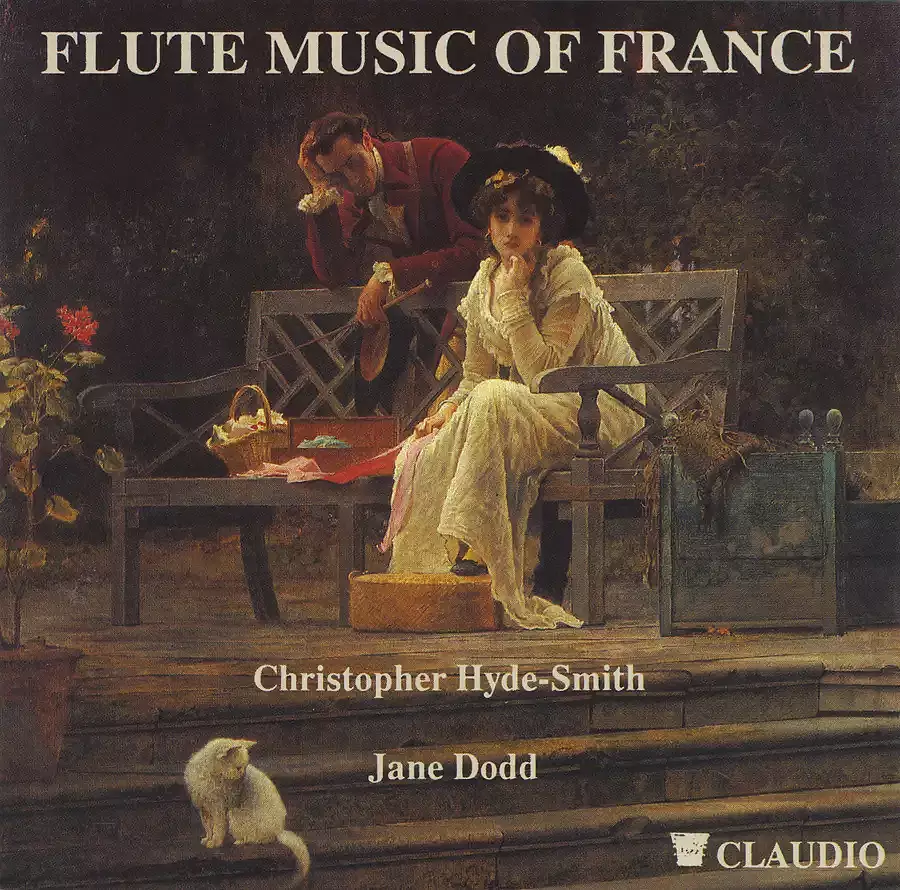


Since the clavecinistes of the 17th century French music has excelled in sensibility, where style, delicacy and refinements take priority over passion. The existence therefore of a strong and abiding tradition of French music for that most delicate of wind instruments, the flute, is no surprise.
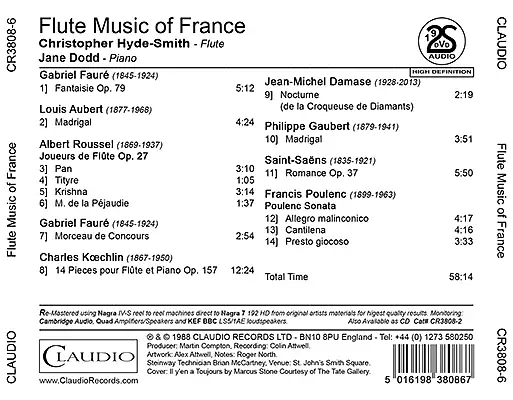
Treatises on Gabriel Fauré (1845-1924) speak of his reticent, restrained and subtle art. His gift was for beautiful melody supported by an occasionally unorthodox, telling harmony, as exhibited in both of his pieces recorded here. In the Fantaisie (1898) a haunting, melancholy E minor andantino is followed by a bright C major allegro with skittish first subject and cantabile second. A suitably burnished version of the andantino melody separates them, but is not recapitulated.
The existence of Morceau de Concours was unknown until rediscovered by an American musicologist in the 1970's. It was found amongst papers which contained treasures by other composers that the Paris Conservatoire had intended for the pulp mills. It is thought to have been written as a sight reading test but is of extraordinary beauty.
The "Madrigal" of Louis Aubert (1877-1968) probably composed in the 1890's is dedicated to the flautist and fellow composer, Philippe Gaubert (1879-1941) who later wrote a "Madrigal" of his own. The title of these two romantic melodies becomes less strange if we know that the madrigal can be traced back to Troubadour songs of a knight's love for a shepherdess.
Visits to the East both as a youth in the navy and later (1909) as an established composer brought Albert Roussel (1869-1937) into contact with Indian Music, widening his melodic and rhythmic scope. His use of non-European scales is relevant here. The god Pan is the first of his Joueurs de Flûte, (1924), each piece dedicated to a different contemporary exponent of the instrument. Several modes are employed, while the underlying two or three tonalities are coloured by others giving the music by turns amorous, sultry, mischievous and frightening (panic) character. The featherweight dancing melody of Joueur number two, the legendary shepherd Tityrus is delicacy indeed, its jollity utterly
Charles Kœchlin (1867-1950) most of whose large output in all forms and many styles has been neglected, believed firmly in the importance of a self-supporting melodic line. This permits the free and greatly varied accompaniments, contrapuntal and chordal, that he supplies to his 14 piéces, only three of which are more than a minute long. The delightfully fresh melodies are deceptively innocent, taking some surprise turns which are however never perverse. A few have titles; No.1 "Old Song" has a modal melody, that of No.7 "Fine Evening" arches broadly across the sky to immensely spacious open 5th-dominated chords, No.9 (untitled) has a vaguely Scots flavour, No.12 is "Spring Dance" and No.13 "Funeral March" with a sombre, dactylar melody. The last piece is almost Handelian, using the flute in a fanfare-like way.
Kœchlin might not have approved of Jean-Michel Damase's sleepy Nocturne, whose drooping eyelid melody of two alternating notes necessarily depends upon its viscous harmony, but so does Chopin's E minor prelude.
Camille Saint-Saëns (1835-1921) whose precocious and prodigious talents as composer, pianist and organist were matched by his industry (13 operas, 10 concertos, extensive tours etc.) is the earliest of the composers represented here. Between the two of-the-period melodies of his Romance (1874) things become unexpectedly not a little agitated, as has been known to happen in romances, e.g. that of Mozart's D minor concerto.
By the 1950's there was little left of the anti-romantic, anti-impressionist obtuseness, which characterised the music of Francis Poulenc (1899-1963) as a member of the "Les Six" group of composers in the 20's. The initial and main theme of the opening allegro malinconico of his Sonata for flute and piano (1957) is set in motion, pervaded and concluded by two versions of an engaging arpeggio 'diddle-diddle-dum', whose major-minor harmony at the end of the movement neatly sums up the strange, conflicting fast and melancholy mood. A sliding figure similarly characterises the middle theme of the movement's simple ABA form.
The central movement, entitled Cantilena consists mostly of an intensely beautiful, wide-ranging melody, at times almost Bach- like, at others essentially French. A Germanic element - perhaps Haydn via Offenbach, or is it the British Grenadiers or even Handel's Halleluja, possibly all three? - also steals into the final Presto giocoso, which lives up to its title. The first movement's 'diddle-diddle-dum' fits in happily, but the melancholy of its more dignified, sliding theme momentarily interrupts this headlong gallop.
© 1989 Roger North.
Published date
2025-11-14
Number of discs
1
Channels
stereo:24:2.0
Made in Sweden since 1999. In collaboration with Textalk.
Cart
| Artikel | Antal | Beskrivning | a pris | Totalt |
Env.session:
NULL


Env.order NULL


string(2) "en"


collector.CheckoutUrl


collector.OrderItemCount
0

collector.CartUrl
NULL


collector.Order
NULL