
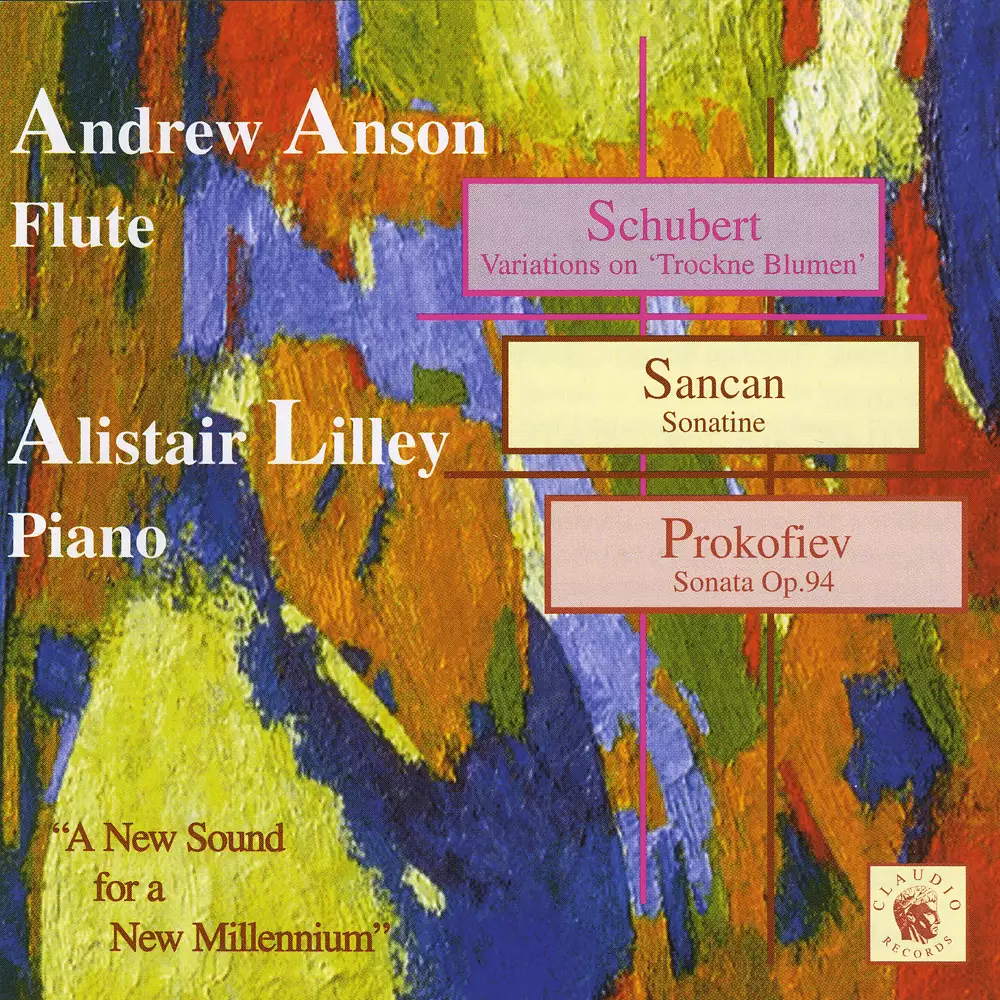
Schubert, Sancan & Prokofiev: Works for Flute & Piano
Catalog Number: CR4942
Schubert, Sancan & Prokofiev: Works for Flute & Piano
Schubert’s miraculous song-cycle Die schöne Müllerin, to words by Wilhelm Müller (no relation), dates from the end of 1823. It was quickly issued by Schubert’s publishers, Sauer & Leidesdorf, early in 1824, and was followed almost immediately by the Introduction and Variations for Piano and Flute (in which order Schubert styled it). He took as his theme one of the most haunting songs of the cycle, No.18 of the twenty, Trockne Blumen- “Withered Flowers”- a poem addressed to a little bunch of dried-out and dead flowers, a present from the poet’s lost love, which he wishes to have placed in his grave. Knowing of Schubert’s impending fate one finds it difficult not to imagine personal forebodings in it.
The publisher, with Sauer, of Die schöne Müllerin, Maximilian Leidesdorf, was himself a composer, like Schubert a pupil of Salieri, and who also wrote flute music; but, although he published the song-cycle, the Introduction and Variations had to wait for nearly thirty years before Anton Diabelli (also a composer, instigator of Beethoven’s variations that bear his name) brought out an edition. Unfortunately, like so much 19th-century music printing, it had many textual errors. Andrew Anson and Alistair Lilley therefore use the more recently published authentic text based on Schubert’s own autograph.
The flautist for whom Schubert is thought to have written the Introduction and Variations was Ferdinand Bogner, Professor of Flute at the Vienna Conservatoire, a family friend of Schubert’s and a virtuoso with a brilliant technique - evidenced by the seven increasingly florid variations that follow the Theme, which is a simple statement of the song. Bogner may well have commissioned the work for his advanced students at the Conservatoire. In spite of its sustained E-minor pathos (with characteristically Schubertian changes to the major) the piece ends on an almost optimistic note, in keeping with the words of the song, “Spring is coming, and flowers will bloom again’’- an optimistic thought Schubert amplifies by making the final variation into a somewhat parodie, almost rum- ti-tum, March. And incidentally, the work that immediately followed the Variations was the sunny and universally beloved Schubert Octet.
In spite of the immense popularity of the flute from the 17th century onwards there has always been a dire shortage of good music for the instrument, especially by post-baroque composers, from Beethoven to the Romantics; it leaves Schubert’s Introduction and Variations as one of the outstanding works in the repertoire.
It need not have been so, at any rate from the later years of the 19th century onwards, had other teaching institutions in Europe taken their cue from the enlightened policy of the Paris Conservatoire. There it has been a long- established practice to commission teaching- and examination-pieces from the best composers of the day. They were written for all instruments, not just flute - and had to conform to a certain length, with often prescribed degrees of difficulty. As a result, French instrumental wind music (as well as wind technique) became pre-eminent-a model to the rest of the world, as nearly all French or French-resident composers of note, from Fauré to Enesco and Ibert, entered the instrumental concours catalogues.
This is where other countries, England especially, missed out. Imagine if the Associated Board of the Royal Colleges of Music had followed the same forward-looking policy as the French: we should now have a wealth of commissioned instrumental music by Elgar, Holst, Stanford, Vaughan Williams, Britten and the rest.
One of the pieces that emanated from the Paris Conservatoire concours commissions was the Sonatine by Pierre Sanean, which he provided for the 1946 Flute Course in response to an invitation by Gaston Crunelle, Professor of Flute, to whom it was duly dedicated, as was customary. Sanean, bom on 24 October 1910 in Mazamet, was himself a Professor at the Conservatoire, where as a student in 1943 he had won the Prix de Rome, tracing the footsteps of Berlioz and others, with his lyric scene Icare. At the Conservatoire Sanean held classes in piano, accompanying, harmony, composition and conducting.
Although falling nominally into three distinct movements the Sonatine is played continuously. It follows in the sparkling tradition of Jaques Ibert, with something of the Gallic lightness of touch of Nadia Boulanger, though in fact Sanean studied with Jean Gallon (one fellow-pupil being Paul Tortelier) and also with the prolific pedagogue Henri Busser, of whose numerous pupils no fewer than 24 also won the Prix de Rome.
In the summer of 1943, the same year as Sanean carried off his Rome Prize under German occupation, Serge Prokofiev was exiled by the Soviets to Kazakhstan - benevolently and for his own good, so as to put Russia’s most cherished composer out of immediate reach of the invading German army. As a national treasure he was pampered in safety, while further West his compatriots starved; but it enabled him to compose music in relative comfort. It was in Alma-Ata, in the Kazakhstan region, that Prokofiev wrote his Sonata for Flute and Piano, op.94, having recently completed the music for Eisenstein’s film Ivan the Terrible. His immediate inspiration was another famous product of the Paris Conservatoire, the flautist Georges Barrère, whom Prokofiev had met while a longtime resident in Paris, but Barrère was now on the other side of the world, long-established in the Principal Flute position of the New York Philharmonic.
It being wartime, the first performance of Prokofiev’s Flute Sonata was given in Moscow, by a Russian flautist named Charkovsky, with Sviatoslav Richter at the piano. There the piece came to the notice of the violinist David Oistrakh who took a fancy to it and - not to put too fine a point on it - implied that it was wasted on mere flautists. He therefore asked Prokofiev to turn it into a Violin Sonata. This the composer did, by making changes small enough to retain the work’s identity (leaving the piano part unchanged) but adding idiomatic violin effects like doublestoppings and pizzicati. In this form the Sonata at any rate gained a wider audience than it would have done as a flute piece, but flautists the world over soon reclaimed it as rightfully theirs: it is now one of the most notable works in their repertoire.
The Sonata is in Prokofiev’s lighter vein, like the Classical Symphony and the ballet Cinderella, with all his characteristic slips into unrelated keys and back again, playing a kind of harmonic hide-and-seek with listeners’ ears.
©Notes By Fritz Spiegl
Published date
2025-10-10
Number of discs
1
Channels
stereo:16:2.0
Made in Sweden since 1999. In collaboration with Textalk.
Cart
| Artikel | Antal | Beskrivning | a pris | Totalt |
Env.session:
NULL


Env.order NULL


string(2) "en"


collector.CheckoutUrl


collector.OrderItemCount
0

collector.CartUrl
NULL


collector.Order
NULL