
8 Canary Composers
Catalog Number: IBS132025
8 Canary Composers
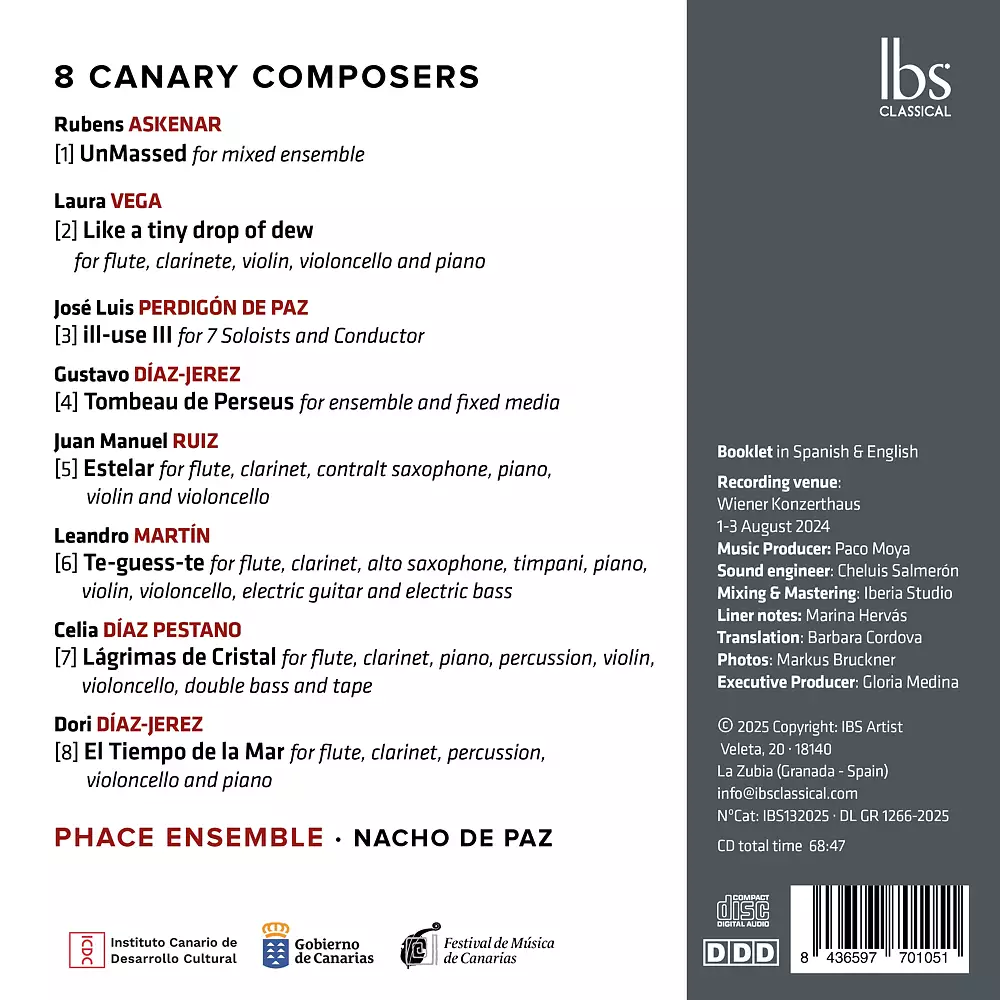
8 CANARY COMPOSERS
A persistent issue in contemporary compositional discourse concerns the extent to which musical writing can be geographically situated. While in earlier historical periods, national or regional styles—such as French Baroque or Viennese Classicism—were characterised by distinctive procedures, practices, and aesthetic preferences, since the late twentieth century, and particularly with the emergence of post-avant-garde movements, such geographic specificity has become increasingly tenuous. Contemporary composers are more readily aligned with particular schools, methodological frameworks, or aesthetic orientations than with any singular locale. At the same time, however, composition remains fundamentally situated. One cannot disregard the circumstances of a composer’s birth and formative training, nor periods of residence abroad—whether voluntary or compelled, as exemplified by Roberto Gerhard—nor the influential centres of artistic magnetism, such as Darmstadt from 1946 onward or IRCAM in Paris from 1970. In discussing contemporary composers from the Canary Islands, one must, on the one hand, examine the networks, institutions, and alliances that the archipelago cultivates “inwardly” to support musical activity, and, on the other, consider how the Canary Islands engage with broader cultural spheres. Likewise, it is pertinent to ask whether any distinctly “Canarian” trace persists—a residue, a mark—within compositional practices, a question that remains open and provocative. All of these factors, more or less explicitly, shape the trajectories of creative activity, which is never neutral nor detached from its context of emergence. Accordingly, these recording functions both as a kaleidoscopic survey of contemporary musical production in and from the Canary Islands, and as a renewed interrogation of the gravitational pull exerted by cultural and geographic spaces—those which, in one way or another, composers are continually negotiating and seeking to inhabit.
Cecilia Díaz Pestano (Tenerife, 1982) studied at the Higher Conservatory of Music of the Canary Islands with Rafael Estévez, Miguel Ángel Linares, and another key figure featured in this compilation, Leandro Ariel Martín. She has also trained with major voices in contemporary composition, such as José María Sánchez Verdú and Cristóbal Halffter. Her work has been heard in Berlin and Sweden, in addition to numerous projects in Spain. A significant portion of her output draws on poets, many of them Canarian, such as Pedro García Cabrera, or with Canarian roots, like Pino Betancor (whose father was Canarian and who spent the final stage of her life in Las Palmas de Gran Canaria). Lágrimas de cristal (Tears of Crystal) seeks to bring the “wild experience” of motherhood, in the composer’s own terms, into music. Although it is not divided into movements, the piece is structured in distinct sections based on expressive elements. It opens with an instruction reading “Abre los ojos” (Open your eyes), which gradually also “opens” the ensemble. Repetitive figures pass from one instrument to another, unfolding colour. Without pause, the next section, “Cuando llega la oscuridad” (When Darkness Falls), features tenuto passages in the winds, supported by the bass drum and contrasted with the string figurations. Díaz Pestano works with a contrasting interplay of dynamics, generating tension throughout. This is followed by “Lágrimas de cristal”, where the titular tears are represented by a delicate vibraphone figuration answered by piano and flute. From extreme fragility emerges “El mundo a través de ti” (The World Through You), which revisits materials from the opening. This circular structure allows us to consider to whom this call to “open the eyes” is addressed: while initially it seems a gesture representing the beginning of life, the return to the initial materials—which are perceived differently after the intervening music—suggests that it is the mother, the one transformed by new life, who ultimately sees with renewed eyes.
Dori Díaz Jerez (Tenerife, 1971) trained in piano and composition at the Higher Conservatory of Music of the Canary Islands and at the Manhattan School of Music in New York, studying with Solomon Mikowsky on one hand, and Giampaolo Bracali and Rocker Cuckson on the other. Her works have been performed in countries such as Japan, Germany, Italy, Austria, and Hungary, as well as in Spain. Part of her work seeks to assert Canarian composition, notably through her leadership of COSIMTE, and to rethink the culture of the islands through music, as is evident in Hyadae (2010) for silbo gomero (a unique whistled language from the island of La Gomera) and string orchestra, Límites (Limits) (2006) for soprano and piano on texts by Cecilia Domínguez, and Naufragio (2006) and El testamento (The Will) (2008–2010), with text by Elsa López. El tiempo de la mar (The time of the sea) is another example of this approach, taking its title and point of departure from the poem of the same name by Pedro García Cabrera, which begins: “The time of the sea / is another time: neither river nor steed”. In García Cabrera, the sea is not taken literally but as a symbolic device: a source of doubt and a horizon of possibility. The composition does not attempt to translate the poem into music, but rather to capture its plastic, suspended time— “that does not pass,” “that does not happen”—which, paraphrasing the poet, is indifferent to the measures of tides and distances, transforming the ensemble into a corner of the sea. The piece begins from extreme fragility—the performance indication is “like the wind”—and gradually gains body. Like the sea, the music stretches and awakens. In the percussion, particularly the tombak, we encounter a kind of pulse that is then negated by the other instruments, whose melodic lines are sketched as if allowed to drift. The piano, almost bare in the middle section, is sustained by subtle interventions from the percussion and occasional clarinet. Its serenity gradually darkens, and brief figures appear—reminiscent of the opening, such as the transformed tombak pulse. These references to the beginning offer a way to understand the poem’s conclusion, which states that the time of the sea is “time of creation, without before or after.” The piece gradually closes, as if immersing us in its vast, ineffable sound, becoming a breath. Díaz Jerez’s work thus becomes an instant of a deep sea, “where there are no ruins,” where “the foam does not age.” This time, which passes and yet does not, is captured in this miniature, which seeks to reflect the contradiction between our linear, ever-forward time and the time of the sea, which remains while endlessly changing.
Gustavo Díaz Jerez (Tenerife, 1970) has for years been working at the intersection of composition, exact sciences, and technology. Trained at the Higher Conservatory of Music of the Canary Islands and the Manhattan School of Music in New York with Solomon Mikowsky, Giampaolo Bracali, and Ludmila Ulhela, Díaz-Jerez works with techniques inherited from spectralism—a compositional movement that emerged in France in the 1960s, grounded in the analysis of the sound spectrum (hence its name), made possible through the physical representation of sound. This is complemented by resources from various scientific disciplines, such as mathematics and computing—especially algorithmic thinking. Tombeau de Perseus is a clear example of this approach. It draws on materials from a sonification, carried out by NASA, of the pressure waves emitted by the supermassive black hole at the centre of the Perseus galaxy cluster. Sonification is a technique that makes phenomena—here, astrophysical ones—audible by “translating” them into sound parameters adjusted to the human audible spectrum. The source material for this piece is brief, barely thirty seconds long, and the work consists precisely in elaborating and unravelling it, a kind of “sound microscopy,” as the composer describes, creating a dialogue between the sonification recording and the compositional process. The piece begins with a combination of tenuto sounds— “deep and immutable,” as indicated in the score—and small oscillations that unfold across the instruments. These oscillations are sometimes rapid, at other times expanding into tiny melodic fragments, as in the dialogue between flute, bass clarinet, and baritone saxophone. Working with contrasting registers, such as the high ranges of flute and violin, opens, so to speak, the timbral dimensions of the original material. This is a meditative, slow-moving work, reflecting the character of the tombeau referenced in its title. This genre, originating in the Baroque, was traditionally used to honour a significant figure in a solemn manner, often represented with a pedal note to evoke gravity (which in this piece corresponds to the enveloping tenuto). Here, there is no individual being commemorated; instead, the focus is on the challenges the universe continues to pose—a continuous inquiry into the limits and aspirations of our knowledge.
José Luis Perdigón de Paz (La Palma, 1990) studied at the Higher Conservatory of Music of the Canary Islands and at the Universität der Künste in Berlin, where he trained in violin and composition with professors Mathias Hinke, Manolis Vlitakis, and Elena Mendoza, among others. He has been awarded the XIX Joan Guinjoan International Prize for Young Composers and has composed on commission for Ensemble Ascolta, Vertixe Sonora, and Valencia Orchestra. He is a founding member of the Berlin-based Kollektiv Unruhe. ill-use III, commissioned by the International Music Festival of the Canary Islands and premiered in 2023 by the ensemble PHACE, continues the work of ill-use (2021), ill-use I and II (2020), premiered respectively by Trio Abstrakt and the Schallfeld Ensemble, all within the framework of impuls (Graz).
The indication “to and fro” marks the tempo at the beginning of ill-use III. This is a nod to the homonymous piece by Rebecca Saunders, which begins with Beckett’s quote: “from one side to the other in the shadow, from the inner shadow to the outer.” In Perdigón’s work, it establishes from the outset a to-and-fro motion, a kind of—also shadowy—breathing, barely audible in the flute. The repeated appearance of this initial motif, interspersed with silences, generates a fragile division of the piece’s time, which seems ready to collapse at any moment. The silences function more as brief suspensions of sound, breaths merely awaiting negation. At the same time, and more broadly, the repetitions that traverse the work lie at the core of its driving idea: abuse, cruel treatment, which, in a context such as slavery, implies, as the composer himself notes, “repetitive, abusive, and mundane tasks.” The piece also seeks to expand the notion of abuse to include the lurking presence of dark ideas or “mental ghosts.” This is why we hear how this sort of breathing is intermittently assaulted by the ensemble, and how small fragments—some obsessive in character, like the rhythm of the ganzá or egg shaker—appear and reappear; their changing context gives them new meaning each time. The work becomes oppressive at times, playing with the distortion of whistles, such as Aztec death or hunting whistles, whose altered sounds imitate voices, cries, or growls. The ending, where the breathing motif is taken up by crotales played with a bow, presents itself as a collapse, a gaze into the abyss, leaving us uncertain whether it returns our gaze.
Laura Vega (Las Palmas de Gran Canaria, 1978) studied piano, oboe, and composition at the Higher Conservatory of Music of the Canary Islands with professors Daniel Roca and Xavier Zoghbi. She has also studied with José Luis de Delás and José María Sánchez Verdú. Since 2016, she holds a doctorate from the University of La Laguna. She is currently a professor at the Higher Conservatory of Music of the Canary Islands and, since 2011, a Full Academic of the Royal Canarian Academy of Fine Arts. The title of the work like a tiny drop of Drew refers to section 32, the last one, of the Diamond Sutra, the oldest printed book known—dating back to 868—and a cornerstone of Buddhist wisdom. The title of the text alludes to the diamond as “a blade”, like a lightning bolt, capable of cutting through all kinds of illusions. The text seeks to provoke reflection on our preconceived notions and to cultivate detachment from fixed beliefs. In section 32, much of the text’s proposal is condensed:
“Like a tiny drop of dew, / or a bubble floating in a stream; / like the flash of lightning in a summer cloud, / or a flickering lamp, an illusion, a ghost, or a dream. / Thus, we should see conditioned existence.” The opposition of energies and the fleeting quality suggested by these lines define the overall character of the work, which is built in continuous sections. Specifically, the tiny drop of dew acts as a catalyst: it is represented in the piano’s initial motif—answered by the clarinet—which opens the work and frames the delicate melodic unfolding of the ensemble in the first part. In the next section, the flute takes the lead, answered by the clarinet and supported by the strings. The piano provides a constant breath until the drop motif returns, leading to a third section where arabesque-like figures gain prominence. The fourth section is meditative and tender, offering a moment of respite before the next, which takes on a more playful, dance-like character. Here, the piano occasionally evokes a music box, a sound reinforced by pizzicato strings. The cello gathers this energy, while the rest of the ensemble provides echo, before the strings and piano re-engage in a dialogue that prepares the work’s conclusion. Unlike the previous sections, the ending adopts a strikingly rhythmic character, leading to the disintegration of sound in an instant—just like a drop falling.
Juan Manuel Ruiz (Las Palmas de Gran Canaria, 1968) is a guitarist and composer, trained at the Royal Conservatory of Music under Juan José Falcón Sanabria, Valentín Ruiz, and Agustín González Acilu, as well as in courses with Leo Brouwer, Salvatore Sciarrino, and Brian Ferneyhough, among others. His works have been performed in numerous festivals across Germany, Austria, the United Kingdom, and Italy, in addition to Spain, by leading orchestras and ensembles. He also works as a music critic for RITMO magazine. Since 2011, he has been a corresponding resident academic at the Royal Canarian Academy of Fine Arts of Saint Michael the Archangel.
Estelar was composed on commission for the 5th edition of the 2023 Concert of Award-Winning Students of the Master’s Degree in Musical Composition with New Technologies at UNIR, of which Ruiz was a mentor. In this sense, the work acts as a kind of witness passed from one generation to the next, as it is dedicated to the memory of journalist, composer, and music critic Guillermo García Alcalde, whom Ruiz regards as a mentor for having supported his career from the very beginning. The piece begins with a dense, general tenuto, into which an ostinato emerges in flute, clarinet, and piano. This opposition of forces—where melodic materials struggle to emerge from the sonic mass—shapes the work. Several materials reappear throughout, such as the short, incisive staccato motif, the fragile frullato melody, and the sixteenth-eighth note structure (anticipating the sound of the whistle), primarily in flute and clarinet. Towards the end, these elements occur in faster succession, forming a kind of stretta. General silences function as tense breaths, reinforcing the expressive component, as they mark the gesture of “propagating, stabilising, or contracting” the sonic energy, according to Ruiz, who seeks to construct an allegory of a fleeting journey through space and time. The work culminates in the brilliant sound of the note G, sustained as a piano pedal. Its significance remains hidden, though one can interpret it in relation to the sun and the stars evoked by the title, as well as to the core of the homage, since G, in Anglo-Saxon musical nomenclature, corresponds to Guillermo.
Leandro Martín (La Plata, 1974) holds degrees in Harmony, Counterpoint, Musical Form, and Composition from the National University of La Plata. He has studied with teachers such as Mariano Etkin, Coriún Aharonián, and Ramón Pelinski. He has taught at the Higher Conservatory of Music of the Canary Islands and currently works as a professor at the La Laguna University. Much of Martín’s work, both compositional and research-based, involves blurring the boundaries between so-called academic music and popular music, as well as offering a critical perspective on cultural Eurocentrism. An example of this is his doctoral research analysing the relationship between tango and contemporary music, as well as the work under discussion here.
The title Te-guess-te refers to the town of Tegueste in Tenerife, where the Spanish-Argentine composer resides, as the work seeks to reimagine the everyday sound environment. This local reference is further reinforced by a citation included in the score from the parish priest of Tegueste at the beginning of the 19th century, the priest and academic of the Royal Canarian Academy of Fine Arts Antonio Pereira-Pacheco y Ruiz, who wrote about the town: “echo of melodious nightingales, /body of distinguished players, /honour of my happy homeland.” The work does not attempt to translate this text into sound; rather, it takes it as a gesture of naming and inhabiting one’s own context through artistic means. Te-guess-te is conceived through the “disfiguration” of the open-string notes (especially D and A) of the timple, the most representative instrument of Canarian folklore. This disfiguration—achieved through retuning instruments or altering pitch (for example, via glissandi)—aims to create a sense of estrangement from temperaments assumed as “normal,” or rather normative, which belong to a rather modern convention that has displaced other historically fruitful possibilities for composition. The sonic foundation based on the timple also challenges expectations associated with instruments linked to particular repertoires. For instance, listeners may hear the piano transformed into a sort of baglama, a plucked string instrument from Turkish traditional music. Te-guess-te thus seeks to reveal both the weight and fragility of the boundaries imposed on the arts, while showing that none of these boundaries are neutral with respect to creative processes.
Rubens Askenar (Tenerife, 1982) studied at the Higher Conservatory of Music of the Canary Islands, the Santa Cecilia Conservatory in Rome, the Aragon Higher Conservatory of Music, and the Royal Academy of Music, where he completed his master’s and doctoral degrees with top marks and where he currently serves as a professor. He has composed commissioned works for the MATA Festival (New York), Sampler Sèries (Barcelona), Huddersfield (United Kingdom), and reMusic (Russia), and has been awarded, among others, the Priaulx Ranier Composition Prize, Alan Bush Composition Prize, Howard Hartog Scholarship, Mosco Carner Award, and the G V Turner-Cooke Composition Award.
UnMassed presents the attempt, as the title suggests, to “de-massify” the ensemble—that is, to seek compositional unity through voices functioning as a collection of soloists. It is amplification and mixing that balance the volumes, thus creating a mass without mass.
The work begins with the gong (representing the sound-mass) very prominently, answered as a resonance by the bass clarinet (the indication is “Desolato. Liberamente, come senza gravità”, meaning Desolate. Drifting freely, as though unbound by gravity). Gradually, hyper-precise, highly material gestures appear, distributed across the ensemble’s instruments, creating ephemeral relationships among them. The expansive opening contrasts with the ending, marked by the gradual development of an insistent rhythm, which in some way represents the definitive fragmentation of that initial sound-mass.
Askenar’s work is consistently a meticulous investigation into the expansion of the sonic and gestural possibilities of instruments. He invites a defamiliarised listening to some of them, such as the extension of the piano’s range using the flexatone, the blending of the marimba with a small mouth siren, or the integration of a PVC hose among the bass clarinet’s resources. That hose, a corrugated tube, or a CD are everyday objects that show how sound exploration does not necessarily depend on the sophistication of materials. Musical instruments are desacralized, becoming objects that dialogue with others that have lost or transformed their original function.
The search within the material itself thus presents a challenge for the performers. Some of his works—UnMassed being a significant example—require the musicians to unlearn and relearn what has been assumed as canonical in performance practice.
About the performers
The PHACE ensemble originated in 1991 as ensemble_online, founded by Simeon Pironkoff, and changed its name in 2010. Its focus on contemporary music encompasses both instrumental repertoire and stage, performative, and/or multimedia projects, always delivering excellent and rigorous results. PHACE has premiered over 200 works and has performed at the most important festivals and venues worldwide, such as the Donaueschinger Musiktage, Untraschall in Berlin, the Barbican in London, Klangspuren Schwaz, and the Avignon Festival, among many others. They have also participated in the programming of Ensems, Mixtur, CentroCentro, and the Canary Islands International Music Festival, and since 2021, they have been a resident ensemble with their own cycle at the Wiener Konzerthaus. Their recordings are included in the catalogs of major labels such as NEOS and KAIROS.
On this occasion, the ensemble is conducted by Nacho de Paz (Oviedo, 1974), who has been associated with PHACE for many years and is one of the indispensable conductors in the contemporary music scene, both in Spain and internationally, due to his impeccable work. Trained with Arturo Tamayo and Pierre Boulez, his dedication to contemporary music has led him to lead ensembles such as Ensemble Intercontemporain, Klangforum Wien, Ensemble Recherche, Ensemble Modern, and Ensemble MusikFabrik, among others, and to premiere several hundred works worldwide.
As a composer, his works have been awarded the Joan Guinjoan (2002), Luigi Russolo (2003), SGAE Electroacoustic (2004), and SGAE-CullerArts (2021) prizes. He is a faculty member at the Aragon Higher Conservatory of Music and has been a guest professor at institutions including Musikene, the ESMUC, the Universität für Musik und darstellende Kunst Wien, and Universität Salzburg.
Marina Hervás Muñoz
Published date
2025-10-24
Number of discs
1
Channels
stereo:24:2.0
Made in Sweden since 1999. In collaboration with Textalk.
Cart
| Artikel | Antal | Beskrivning | a pris | Totalt |
Env.session:
NULL


Env.order NULL


string(2) "en"


collector.CheckoutUrl


collector.OrderItemCount
0

collector.CartUrl
NULL


collector.Order
NULL