
Aeternum: Spanish Contemporary Piano Trios
Catalog Number: IBS222025
Aeternum: Spanish Contemporary Piano Trios
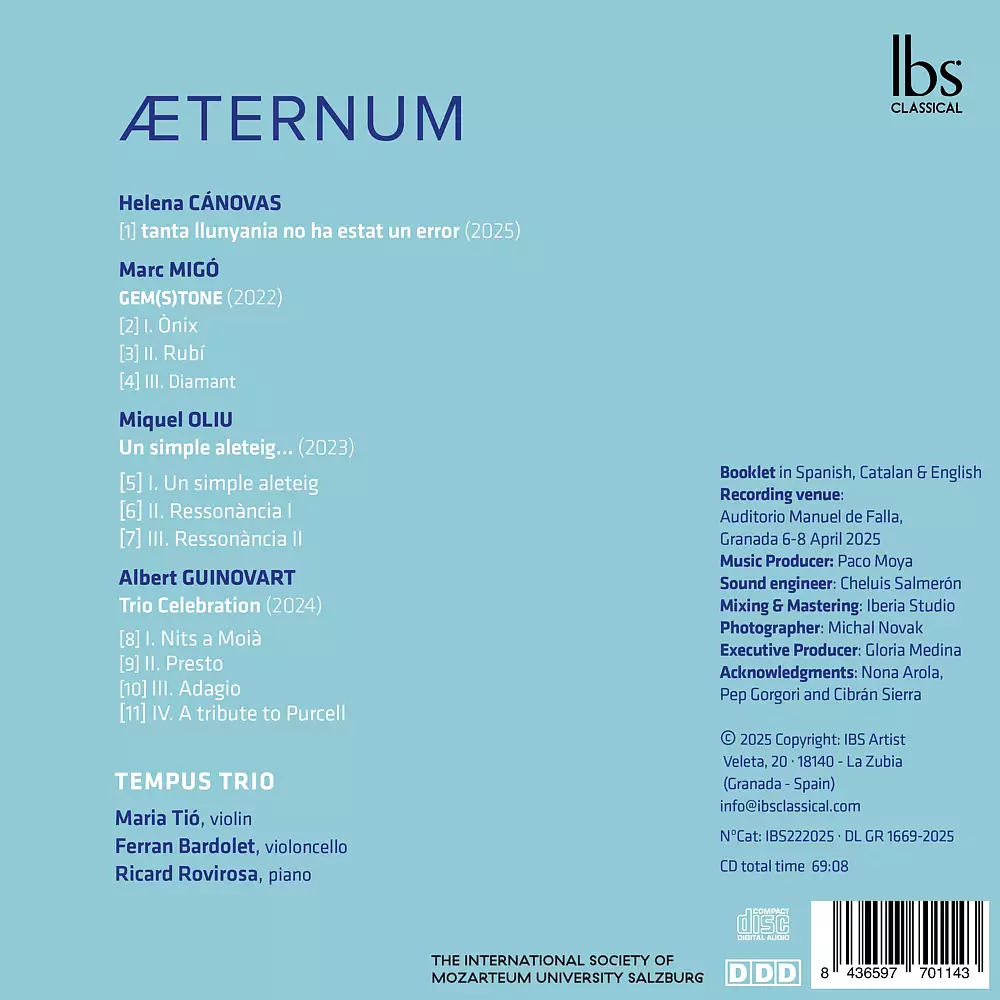


ÆTERNUM — Tempus Trio**
With Æternum, the Tempus Trio presents a debut recording that firmly positions the ensemble within the most compelling landscape of contemporary chamber music in Spain. The album brings together four works written expressly for the trio by Helena Cánovas, Marc Migó, Miquel Oliu, and Albert Guinovart—composers whose contrasting aesthetic languages form a representative panorama of current creation.
The conceptual backbone of the project—music’s relationship with time—is not treated as a mere unifying idea, but as a structural and poetic principle that permeates the entire album. The notion of an “eternal” moment arising from the ephemeral act of performance, suggested in the title Æternum, becomes a multidimensional exploration: fragmented time, expanded time, suspended time. The programme thus forms a dialogue between introspection, symbolism, and post-romantic narrative.
The Repertoire: Four Perspectives on Musical Time
Helena Cánovas — tanta llunyania no ha estat un error (2025)
Cánovas’s work unfolds as a single movement built from sharply differentiated fragments, each functioning as a self-contained state. Its poetics of waiting and distance materialise in winter-like sonorities, reduced harmonic vocabulary, and sudden shifts in texture. The piece rejects linear narrative in favour of discontinuous temporality, creating a quasi-cinematographic succession of moments. For critics, its structural use of gesture and its refusal of repetition provide an especially rich terrain for analysis.
Marc Migó — GEM(S)TONE) (2022)
Migó offers a triptych of strong symbolic resonance, where Ònix, Rubí, and Diamant act as expressive metaphors rather than literal depictions. The composer moves with fluency from dark, enigmatic textures to bright sonic outbursts. His writing demonstrates a masterful command of the trio’s possibilities, highlighting the ensemble’s precision, range of colour, and collective virtuosity. The work’s narrative progression—from heaviness to radiant clarity—gives the album one of its most architecturally cohesive arcs.
Miquel Oliu — Un simple aleteig... (2023)
The album’s most introspective work, articulated in three brief movements, draws on a language that resonates with Saariaho’s spectral influence. Natural harmonics, oscillating tremolos, and micro-gestural textures shape a music that seems to hover in a state of suspended delicacy. The two “Ressonàncies” deepen the emotional scope of the opening movement, while the entire work serves as a subtle homage to Kaija Saariaho, whose passing coincided with its composition. Its transparent textures and temporal fluidity make it a key contribution to the trio repertoire.
Albert Guinovart — Trio Celebration (2025)
The album closes with a striking contrast: a four-movement trio spiralling outward from the great Romantic models. Guinovart—drawing from Schubert, Mendelssohn, Tchaikovsky, and his own pianistic background—constructs a work of solid architecture and direct expressive impact. References such as the Schubert-inspired accompaniment in the Adagio or the final tribute to Purcell’s The Cold Song invite rich intertextual readings. It is a piece conceived a misura for the ensemble, blending lyrical amplitude with brilliant technical demands.
Interpretative Approach of the Tempus Trio
A major strength of Æternum lies in the Tempus Trio’s ability to inhabit four distinctly different compositional voices while maintaining a clearly defined sonic identity.
• Maria Tió offers a violin sound that combines clarity, brightness, and great flexibility across contrasting idioms.
• Ferran Bardolet brings a cello of depth and warmth, anchoring the architecture of works that rely on suspension or fragmentation.
• Ricard Rovirosa, at the piano, acts as the ensemble’s rhythmic and harmonic axis, particularly central in Migó’s and Guinovart’s works where pianistic writing drives the narrative.
The trio demonstrates refined control of colour, rhythmic cohesion, and a structural awareness that allows each score to unfold with full expressive coherence.
A Debut with Artistic Projection
The convergence of these four premieres—four languages, four conceptions of musical time—makes Æternum an essential release for critics and listeners following the evolution of contemporary chamber music in Spain.
The recording, made at the Auditorio Manuel de Falla (Granada), enhances the transparency and timbral delicacy demanded by these technically and poetically intricate works
Published date
2025-12-03
Number of discs
1
Channels
stereo:24:2.0
Made in Sweden since 1999. In collaboration with Textalk.
Cart
| Artikel | Antal | Beskrivning | a pris | Totalt |
Env.session:
NULL


Env.order NULL


string(2) "en"


collector.CheckoutUrl


collector.OrderItemCount
0

collector.CartUrl
NULL


collector.Order
NULL