
Deux tableaux pour orchestre ‘65
Catalog Number: MYCL-00085
Orchestra Nipponica revisits a golden age of Japanese composition. Orchestral works from the 1960s and early 1970s by Masayuki Nagatomi, Roh Ogura, Michio Mamiya and others return to the spotlight – vivid, individual music that deserves to be heard again.
Sample rate
192000 Hz
Deux tableaux pour orchestre ‘65
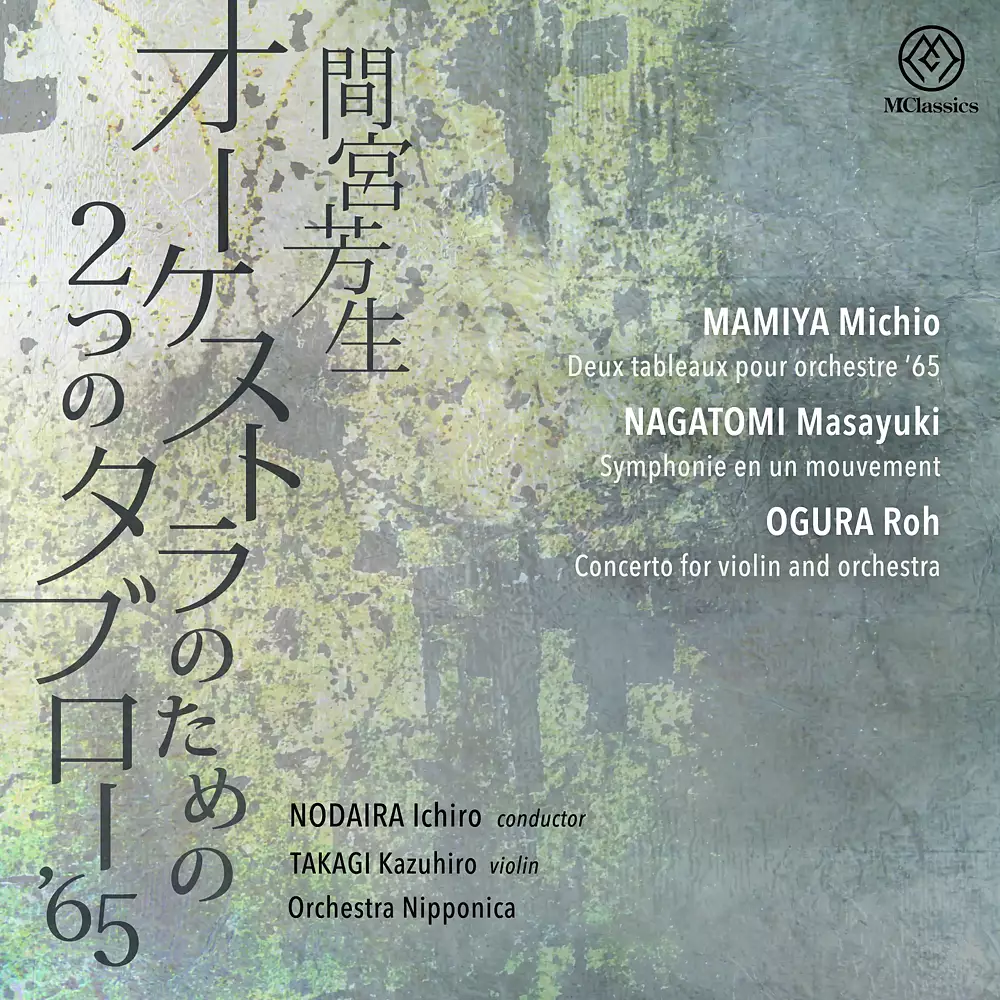
In the 1960s and early 1970s, the Japanese composition world produced a vast number of works. However, the re-evaluation and performance of many of these pieces remain insufficient to this day.
In 1963, Akira Miyoshi composed Concerto for Orchestra; in 1967, Toru Takemitsu brought forth November Steps and Akio Yashiro his Piano Concerto; and in 1969, Maki Ishii created Kyoso (Kyōso)—each recognized as an uniquely individual masterpiece representing Japan.
Orchestra Nipponica presents the orchestral works on this CD to bring them once again to the public’s attention.
Masayuki Nagatomi (1932–2020) studied at the Conservatoire de Paris, becoming the first Japanese student under Henriette Puig-Roget. His Symphony in One Movement (1963/67) is a meticulous and delicate work into which the composer poured everything he gained from studying écriture in France.
Roh Ogura (1916–1990) learned under the finest mentors of Japan's pre-war composition era, including Shiro Fukai, Meiro Sugahara, Tomojiro Ikeuchi, and Joseph Rosenstock. In the post-war period, alongside Sadao Bekku, he was one of the most active composers in music ideological debates. Heavily influenced by German classical music and Béla Bartók, his style shifted with each exposure, but his Violin Concerto (1971) stripped away those transitions to reveal a refined, almost neoclassical form.
Michio Mamiya (1929–2024) studied composition with Tomojiro Ikeuchi, though he was largely self-taught in both composition and piano. Amidst a history where Japanese composers struggled between Eastern and Western music, he was the first to focus on the "North-South problem in music." The fruit of this focus is Two Tableaux for Orchestra '65 (1965).
These three works from the 1960s and early 1970s represent a musical peak achieved after each composer navigated various influences and evolving techniques.
(Hajime Okudaira, Executive Advisor, Orchestra Nipponica)
Published date
2026-10-23
Number of discs
1
Sample rate
192000 Hz
Channels
stereo:24:2.0
Made in Sweden since 1999. In collaboration with Textalk.
Cart
| Artikel | Antal | Beskrivning | a pris | Totalt |
Env.session:
NULL


Env.order NULL


string(2) "en"


collector.CheckoutUrl


collector.OrderItemCount
0

collector.CartUrl
NULL


collector.Order
NULL