
A Worthy Mirror
Catalog Number: FCR523
Medieval ensemble Alkemie and cellist Amanda Gookin commissioned contemporary composers to respond to poetry by the trobairitz, the women troubadours of 12th- and 13th-century Occitania – a vivid meeting of old and new.
A Worthy Mirror
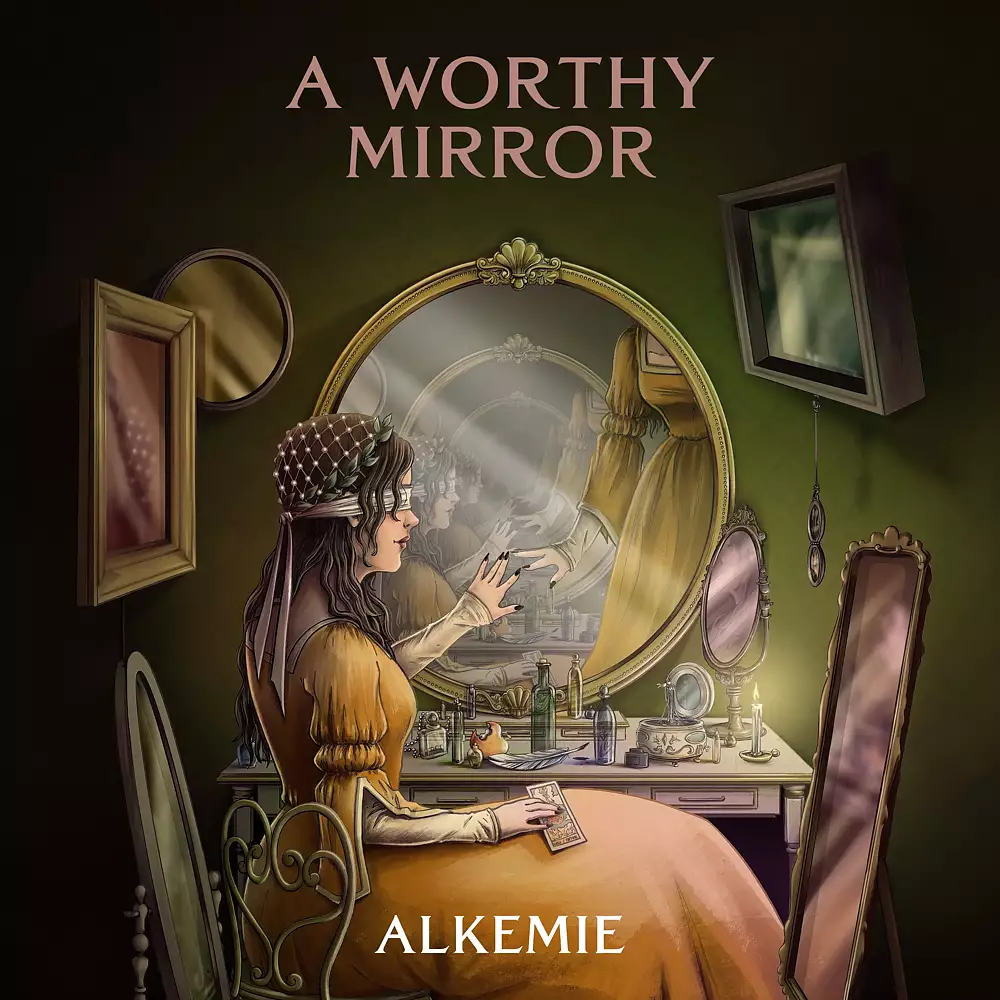
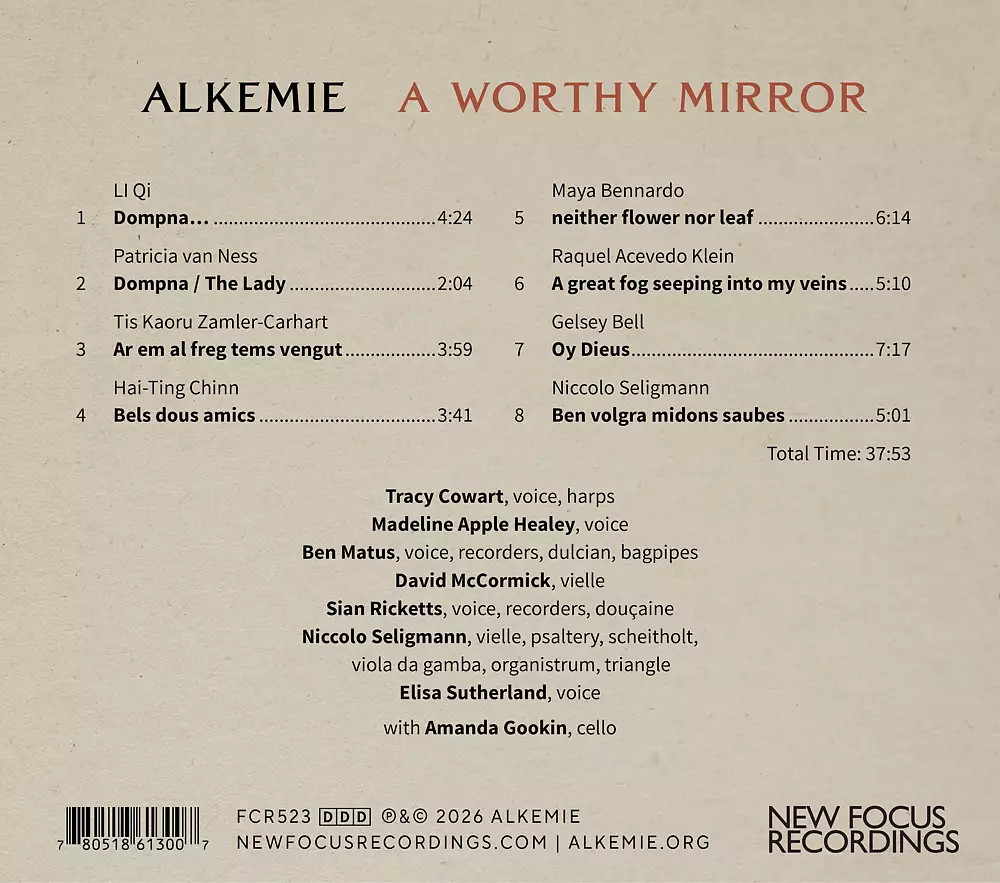


Alkemie occupies a unique place in today’s concert music scene. The ensemble, comprised of several singer-instrumentalists, specializes in music that is connected to the rich lineage of the Medieval era. But unlike other early music ensembles that focus solely on one period and body of repertoire, Alkemie sees Medieval music as a filter through which to explore broadly, mixing their excellent period performances with experiments in merging aspects of historical practice with the music of today. A Worthy Mirror falls into the second category; along with cellist Amanda Gookin of Forward Music Project, the Alkemie directors embarked on a fascinating commissioning project. They invited eleven contemporary composers to respond to poetry from the trobairitz, women poet-composers associated with the troubadour tradition of 12th- and 13th-century Occitania. A Worthy Mirror includes eight of those compositions, each approaching the material from a unique angle.
Some of the works set the historic texts directly, some incorporate fragments, and others use the original texts as jumping off points for new lyrics altogether. The musical results are similarly eclectic, ranging from overt usage of Medieval techniques like organum and monody to decidedly contemporary textures. However these composers chose to frame their responses, Alkemie has created a dialogue through time, shining new light on the trobairitz and on eight contemporary composers at the same time. Throughout, their virtuosity is matched by their versatility, a group of thinking musicians who understand style and its evolution and bring that perspective to this project.
Li Qi’s Dompna… opens the collection with a lyrical work that muses over what a contemporary troubadour song would sound like. Ephemeral swells in the vielles and cello create a wistful character, while the voices sing two poems in intertwined dialogue. Their rich, melismatic lines evoke early vocal music but the harmonic material, instrumental accompaniment, and content of the vocal lines place the piece squarely in the present.
Dompna / The Lady by Patricia van Ness gives us a chance to hear Alkemie’s prowess as a Medieval consort. Tracy Cowart’s harp and Niccolo Seligmann’s psaltery provide florid accompaniment, while Amanda Gookin and Ben Matus alternate articulating the bass line on cello and dulcian (a predecessor to the bassoon), and Sian Ricketts’ recorder and David McCormick’s vielle provide lithe countermelody. Over this joyful band, vocalist Elisa Sutherland sings an earthy melody that blossoms with ornamentation.
Tis Kaoru Zamler-Carhart creates a striking soundworld in Ar em al freg tems vengut by setting the text in a kind of modernized organum, using dissonant intervals that would not have found their place into early church polyphony. Zamler-Carhart started the compositional process with a single vocal line suggested by the text and then experimented with different interval combinations to arrive at the haunting glimmer of the final result.
Hai-Ting Chinn’s Bels dous amics setting invokes Renaissance polyphonic vocal writing in its voice leading, but its harmonic and melodic movement is decidedly modern, relishing the crunch of closely spaced intervals. Ben Matus joins on dulcian as the only instrumentalist on the piece, playing a part that far surpasses the limited supporting role bassoons have often taken in historical repertoire.
Maya Bennardo’s neither flower nor leaf is static and in constant movement at once; a shifting timbral cello chord provides a luminous halo of sound that bathes the voices in its resonance. Cowart’s harp paints pointillist attacks on the delicate canvas. Bennardo has captured the expansive timelessness of longing in the piece, a six minute long exhalation of reflection and serenity.
A great fog seeping into my veins by Raquel Acevedo Klein uses original texts inspired by the trobairitz, and returns to the quasi-consort format that we heard in the van Ness settings. The rhythmic groove of the song-like first section gives way to a mournful cello solo near the work’s midpoint, leading into a flowing second section where a sultry vocal line is accompanied by lush, fluid string voicings.
Gelsey Bell’s Oy Dieus is a sensual love song that affords vocalist Elisa Sutherland the opportunity to lean into a pop style expressive palette. Bell’s instrumental writing gives Alkemie license to behave somewhat more like a band, leaning into weighty chord progressions and free, improvisatory interludes. For the delicate final chorus, Cowart joins Sutherland for an elegant vocal harmony.
The final work on the album, Niccolo Seligmann’s Ben volgra midons saubes, reinforces Alkemie’s Medieval roots, drawing a clear connection between the consort music of that era and modal folkloric styles. Seligmann incorporates strophic monody and organum into this playful dance texture. After a free middle section which features embellished dialogue between duos pairings over a pedal point, the joyful rhythm returns to close the work for a rousing conclusion.
– Dan Lippel
Published date
2026-11-06
Number of discs
1
Channels
stereo:24:2.0
Made in Sweden since 1999. In collaboration with Textalk.
Cart
| Artikel | Antal | Beskrivning | a pris | Totalt |
Env.session:
NULL


Env.order NULL


string(2) "en"


collector.CheckoutUrl


collector.OrderItemCount
0

collector.CartUrl
NULL


collector.Order
NULL