
Arches
Catalog Number: FCR525
Sample rate
96000 Hz
Arches
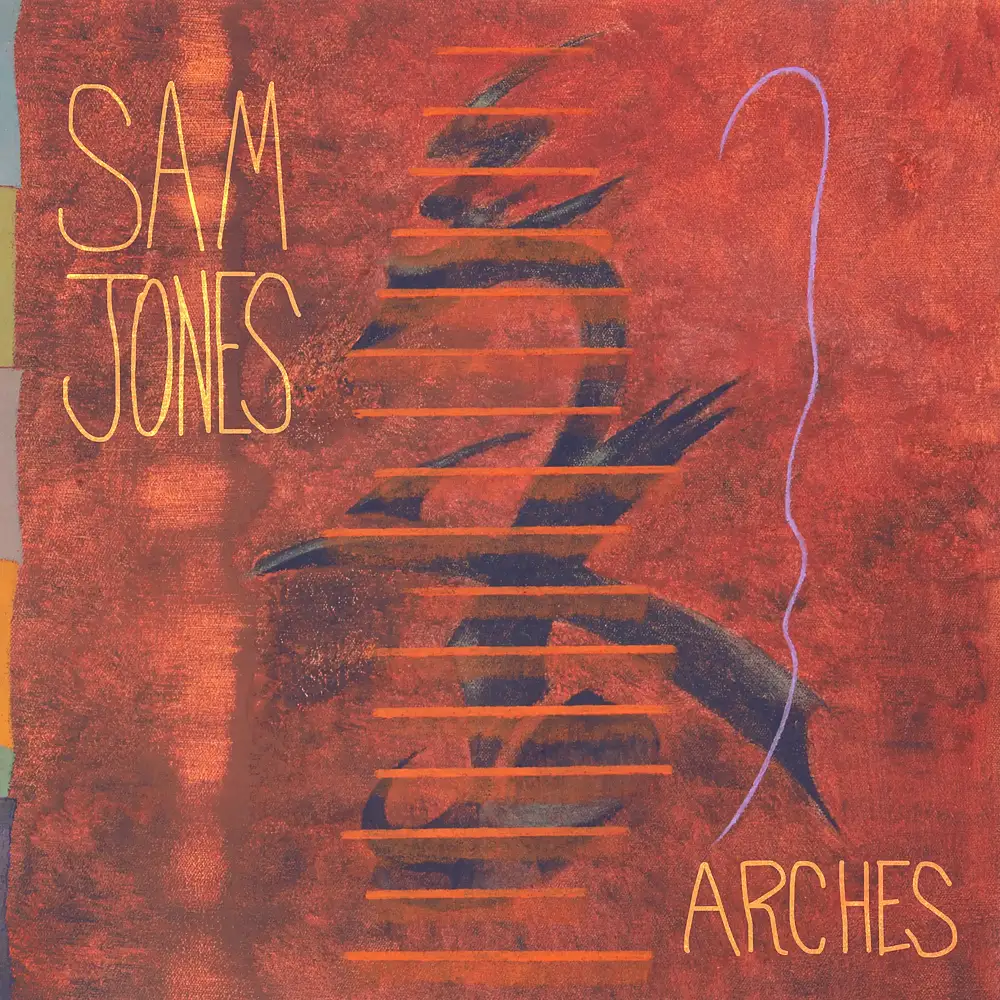
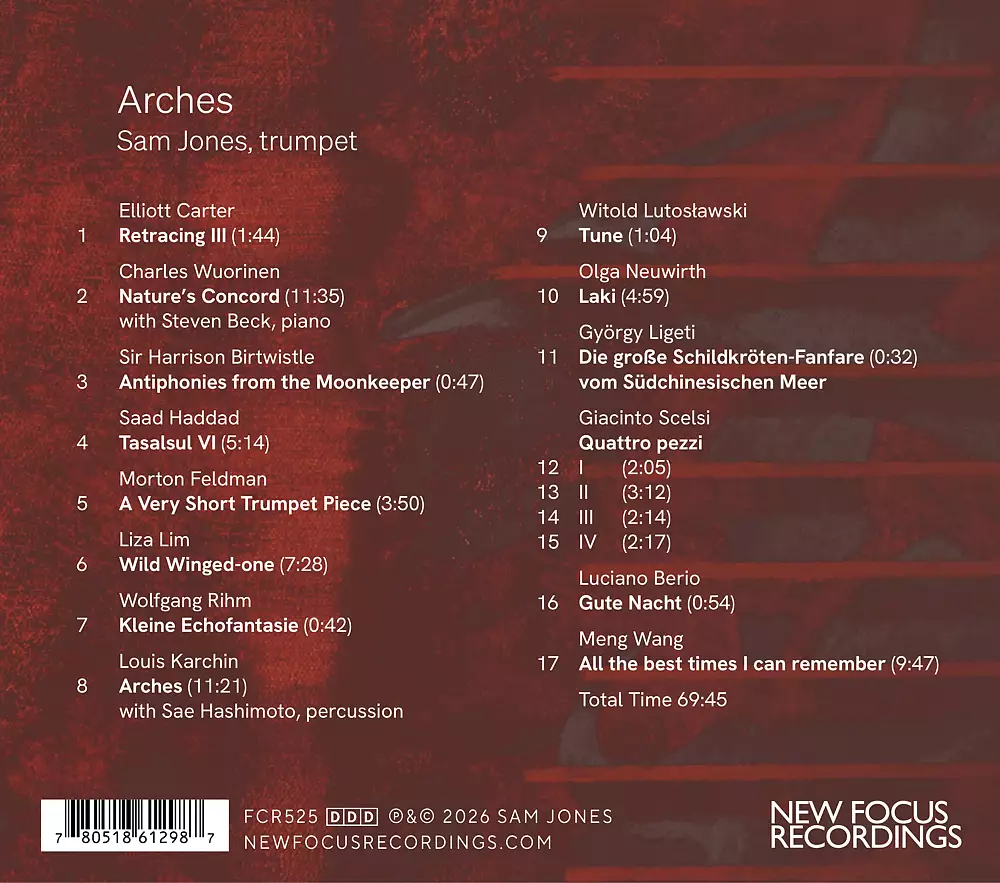


Trumpeter Sam Jones assembles a tour-de force program of music featuring trumpet, primarily as a solo instrument but also in two significant duo works. Jones organized the program around several short fanfares by a list of modern compositional luminaries, highlighting the form’s core role in the instrument’s history. The larger works presented here demonstrate a remarkable range of timbral and expressive versatility, brought to life by Jones’ solid technical command and commitment to each score’s demands.
In the last decades of his astonishingly long career, Elliott Carter wrote several short solo works that are remarkable for their concision. Retracing III is one of such pieces, clocking in at a mere one minute and forty five seconds, and is a compositional masterclass on how to fit multiple strands of musical information into a short container, and do so with humor and wit.
Charles Wuorinen’s Nature’s Concord for trumpet and piano (Steven Beck) is heard here in its first commercial recording. The mercurial opening trumpet solo establishes a gestural language of oppositions, from the sustained call, to the tightly focused accelerating half-step trill, to the angular melodic leaps that lead into and out of the initial piano entrance. Wuorinen carries this oppositional language through the work, first using the piano to articulate new pitch arrivals in the trumpet, and later inviting it to join the trumpet for forceful, angular lines and towering, expansive arpeggiations.
Harrison Birtwistle’s Antiphonies from the Moonkeeper (also heard here in its first commercial recording) features phrases that alternate between muted and non-muted timbres, creating the illusion of spatialized performers. Jones performs the work on a double bell trumpet, which facilitates the mute changes, navigating though the quick, imitative shifts with fluidity.
Saad Haddad’s Tasalsul VI, also for double-bell trumpet, was written for Jones and draws inspiration from both traditional Arabic music and Giacinto Scelsi’s Quattro pezzi for solo trumpet. Struck by an improvisatory quality in Scelsi’s work that reminded him of the Arabic taqsim practice, Haddad transformed some of the gestures from “il primo pizze,” mapping them onto traditional Arabic modes, reveling in microtonal inflection and ornamental embellishment.
Morton Feldman is not necessarily known for temporal brevity, and yet here is his A Very Short Trumpet Piece, one of his last compositions and his only for solo trumpet. The work has a deliberate, processional quality, as Feldman characteristically develops an initial ascending scalar figure with minute melodic and pitch adjustments that establish an unfolding semantic argument.
Liza Lim’s Wild Winged-one (2007), aria for solo trumpet in C (with wacky whistle), establishes its unique timbral vocabulary right away, made on the tiny whistle that adheres to the player’s palate. These high register bird-call like sounds immediately conjure an untamed environment, integrating into a developed vocabulary of sultry growls, bent pitches, and breath sounds, fluttering and flapping like the wings of an airborne creature.
Wolfgang Rihm’s forty-three second Kleine Echofantasie explores one theme that ascends a perfect fifth and descends a major second from the principal note, hinting at an outline of a dominant seventh chord. With dynamic echoes and subtle pitch adjustments, Rihm alludes to antiphonal brass and fanfare traditions within this concise miniature.
Louis Karchin’s Arches for trumpet and percussion (Sae Hashimoto), centers the vibraphone for its clarity, augmenting it with chimes and cadenzas for non-pitched percussion. The work opens with ritualistic grandeur, as the trumpet plays a resolute theme with tolling chimes and vibraphone accents accentuating pillar arrivals. Virtuosic passagework, first in the trumpet and them in the vibraphone, dominates the lively material in the work, with the two instruments occasionally sparring with each in hocketed rhythms. Resonant cymbal rolls and scrapes are featured in two percussion cadenzas; Jones emerges from the first with a far away, muted melody, while the second leads into a climactic ensemble passage. The piece retraces its steps back towards the ceremonial opening music, closing with a brief recall of the muted trumpet over luminous vibraphone chords.
Witold Lutosławski’s Tune from 1985 brings a touch of melancholic nostalgia to the fanfare miniature. Like the Rihm, dynamic terracing imitates antiphonal spatialization, while a quick ornamental figure enhances the march-like character of the short work.
Olga Neuwirth’s Laki recasts material from her trumpet concerto, …miramondo multiplo…, into a five minute solo work. Neuwirth has a background as a trumpeter; her intimate familiarity with the instrument is demonstrated here in the idiomatic writing and an intuitive understanding of the intertwined relationship between register, timbre, and resonance. A mix of contrasting gestures, from quick tongued repeated figures, heroic ascending scalar passages, and angular, jazz-inflected lines played with a mute, creates a well-balanced composition that never seems limited by its spare instrumentation.
György Ligeti’s Die große Schildkröten-Fanfare vom Südchinesischen Meer (The Big Turtle-Fanfare from the South China Sea) is a jovial character piece expressed as a fanfare. Never straying from the central harmony or diatonic melodic pitches, Ligeti nevertheless manages to create a satisfying shape and clear expressive content in thirty-six short seconds.
Giacinto Scelsi’s Quattro pezzi (1956) is a landmark work in the contemporary trumpet repertoire. Scelsi cultivated a meticulously notated style that nevertheless sounds improvisatory, marshaling the instrument’s capacities with deft sensitivity. The opening piece (the primary source of inspiration for Saad Haddad’s work heard earlier in the collection) is modal and ornamental in character, while the second is somber and reflective, with brief moments of bold extroversion. The third piece explores wide intervallic leaps and dramatic swells, while the final piece explores one initial note, excavating various timbral variations and embellishments of the pitch and its upper octave, crafting a narrative from limited materials.
Luciano Berio’s Gute Nacht (Good Night) (1986) opens with the most elemental of fanfare gestures, ascending perfect intervals, but quickly ventures outside the home key with a series of clever chromatic pitch inflections that create harmonic dimension.
Jones finishes this collection with Meng Wang’s All the best times I can remember, a work written for him in 2019 that pushes the boundaries of extended technique and timbral variety on the trumpet, at times creating the sense of listening to multiple instruments. The work has an intentionally fragmented structure, evoking faded memories. This adventurous work is a fitting close to this ambitious album that chronicles experimental approaches to the trumpet tracing back to 1956.
– Dan Lippel
Published date
2026-11-13
Number of discs
1
Sample rate
96000 Hz
Channels
stereo:24:2.0
Made in Sweden since 1999. In collaboration with Textalk.
Cart
| Artikel | Antal | Beskrivning | a pris | Totalt |
Env.session:
NULL


Env.order NULL


string(2) "en"


collector.CheckoutUrl


collector.OrderItemCount
0

collector.CartUrl
NULL


collector.Order
NULL