
Elijah Daniel Smith: Forbidden Oracles
Catalog Number: FCR516
Ancient oracles, modern sounds. Inspired by a miniature codex, The Gospel of the Lots of Mary, Elijah Daniel Smith's Forbidden Oracles unites ~Nois saxophone quartet and Sō Percussion in a haze of microtonal colour, followed by the propulsive Perihelion.
Sample rate
44100 Hz
Elijah Daniel Smith: Forbidden Oracles
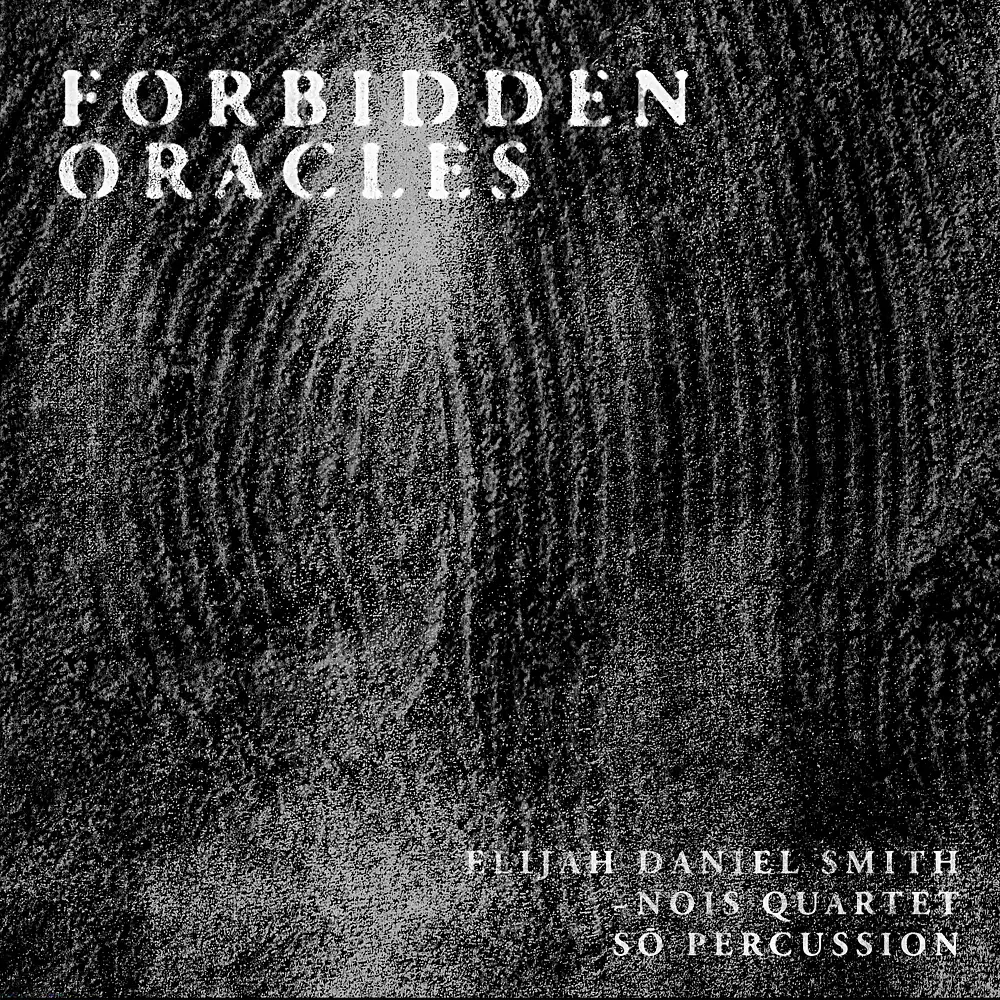
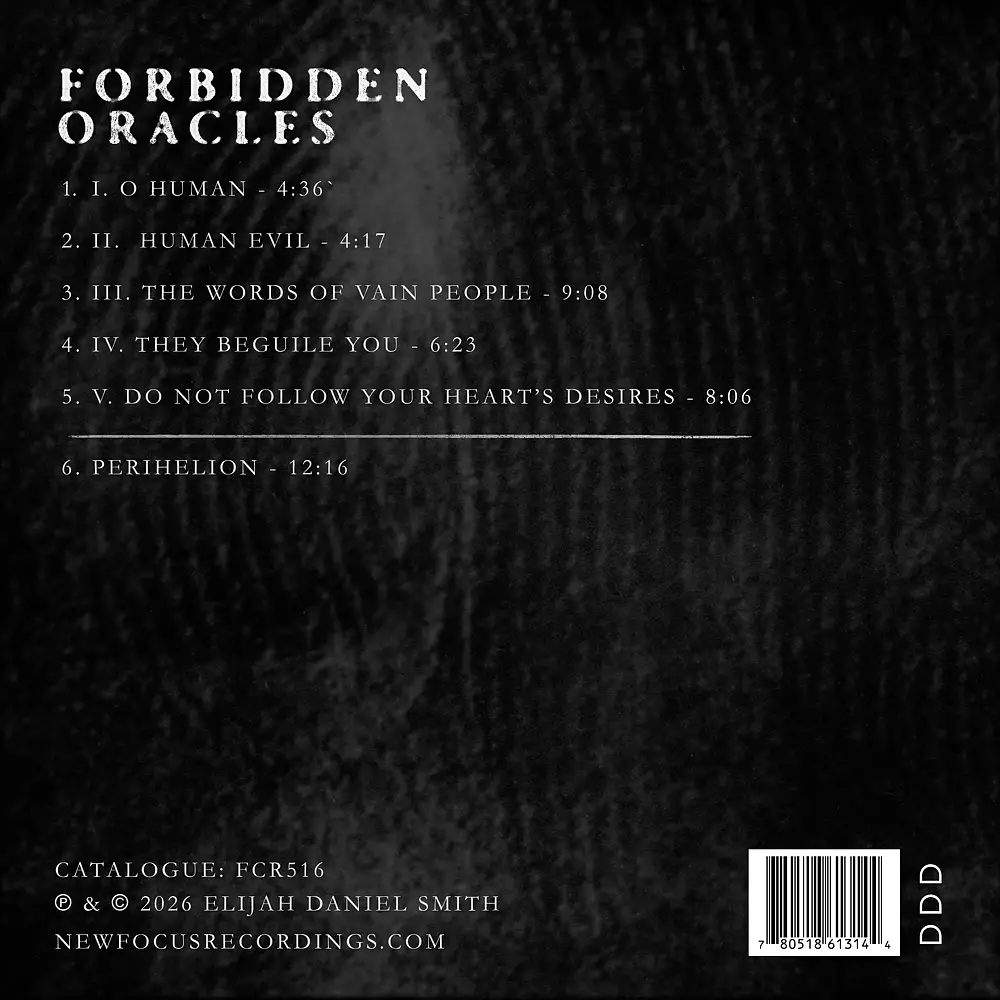


Texts from antiquity have been a source of intrigue and mystery for generations of artists, revealing how ancient civilizations understood their realities. Elijah Daniel Smith’s Forbidden Oracles is inspired by a miniature codex containing 37 oracles, entitled The Gospel of the Lots of Mary, containing predictive and selected wisdom to be offered to those seeking guidance while on a pilgrimage or at a festival. Smith, noting the dark tone of the texts, has focused on five of these oracles as the source material for his composition for saxophone quartet (~Nois Quartet) and percussion quartet (Sō Percussion). Closing out the album is his piece for saxophone quartet, Perihelion, a forceful, propulsive work that takes advantage of the sonic versatility inherent in its instrumentation.
A burst of percussive color opens “O Human," as an initial gong, almglocken, and cymbal attack leaves an primordial tremolo sonority in its wake. The saxophone quartet enters with taut swells that grind against each other in tart microtonal intervals. Smith plays with subtle pitch discrepancies throughout the movement, reveling in the idiosyncratic temperament of steel drums and saxophone multiphonics. Rolls in the marimba and vibraphone that might ordinarily assert themselves as definitive with respect to pitch are ambiguous here; Smith has blurred the lines such that their pitch is heard as one component in a murky haze of variable intonation.
A raw, growling saxophone multiphonic breaks the spell at the opening of “Human Evil,” as it explodes into a driven, insistent texture of syncopated rhythmic cells. Motivic repetition becomes a tool for playful syncopations, and vibrant polyrhythmic figures, as the initial growl becomes an idée fixe that recurs throughout the movement. Descending sighs in the saxophones and gentle splashes of steel drum harmonies offer a brief moment of repose before the hi-hat anchors a return to the insistent groove.
“The Words of Vain People” opens as a dirge, with a haunting oscillating figure in the low register of the saxophones answered by faraway calls on recorders. One can imagine a nighttime scene in a foggy cove surrounded by cliffs, the reflections of sound against the rocks distorting the pitch as they echo across the water. Gentle percussion figures enter periodically, bounce in decelerating, repeated attacks, and fade away, while mournful, sustained saxophone lines emerge and recede. Smith’s use of microtonality is acutely attuned to its expressive power; each gradation of pitch contains its own semantic meaning within the phrase. The percolating stasis boils over into a chorus of foghorn-like sounds, accompanied by an unsettling pattern on cymbal that is choked at irregular intervals.
“They Beguile You” contains two different kinds of music. Agitated, furtive activity characterizes the opening section, as off-kilter figures throughout the ensemble fuse together into an unpredictable mechanistic texture. A contrasting soundscape features diffuse timbres — breathy sounds in the saxophones, a sustained mallet dragging along an anvil. The independence of instrumental figures in the movement’s opening gives way to forceful gestures midway through, with cathartic passages of wailing saxophone lines and stabbing percussion. A disjointed chorale in the sax quartet emerges in the wake of the previous climax, colored by disembodied chords in the steel drums.
The closing movement of Forbidden Oracles, “Do Not Follow Your Heart’s Desires,” turns inward, exploring modulating sonorities that float like a mist between the instruments of the ensemble. Smith’s klangfarben style orchestration leans heavily on the beatings produced by slight pitch discrepancies in microtonal intervals, and the listener is drawn to shifting shadings of harmonic implication and timbre as different voices enter and recede. As the movement develops, otherworldly ritualistic music emerges in the percussion over increasingly ominous sustains in the saxophones. The work closes with an expansive passage based around a three note motive that is passed through the ensemble, at first grounded over a central drone before the harmonic frame shifts uneasily towards its end, basking in uncertainty.
A perihelion is defined as “the point in the orbit of a planet, asteroid, or comet at which it is closest to the sun.” Perihelion for saxophone quartet is organized into cycles as sonic objects, both fixed and moveable, establish a kind of orbital relationship with each other. Short, accented attacks play a crucial role in defining rhythmic patterns, while central pitches establish a fundamental anchor around which vertical sonorities are contextualized. Smith’s timbral palette in his saxophone writing is extensive, making great use of rough, crude sounds as well as delicate, rarefied textures. An oscillating figure between closely spaced intervals provides a disquieting backdrop for pulsing Reich-ian repeated figures. In Perihelion we hear a transparent presentation of many of the techniques that enliven Forbidden Oracles, heard in clearer relief in this smaller instrumentation, and mined for maximal developmental potential.
– Dan Lippel
Published date
2026-10-23
Number of discs
1
Sample rate
44100 Hz
Channels
stereo:16:2.0
Made in Sweden since 1999. In collaboration with Textalk.
Cart
| Artikel | Antal | Beskrivning | a pris | Totalt |
Env.session:
NULL


Env.order NULL


string(2) "en"


collector.CheckoutUrl


collector.OrderItemCount
0

collector.CartUrl
NULL


collector.Order
NULL