
Lei Liang: String Quartets (Live)
Catalog Number: FCR470
Lei Liang: String Quartets (Live)

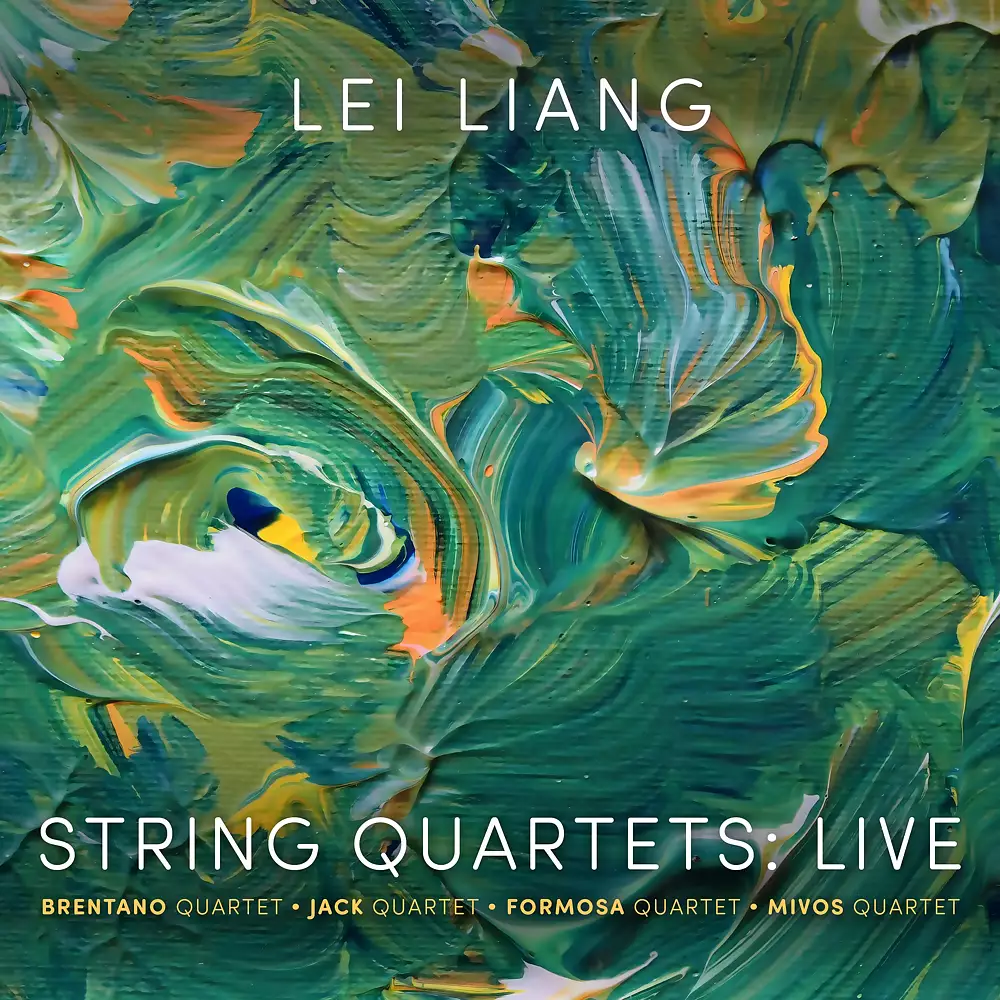


This collection of string quartets by Lei Liang provides a window into some of his most meaningful sources of inspiration, with a special focus on Mongolian traditional music which has captivated Liang's imagination for many years. The album is also an opportunity to hear Lei Liang realize his aesthetic goals using an instrumentation that has brought out the best of so many composers since its codification in the 18th century. Lei Liang’s breadth of musical curiosity and openness is matched by his depth of investment in immersing himself in the traditions from which he draws, an involvement that grows from a study and personal connection alike.
The album opens with an elegant setting of Monteverdi’s Lamento della ninfa, a madrigal which is set as a dialogue between a lamenting nymph and three sympathetic male voice parts. Lei Liang revels in Monteverdi’s voice leading and changes of pace in the opening section, taking advantage of the Brentano Quartet’s impeccable ensemble playing, as the group breathes as one. Cello pizzicato supports the solo violin line (a stand-in for the nymph) in a lilting Chaconne progression, while other voices enter with embellished imitation and poignant suspensions.
Gobi Gloria, performed by the JACK Quartet, is the first of three works on this recording that is inspired by Mongolian music. One of Lei Liang’s priorities in his adaptations of folkloric material is a diligent understanding of stylistic subtleties, arrived through exhaustive study. We can hear this reverential approach in the detailed ornamentation and embellishment in Gobi Gloria. Lei’s treatment of a primary melody utilizes contrapuntal techniques that would have been familiar to Monteverdi (or at least certainly Bach, Schoenberg, and Babbitt!), subjecting it to inversion, retrograde, and retrograde-inversion treatment. Glissandi, trills, timbral shifts, and sweeps of harmonics color the evocative texture. At the work’s first climax, waves of sound cascade and crest, coalescing into a cathartic dance, while a culminating subsequent peak ushers in the work’s close joyfully, with jaunty rhythms in the high strings and spiky accented pizzicati in the low strings, setting a melody from the Nei Monggol region as a kind of cantus firmus.
Lei Liang turns to the music of Taiwan’s Aboriginal tribes for source material in Song Recollections, performed by the Formosa Quartet. He draws on several songs from this tradition in the work, treating each like its own landscape through which the listener travels. This approach highlights Liang’s vibrant vocabulary of colors in his string writing; we hear grainy ponticello timbres, circular and ricochet bowing, percolating pizzicati leading into evocative slides, delicate tremolo articulations, and halos of ensemble harmonics. The quartet plays staggered pizzicati, its sonic drops fusing together to become a midday rain shower; rich, vibrato-laden lines intertwine to sound an expansive anthem. Expressive microtonality shades the harmonic and melodic content within a hazy, amorphous frame in select sections, while elsewhere, broad pentatonic harmony is a counterpoint, providing the basis for energetic timbral and motivic development.
Serashi Fragments is a tribute to Serashi, a 20th century performer on the Mongolian two-string fiddle called the chor. Liang is careful in his program note to write that the work is not an imitation of Serashi’s playing style, or the music of Mongolia. Instead it represents an abstract impression Serashi has made on Liang, and is the most experimental music on the album. The work opens with a dialogue between brazen, accented chords and fragile gestures emerging from a charged silence. A dense texture follows, with furious double stops supporting accumulating tremolandi and glissandi. The negative space in the work is full of potential energy, set up by dramatic truncated phrases. The overall character of Serashi Fragments is one of pent-up intensity, released in short, explosive bursts in quiet and loud passages alike, save for the ending, which diffuses that energy in a squirrely ascending passage.
In contrast, the material in and spirit of Madrigal Mongolia is very intentionally grounded in the music of Inner Mongolia. Lei Liang cites a friend of his family in childhood and Mongolian scholar, Wulalji, as the source of his lifelong love for this musical tradition, as well as the enduring influence of Professor Chou Wen-chung. The music reflects Liang’s abiding love for this tradition, as the piece opens with a meditative series of homophonic chords that swell and recede like inhalations and exhalations. A rich melody in the cello is accompanied first by light pizzicati in the ensemble and later by soaring sustains in the high strings. A contrasting section of fleet, bracing chromatic passagework and angular accents follows. Beginning at 9:58, once again we hear Liang’s sensitivity to stylistic elements in a powerful passage that highlights subtle embellishments and ornamentation, adapting the string instruments to inflections of traditional vocal singing. The work closes as it began, with a resonant chorale in the quartet, an homage to the resilience and timelessness of an ancient culture.
– Dan Lippel
Published date
2025-10-17
Number of discs
1
Channels
stereo:24:2.0
Made in Sweden since 1999. In collaboration with Textalk.
Cart
| Artikel | Antal | Beskrivning | a pris | Totalt |
Env.session:
NULL


Env.order NULL


string(2) "en"


collector.CheckoutUrl


collector.OrderItemCount
0

collector.CartUrl
NULL


collector.Order
NULL