
Miya Masaoka: Botantical Life — The Complete String Quartets
Catalog Number: FCR514
The Mivos Quartet perform Miya Masaoka's complete string quartets – music that treats the quartet as a living organism, connected to the world of trees, inviting us to lean in and listen closely to sound and to the living world around us.
Sample rate
96000 Hz
Miya Masaoka: Botantical Life — The Complete String Quartets
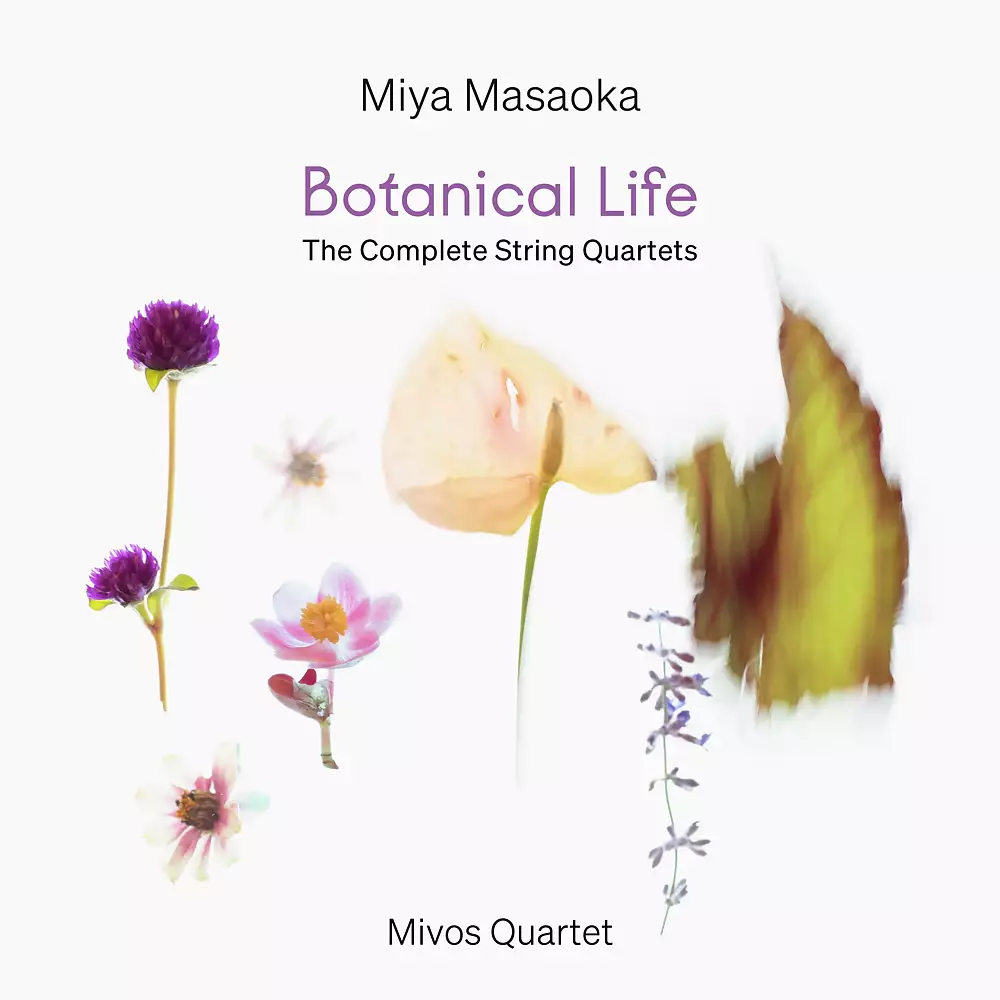
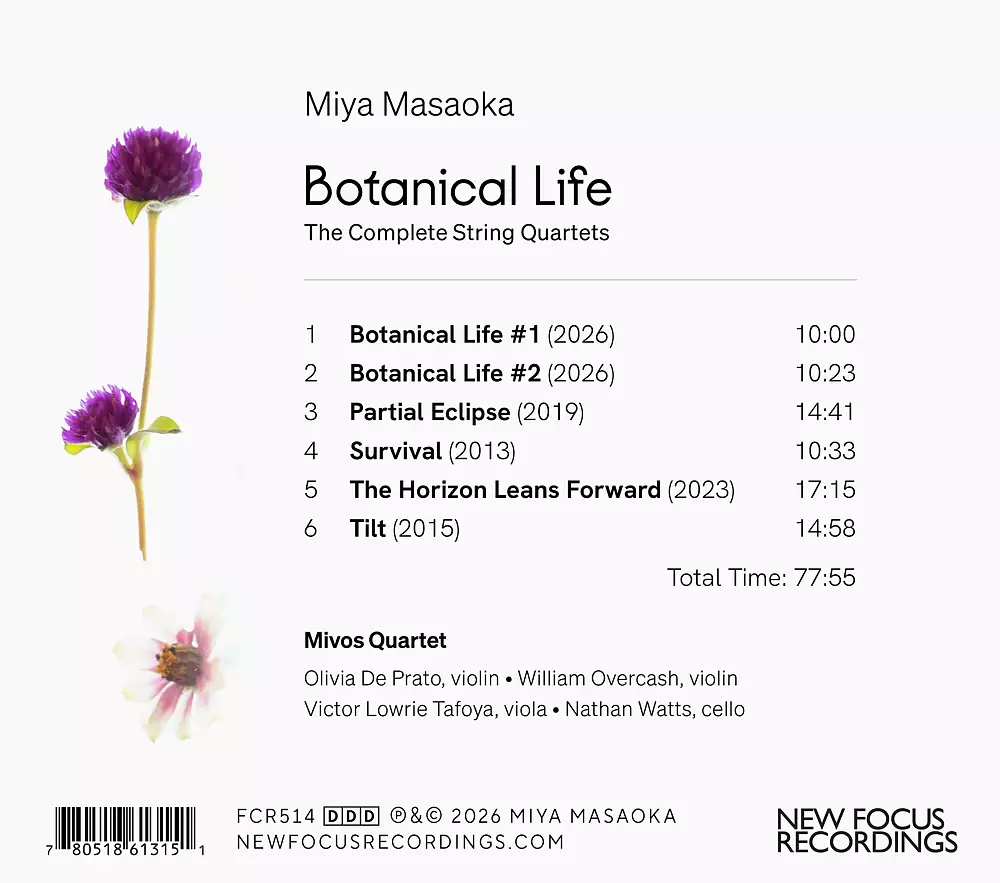


Composer Miya Masaoka approaches the string quartet as a living organism, focusing on its organic composition and its inherent connection to the world of trees. This sensibility pervades the works for string quartet included on Botanical Life, as Masoaka explores a range of resonant and muted timbres, all engaging with the physical materials of the instruments. There is an implicit foundational entreaty built into these works, an invitation to lean in and listen to the essence of sounds, and extend that attention to the living things that surround us. Masaoka’s music positions itself as part of this unceasing activity that unfolds constantly, first drawing us in, and then broadening our listening to allow the sounds around us to filter through. The intrepid Mivos Quartet performs on all six works on the recording, solidifying their commitment to rarefied, timbrally focused composition.
Botanical Life #1 opens with the ensemble organism coming to life, with percolating creaking sounds, percussive knocks, and a droning circular bowed articulation. Masoaka varies the density of materials, steadily bringing a grainy, overpressure sustain to the fore before more pitched material gradually enters. Unstable high harmonics underscoring the overtone series, pizzicati on slackened strings that incorporate modulating buzzing sounds, and furtive, irregular tremolos animate the texture. Long phrases accumulate like emerging weather patterns, showing initial signs of change that overtake the soundscape before cresting and receding into the next episode.
Botanical Life #2 develops in a similarly organic fashion, but emphasizes pitch from its outset instead of non-pitched timbres. Masoaka explores tremolo textures that are stratified through registers; ethereal harmonics oscillate between harmonies, a focused high pitch emerges like a buzzing insect from a compressed, scratchy bow technique, and haunting irregular tones emerge in the middle register like distant foghorns. A pedal point in the cello provides an anchor over which percussive attacks and textural pizzicati develop, increasing density before bubbling over into a hive of punctuated activity. Botanical Life #2 circles back to where it began, with more pitched material in a brightly hued section before it fades into celestial, airy textures.
Partial Eclipse was originally written for the JACK Quartet, and is comprised only of harmonics. The opening of the piece is luminous and expansive, reveling in the resonant vibrations of the natural harmonics produced on the four instruments. This compositional self-limitation does not restrict the work’s sonic range however, as Masaoka focuses on specific registers to delineate structural pillars. Each new voicing becomes a sound object to inhabit and meditate on, tuning in to the tactile vacillations that occur within sustained sonorities.
Masoaka composed Survival for her parents who were interned in the Japanese prison camps during World War II, and was included in a multi-media performance entitled Triangle of Resistance. The ensemble writing here is taut and integrated, in contrast to the gradually evolving sonic ecosystems from Botanical Life #1 and #2, Survival is rhythmic and pulse oriented, treating the quartet as multiple limbs of one organism. Vertigo inducing slide gestures swoop through the ensemble in the work’s opening before pentatonic fragments establish a motivic seed. Dramatic unison figures are interspersed with intertwined ascending and descending glissandi and tremolos. Later, propulsive sixteenth note lines cascade through the quartet, and an off-kilter folkloric dance emerges that incorporates subtle slides and ornaments. It is not hard to imagine how effective this piece would be in a multimedia context.
Inspired by a quote from Maya Angelou’s On the Pulse of Morning, The Horizon Leans Forward is also driven by a wide vocabulary of quartet textures. Masaoka revels in slow glissandi that lean into shifting intervals. Quick swells are passed around the ensemble like pressurized valves releasing compressed air or a series of reverse loop effects. The quartet leans into bracing microtonal verticalities, launches into energized bursts of pizzicati, and temporarily suspends the forward direction of the work with disembodied sustains.
Tilt, written for the Del Sol Quartet in 2015, begins with several phrases of harmonic glissandi, like collective exhales in the ether of each instrument. The ethereal mood is quickly broken by a raw, scratching overpressure tutti in the quartet. Quick glissandi figures take on a sing-song vocal quality, almost as if they are imitating speech cadence in a tonal language. Masaoka begins to animate these figures with nervous trills and kinetic glissandi. Towards the end of the piece, closely spaced sustained chords float above an anxious, stuttering pitch in the middle voice, before a passage of frenetic rising scalar figures and tremolos careens towards a climax that ultimately disperses into the air as it ascends.
– Dan Lippel
Published date
2026-11-06
Number of discs
1
Sample rate
96000 Hz
Channels
stereo:24:2.0
Made in Sweden since 1999. In collaboration with Textalk.
Cart
| Artikel | Antal | Beskrivning | a pris | Totalt |
Env.session:
NULL


Env.order NULL


string(2) "en"


collector.CheckoutUrl


collector.OrderItemCount
0

collector.CartUrl
NULL


collector.Order
NULL