
New Music for Two Voices
Catalog Number: FCR494
New Music for Two Voices
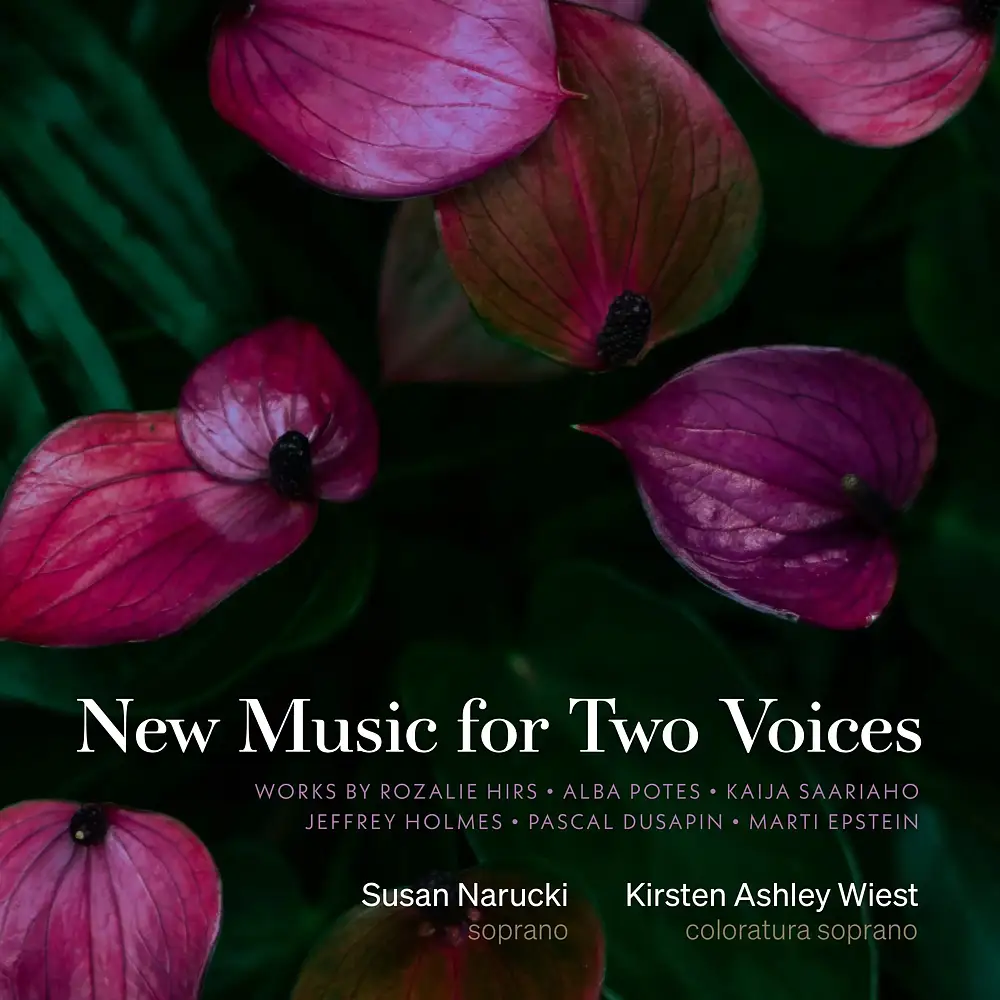
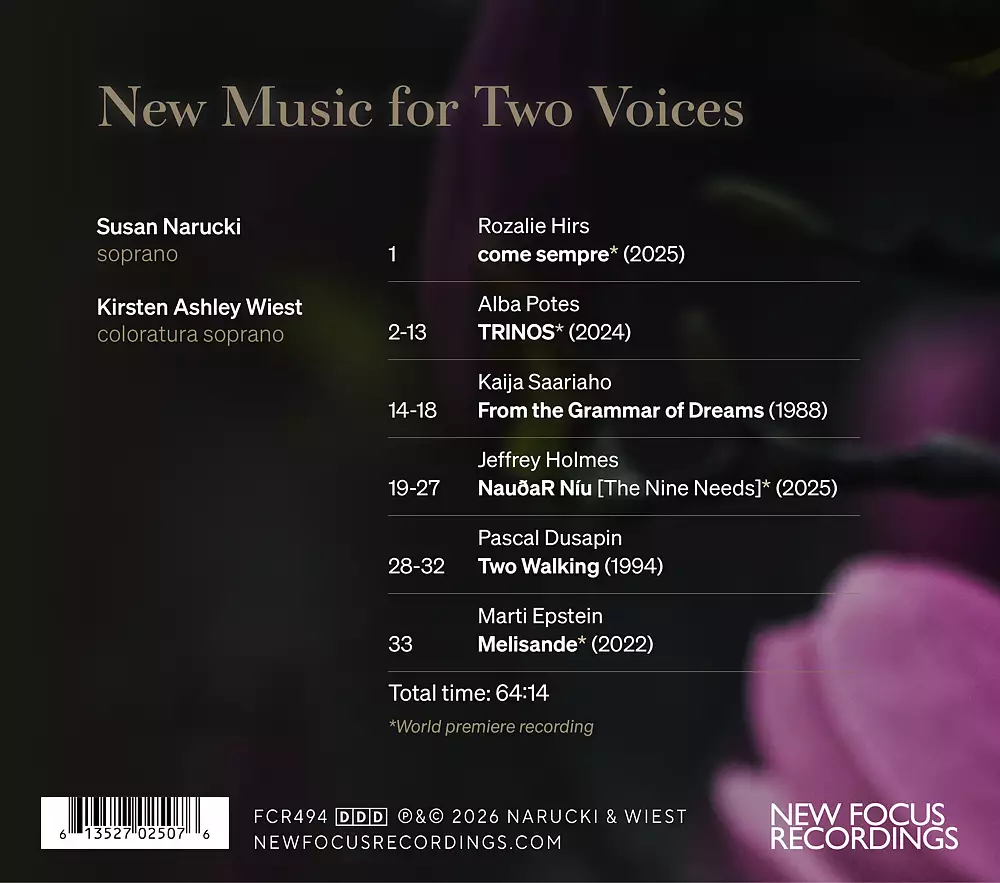


The music on this recording by Susan Narucki and Kirsten Ashley Wiest for two unaccompanied soprano voices makes its primary limitations its central strengths. The melodic exclusivity of the human voice and its raw vulnerability facilitate works that communicate harmonic information through the subtlest of means and bring the listener into an intimate expressive space immediately. Narucki and Wiest embrace this challenge with enthusiasm and artistry, presenting a compelling program that captures very diverse visions for the instrumentation from six distinct composers.
Come sempre takes its text from the opening poem of Rozalie Hirs’ eighth collection, ecologica, here sung in an Italian translation by Patrizia Filia. come sempre centers the joy of singing itself, particularly singing with another. Hirs’ language prizes equality in its allocation of vocal roles, reveling in various forms of interplay, including call and response, interwoven phrases, and parallelism. The work’s melodic vocabulary is singable and transparent, pointing to clear harmonic frames while preserving a sense of mystery and subverted expectation.
Alba Potes’ TRINOS provides twelve short snapshots of expression, notable for their succinct encapsulation of individual affects. Using ornamental figuration, microtonal shading, and the extremes ranges in each voice part, Potes extracts haunting expression from limited means. “Jazmin” announces the work with dramatic sighing gestures, while the intervallic leaps in “Entra illuminando la casa” are coy and playful. “La calle que camino” casts a somber, reflective mood, with the silences between phrases carrying as much weight as the phrases themselves. “Timida flor” returns to the dramatic leaps of the second movement, barely lingering on their impact before transitioning into the heaviness of “Ven, anclemos,” a mournful exhalation. “Se hundío el buque” is declamatory and severe, while “Canta pajarillo” provides a contrast with wide ranging, trilled high register figures. “En los hilos” closes the evocative set with liquid lyricism.
Kaija Saariaho’s From the Grammar of Dreams sets excerpts from The Bell Jar by Sylvia Plath for two singers, embodying the instability of the protagonist’s struggles with issues of life and death, madness and solace. In the second movement, each singer in the duo alternates between athletic singing and forceful, rhythmic recitation of the text, creating an unsettling texture where song and speech are unbroken even as each individual performer leaps back and forth between roles. This alternation culminates in the earthy fourth movement, as the two singers hocket between each other in spats of heavy breathing and swooping, plaintive figures.
Composer Jeffrey Holmes’ music is notably engaged with microtonality and alternate tunings; in this work, NauðaR Níu (translated as The Nine Needs) he adds auxiliary percussion to the ritualistic score. The texts, compiled by the composer from ancient Runic carvings in Proto-Germanic and Old Norse languages, are presented in the manner of incantations, accompanied by poignant chimes, gongs, and non-pitched instruments. Holmes conjures an otherworldly sonic landscape, marshaling his modal melodic material, overtone based tuning, and subtle ear for timbre in the service of a score that transports the listener to another time.
Pascal Dusapin’s Two Walking has a connection with his chamber opera also based on Gertrude Stein texts, To Be Sung, whose premiere Susan Narucki performed. Dusapin cleverly mimics the repetition with variation nature of Stein’s texts with a musical analogue of his own, turning motivic kernels around to listen to them from every angle and leaning on embellishment and interaction to propel the direction of the texture. “Kiss my lips” integrates extended vocal technique to add timbral diversity and wry humor. The two voices are treated like a hybrid instrument, like in “A scene in singing,” where one soprano articulates an attack on a pitch and the reveals the sotto voce sustain in the other. “It seems to be” creates a structural mirror with the opening movement, toying with fragmentary figures that are oriented around consistent intervals, fashioning an overall fabric that is circular in its recurring material and linear in its constant sense of forward motion.
The final work on the recording is Marti Epstein’s Melisande, a nearly thirteen minute work of thoughtful repose that reveals, on closer examination, a wealth of textural variety. Epstein adapted texts by Maurice Maeterlinck and gave voice to the thoughts of the character Melisande, circumventing the extent to which male characters have imprinted their identities and desires onto her. The two voices sing alternatively in homophony, responsively, and in heterophonous counterpoint, always processing with an organic sense of gradual unfolding, the revealing of a previously unexamined inner world.
– Dan Lippel
Published date
2026-08-21
Number of discs
1
Channels
stereo:24:2.0
Made in Sweden since 1999. In collaboration with Textalk.
Cart
| Artikel | Antal | Beskrivning | a pris | Totalt |
Env.session:
NULL


Env.order NULL


string(2) "en"


collector.CheckoutUrl


collector.OrderItemCount
0

collector.CartUrl
NULL


collector.Order
NULL