
Noah Meites: COUNTING
Catalog Number: FCR475
Noah Meites: COUNTING
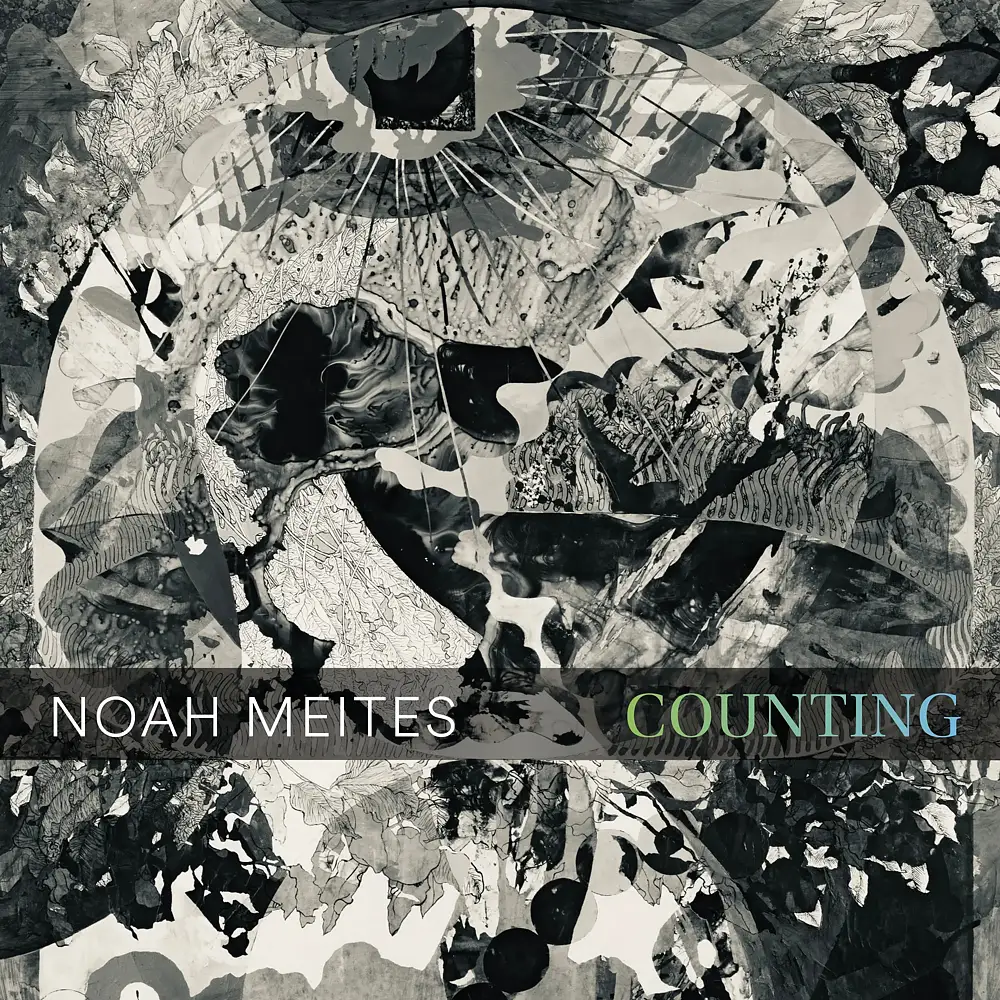
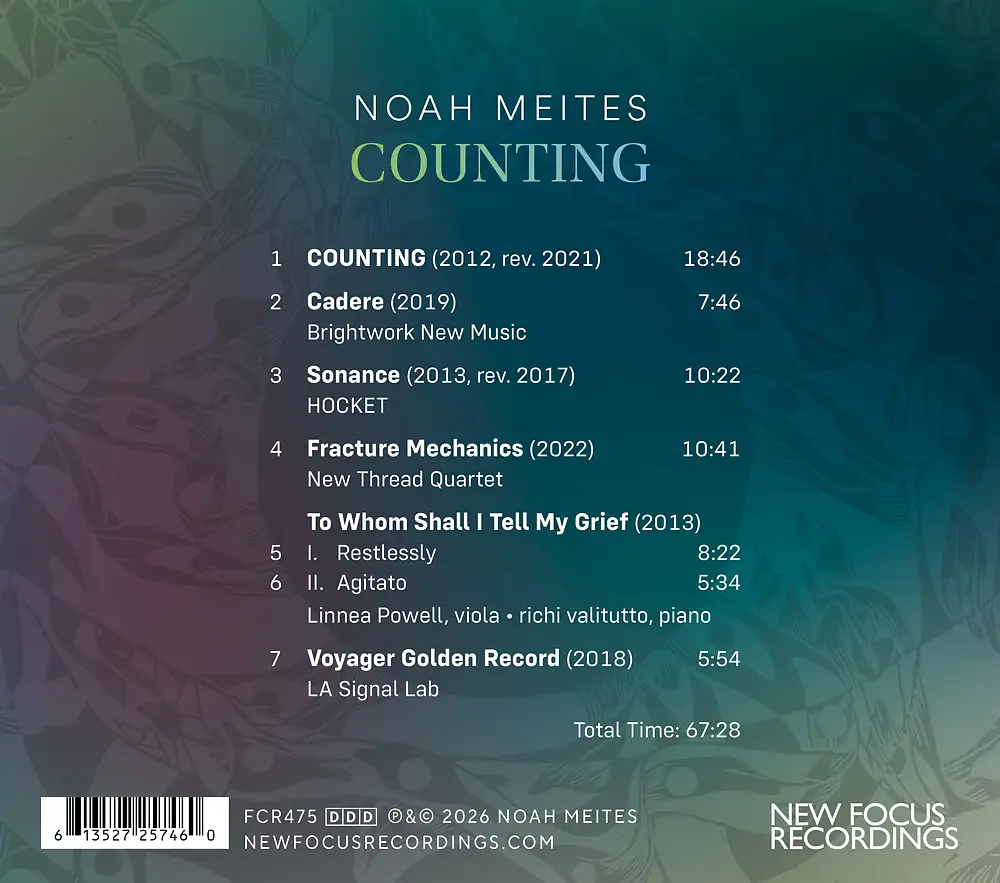


Composer Noah Meites wrote his doctoral dissertation on affinities between the music of Prince, Igor Stravinsky, and Louis Andriessen. This fact might lead one to assume his music is an amalgam of the three, and while one hears influences of their work in his, Meites has decidedly charted his own path. What his scholarship topic does indicate however is a broad range of practice in his musical background, from commissions and premieres by many ensembles and festivals in the new music firmament, to a certificate in jazz trumpet performance from a university in France, to co-founding LA Signal Lab, a stylistically diverse ensemble specializing in the intersection between improvised and pre-composed music. This flexibility and wide range of experience comes across in Meites’ music in an entirely natural fashion. His collaborators on this album are many of Los Angeles’ most active musicians in the contemporary music scene, including Brightwork New Music, HOCKET, New Thread Quartet, and a host of top freelancers. The music on this collection is finely crafted and each piece defines its own aesthetic terms in organic ways, demonstrating an artist who has a broad tool set but does not feel the need to brandish it gratuitously.
COUNTING opens the album, a tour-de-force work for nineteen instruments and four high voices. Meites uses the relatively large new music ensemble forces to great effect, with ecstatic towering chords led by the brass, percolating, off-kilter rhythmic cells driven by a cadre of saxophones and an extended rhythmic section, and ethereal clouds of harmony framed by the vocal quartet. The choice of instrumentation, reliance on rhythmic devices to vary and develop material within a regular pulse, and harmonic and stylistic language demonstrate the deep impact Andriessen had on Meites. The piece’s expressive world vacillates between vigorous propulsion and evocative soundscape. The vocal quartet often functions as an austere, homophonic chorus, intoning the foreboding text from Jeremy A. Schmidt’s Censuspeak with chilling neutrality. The prevailing rhythmic grid is offset by free gestures in the keyboard, electric guitar, and high winds at select moments in the work to loosen its skeletal infrastructure. Prince’s influence is felt strongly at the fourteen minute mark, with a repeated ostinato growing out of the fretted electric instruments featuring a funk rhythm guitar part that migrates throughout the ensemble into a simmering groove. From that pad, saxophonist Patrick Shiroishi ignites into a blistering improvised alto sax solo. COUNTING ends with an incantation, led first by the vocal quartet and closing with a series of bell-like attacks in the piano, percussion, and guitars.
A drone in the strings and winds, dotted by tolling attacks in the vibraphone, begins Cadere, an emerging consonance trying to peak out from behind obscured clouds. A plaintive clarinet solo provides a bridge to the introduction of brief, frenetic tutti outbursts. The leaner sextet instrumentation leads Meites to distinguish individual voices, developing complex heterophonic dialogues that explore multiple contrasting characters at once. Pitched percussion plays a pivotal role in the work, coloring prevailing harmonies, signaling formal transitions, and supporting primary melodic ideas with imitation and counterpoint. A gentle, prismatic chorale coalesces around a repeated Morse code like figure in the flute. The texture diffuses as the piece winds down, individual parts disentangling from each other like figures splitting from a group and going on their independent paths.
Sonance, for two pianos and played by the HOCKET duo, is pointillistic at first, with delicate sonorities interspersed with sudden, nimble figures. The interaction between the two keyboards creates a complex web of contrapuntal activity across registers that unfolds linearly as it develops vertically. A semi-regular walking figure emerges in the middle register and provides forward direction, occasionally stuttering in a slightly faster speed. Sparse attacks muted inside the piano create anticipation before the suspense is shattered by dramatic, widely spaced forte chords. The mechanical texture that emerges suggests a slightly rickety player piano, one which seems to increasingly rebel against its predetermined role, careening towards an explosive close.
Fracture Mechanics for saxophone quartet balances post-minimalist imitative textures with an exploration of timbre. After an atmospheric, fragile opening featuring multiphonics and swells, Meites brings in a circular, hocketed figure, and the quartet almost sounds like it is chasing the tail of its own phrases. Accents and dynamic contrasts up the stakes of these ensemble passages, before a cathartic squeal emerges from the quartet, an explosion of unhinged energy referencing free improvisation. The outburst is immediately reined in with a genteel section featuring the baritone sax over elegant, pointed accompaniment. The disembodied multiphonics return for the close of the piece, embracing the music in between a hazy cloak.
To Whom Shall I Tell My Grief is an evocative work for viola and piano, with a rhapsodic, brooding opening movement and a taut, charged second movement. Melodic lines with grace note ornamentation lend the chromatic melodic material in “Restlessly” a mournful, folkloric character. Hollow harmonics in the viola extend brilliant high register keyboard attacks and create hybrid timbres, and rumbling low register figures carve out cavernous sustains. The spacious resonance of the work’s early phrases closes in on itself, as the texture becomes increasingly dense. The “Agitato” is playfully rugged, answering brusque heavy passages with light figuration. As in COUNTING, Meites uses repeated ostinatos with subtle variation as a propulsive vehicle. Strident double stops in the viola bring the movement to a peak before watery arpeggios in the keyboard lead to a simple three chord ending.
The final work on the album is Voyager Golden Record for septet and fixed media electronics. The playback part is a collage of recorded communications related to the Voyager space program. Meites’ use of the ensemble facilitates earthy improvisations that track long, structural shapes. After an accumulation during the opening two minutes, the texture clears and opens into an expansive harmonic pad, a sentimental paean to our planet, “the only one we have.” Strains of weightless lyricism float through the ensemble, fusing together into an ethereal closing hymn and a humanistic final gesture for the album.
– Dan Lippel
Published date
2026-05-08
Number of discs
1
Channels
stereo:24:2.0
Made in Sweden since 1999. In collaboration with Textalk.
Cart
| Artikel | Antal | Beskrivning | a pris | Totalt |
Env.session:
NULL


Env.order NULL


string(2) "en"


collector.CheckoutUrl


collector.OrderItemCount
0

collector.CartUrl
NULL


collector.Order
NULL