
Pursue Peace: Contemporary Chamber Music by Canadian Jewish Composers
Catalog Number: FCR485
Pursue Peace: Contemporary Chamber Music by Canadian Jewish Composers
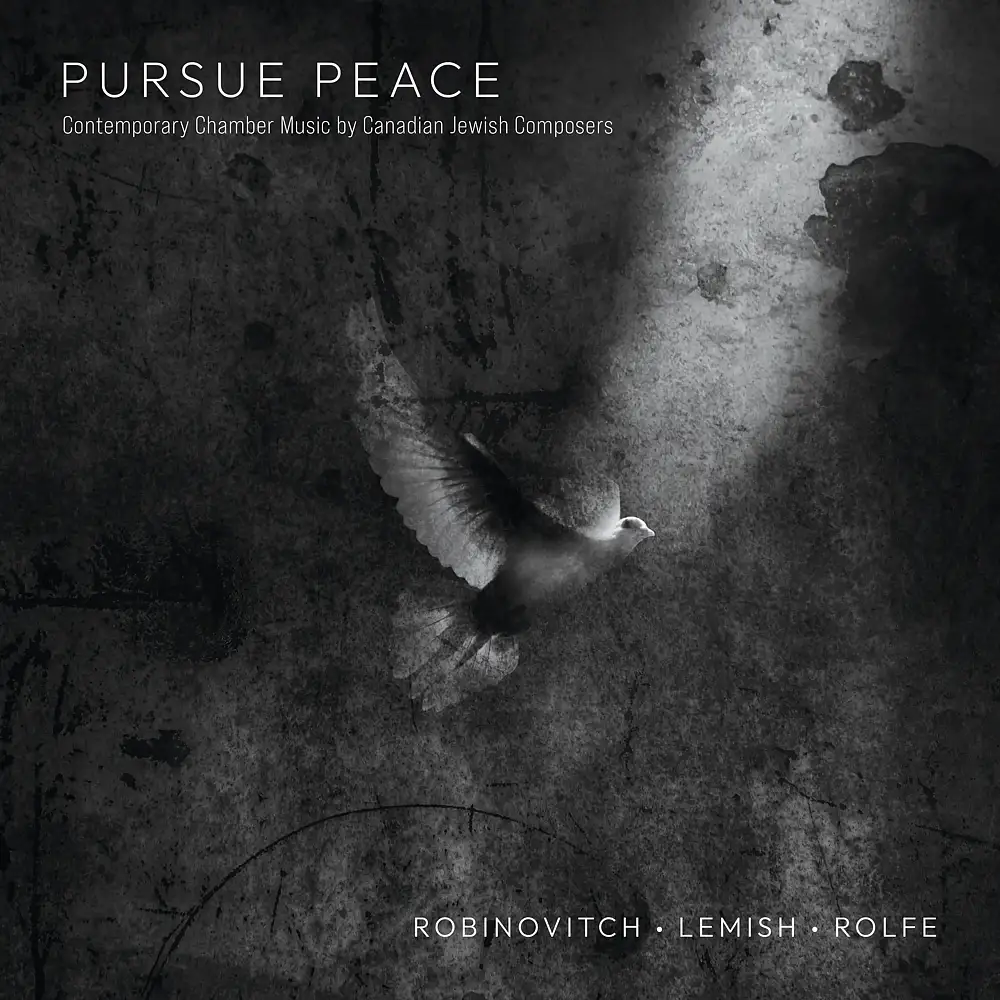
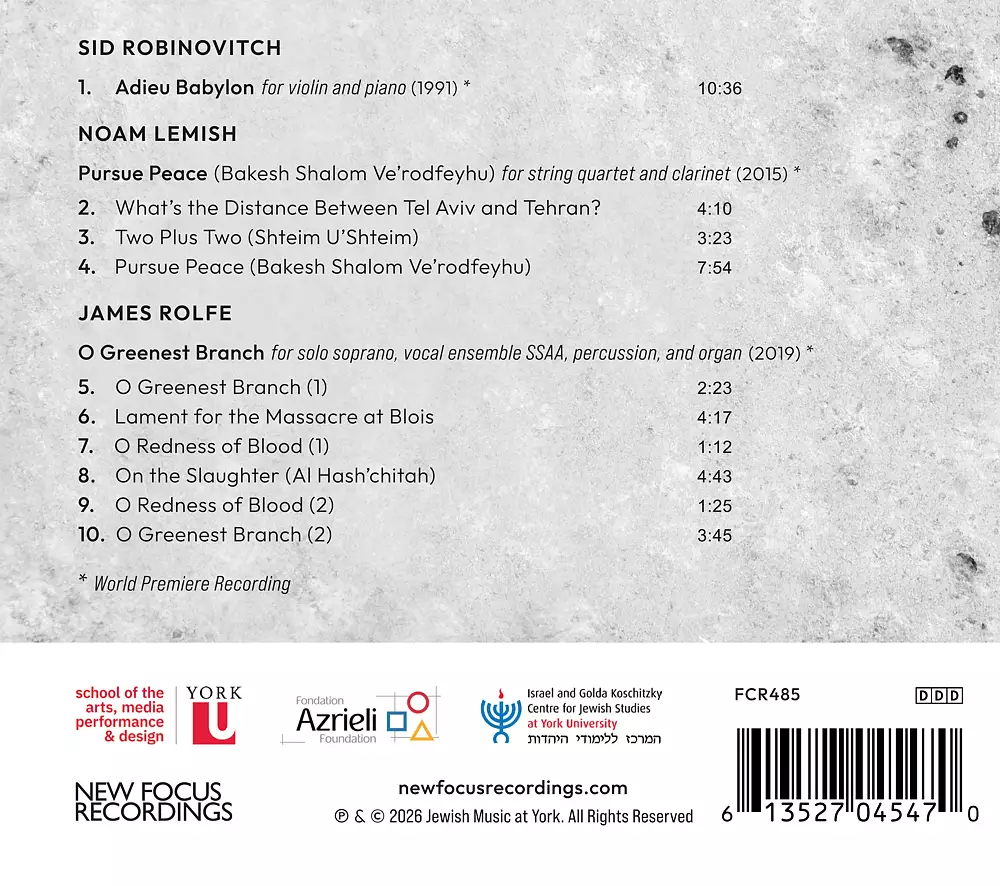


Pursue Peace is the first project in a series organized by the “Jewish Music at York" initiative from York University in Canada. Led by composer Noam Lemish, the initiative’s mission is to showcase the music of the Canadian Jewish contemporary music community, and to contribute to a climate of dialogue that serves Jewish artists while reaching out to the broader artistic and cultural community. The recording features works by Lemish, Sid Robinovitch, and James Rolfe, integrating Jewish texts and historical context. The compositions, curation, and committed performances all point to a shared conviction about music’s unique capacity to engage with larger issues on an intellectual and emotional level. Two of the works explore Jewish life in contemporary West Asia, while the third looks back to medieval central Europe for inspiration. The composers are subtle in their references to a specifically Jewish musical repertoire, but its presence is felt throughout as they rectify this lineage with each of their individual artistic voices.
Sid Robinovitch’s Adieu Babylon for violin and piano opens the collection, performed by violinist Amy Hillis and pianist Katherine Dowling. Written in 1991, amidst the full blown Persian Gulf War, the work grapples with the turmoil that the region has suffered under over the last several decades. Middle Eastern musical allusions are heard throughout the piece, with characteristic modal colorations embellishing the melodic material. The piece opens with a reverential lament, as the violin spins out rhapsodic lines over a tolling pad. Flowing, rhythmically additive figures enter briefly in unison between the keyboard and violin before the somber opening material returns and is subjected to development. Robinovitch toggles between poignant, nostalgic music and vigorous material, capturing the tension between the centuries old history of the region with the alacrity with which current events were transforming the region at the time. After a frenetic episode of trills, buzzing figures, and tremolos that ascend to the high register in both instruments, we hear an ethereal passage featuring violin harmonics and airy arpeggiations. Vigorous chords interrupt the reverie and drive the work towards three bracing high register accents before quickly disintegrating into pointillistic staccato attacks and angular pizzicati. A coy reprise of the opening mournful music gives way to one more outburst of furious virtuosity before Adieu Babylon closes with lyrical violin phrases that return, searchingly, to the modal material from its opening.
Lemish’s three movement work Pursue Peace for string quartet and clarinet was composed in 2015 for the debut concert of the Israeli-Iranian Musical Initiative, a Toronto based collective active between 2015-2020. The work’s message for peaceful co-existence echoes loudly today, and speaks as well to the long history of friendship between the populations, despite the antagonistic paradigm that currently exists between their respective leadership. The title references the closing words of Psalm 34 (“Avoid evil and do good in the world. Seek and pursue peace."), while the final movement draws inspiration from a musical setting of that same psalm by songwriter Baruch Chait. The opening movement, “What’s the Distance Between Tel Aviv and Tehran?” engages with physical and metaphorical distance. Lemish captures this duality through a multi-layered texture; the clarinet explores a modal melody that grows from a simple questioning five note motive, supported by flowing, sustained figures in the strings. Clarinetist Eric Abramovitz’s phrases become increasingly ornamental as the accompaniment gains in intensity before receding to a quiet final resolution. “Two Plus Two” draws on material from Israeli composer and songwriter Sasha Argov, and alternates between a lilting, pathos-laden melody and driving passages of repeated notes voiced in close intervallic spacing. A hazy passage midway through the movement staggers fragmentary entrances in the strings, creating a ghostly effect, before Lemish closes the movement with three deliberate pizzicato attacks. The work’s final movement opens with a prayerful solo melody in the clarinet before the strings take the baton with a lush setting of the same material. The clarinet rejoins for a tutti passage, increasingly embellishing the material as Lemish develops motives embedded inside the initial melody. After the movement reaches a resolved cadence, a sustained trill in the clarinet and viola serves as an activated background for a haunting composite melody in high violin harmonics, each new pitch arrival punctuated by a dry pizzicato attack in unison. The work ends amidst this shrouded ambiguity — to the extent that it explores the dynamic relationship between two nations in conflict, it reflects the unsettling uncertainty that hovers ominmously over the region.
The final work on the recording, James Rolfe’s O Greenest Branch for soprano, vocal ensemble, percussion, and organ, turns its attention to 12th century Germany. Commissioned for a program featuring the music of 12th century composer Hildegard von Bingen, Rolfe reflected on the disparity between the beauty of her music and the violent persecution of the Jewish community in Germany during Hildegard’s lifetime. Rolfe chose to combine sources, setting two texts by Hildegard alongside a medieval lament by Ephraim of Bonn memorializing his fellow Jews alongside a 20th century lament by Chaim Nachman Bialik, connecting the need to bear witness to suffering across generations, and indeed across nations and ethnic groups. Rolfe divides the work's movements cyclically by orchestration, alternating between Sara Schabas’ solo soprano and the vocal ensemble, combining all the forces for the final two movements. The opening movement features the vocal ensemble singing chant-like figures in unison in a moderate, rhythmically irregular dance accompanied by drums. The percolating rhythm is interrupted at select points for the voices to divide from their unison melodies into sonorous harmony. “Lament for the Massacre at Blois” and “On the Slaughter” both feature poignant soprano solos over organ accompaniment, evoking medieval textures without being limited by their restrictive parameters. The former is spare and ritualistic, while the latter vacillates between rigorously rhythmic sections and haunting lyricism. Accented attacks in non-pitched percussion enliven the texture, adding drama and propulsion to the powerful vocal features. The vocal ensemble reenters for brief interludes: in “O Redness of Blood (1),” luminous harmonies build on top of pedal points in the organ, while the soprano soars over the choral voices in “O Redness of Blood (2),” growing towards the final climatic movement, “O Greenest Branch (2).” By combining soloistic vocal material with ensemble singing and instrumental in the work's finale, Rolfe captures the power of collective ritual and individual expression at once for the culminating movement of the piece.
– Dan Lippel
Published date
2026-09-25
Number of discs
1
Channels
stereo:24:2.0
Made in Sweden since 1999. In collaboration with Textalk.
Cart
| Artikel | Antal | Beskrivning | a pris | Totalt |
Env.session:
NULL


Env.order NULL


string(2) "en"


collector.CheckoutUrl


collector.OrderItemCount
0

collector.CartUrl
NULL


collector.Order
NULL