
The Promise of Escape
Catalog Number: FCR486
The Promise of Escape

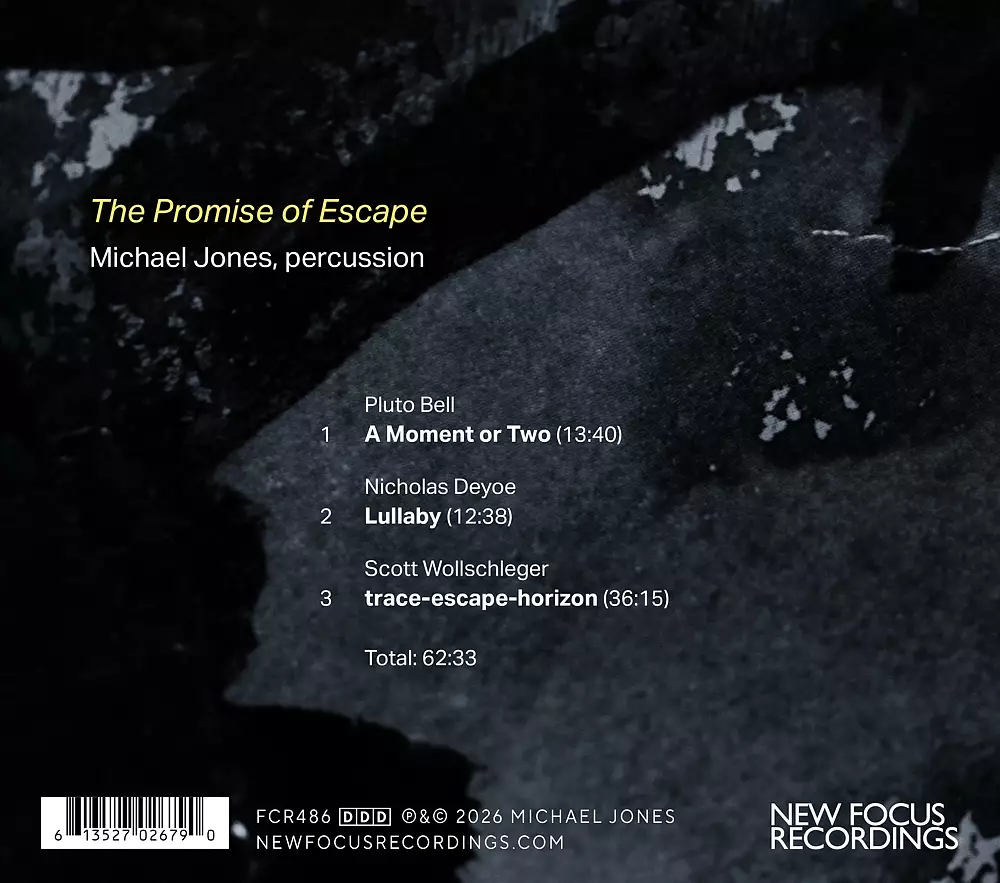


Michael Jones’ The Promise of Escape is a rich addition to the growing repertoire of expansive solo percussion works that focus on timbre, sustain, and texture. Often, and for many years, percussion music has celebrated a kind of vigorous physicality, but quietly behind the scenes, a counterbalancing trend has been growing. These three works by Pluto Bell, Nicholas Deyoe, and Scott Wollschleger represent that subtler, inward looking impulse in percussion writing, and document the cultivation of an alternative virtuosity for the instrument. A few New Focus releases by solo percussionists come to mind as contributors to this space as well: Haruka Fujii’s Ingredients, Greg Stuart’s Subtractions, and Christopher Whyte’s Cold Stability. On this collection, Michael Jones brings his own artistry and sensibility to these substantial works, two of which (Bell and Wollschleger) are the result of his own commissions.
Pluto Bell’s A Moment or Two (2021) draws the ear in to the resonance of a range of pitched percussion. A battery of instruments, including singing bowls, small tuned bells, bell plates, crotales, and individual glockenspiel bars ring in spacious phrases that highlight their unique timbral profiles. The texture allows the listener to examine the subtle distinctions between each, the purity of a finger cymbal note versus the graininess of a spring coil and the complexity of a triangle. Bell punctuates these sound constellations with terse accents on the bass drum. After the six minute mark, the piece focuses its meditation on bell sounds, creating a slow, ritualistic chorus.
Nicholas Deyoe’s Lullaby (2011) affords a significant deal of variability in its realization. The work is scored for drums, wood blocks, glockenspiel, and cymbals. Deyoe inverts the conventional roles of the glockenspiel and drums, giving the former harmonic accompanimental material to support implied lullaby melodies on the latter. Because of this orientation, each performer’s decisions about how to tune the drums, mallet choice, and balance between glockenspiel and drums have a profound impact on how the piece is heard. As the piece evolves, the roles pivot around a haunting series of cymbal scrapes and percussive attacks after the 7:45 mark, and the glockenspiel eventually emerges as the primary melodic voice. Jones’ performance is austere and restrained, holding the ritualistic mood throughout with a taut intensity.
On his work trace-escape-horizon (2023-24), Scott Wollschleger writes, “While composing the work I developed various procedures of disorientation and I tried to eliminate any sense of development.” Wollschleger’s process strived to inject ambiguity and weightlessness into the composition. Despite the hypnotic state the music can induce in the listener, this kind of texture demands acute concentration from the performer lest the spell be interrupted, conjuring a tense dichotomy between the execution of the sound and its effect. Wollschleger establishes a dialogue between two pitches in the opening several minutes of the piece, often articulated as harmonics via two different techniques. This sonic meditation explores the relationship between these two sustains from myriad possible angles and refractions. Only after sixteen and half minutes do we hear new pitch material introduced, and the subsequent subtle expansions of the register and harmonic palette read as seismic shifts in context. The multi-hued timbre of a chromatic pitch pipe sounds as a yawning growl from an emerging creature, and Wollschleger’s bent vibraphone pitches distort sonic reality, as if the music has suddenly gone into a bowl of water. The bending notes create a bridge to a section focused on oscillation, with warbling tremolos and glistening trills, leading into a halo of luminescent sound. trace-escape-horizon takes a surprising turn at the 32:25 mark, as brightly, closely spaced sustains animate the high register like reedy organ pipes, before the work closes on fifty seconds of a hollow white noise texture. Whether or not Wollschleger was aiming for development or static ambiguity, trace-escape-horizon traverses significant expressive and sonic territory. His work, along with that of Bell and Deyoe and Jones’ sensitive realizations, demonstrates that along with a new set of performance demands, this developing trend in percussion music is finding new structural skeletons within which to house innovative sounds and gestures.
– Dan Lippel
Published date
2026-04-17
Number of discs
1
Channels
stereo:24:2.0
Made in Sweden since 1999. In collaboration with Textalk.
Cart
| Artikel | Antal | Beskrivning | a pris | Totalt |
Env.session:
NULL


Env.order NULL


string(2) "en"


collector.CheckoutUrl


collector.OrderItemCount
0

collector.CartUrl
NULL


collector.Order
NULL