
Kosmos
Catalog Number: PAN37
Kosmos is the third and final album from Jon Nelson's Genkin Philharmonic, a Buffalo big band where classically trained players, improvisers and rock musicians meet – in music by living American composers, reworked early-20th-century classics and rock landmarks.
Kosmos
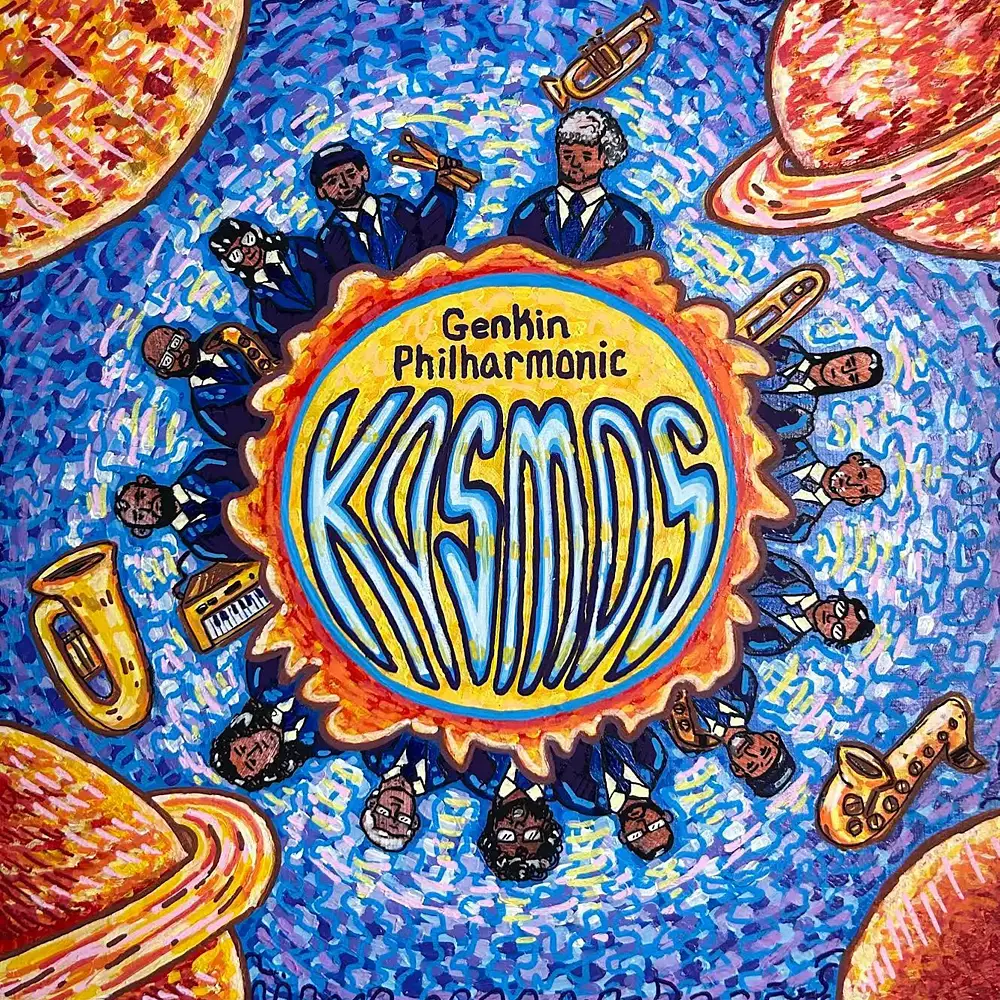
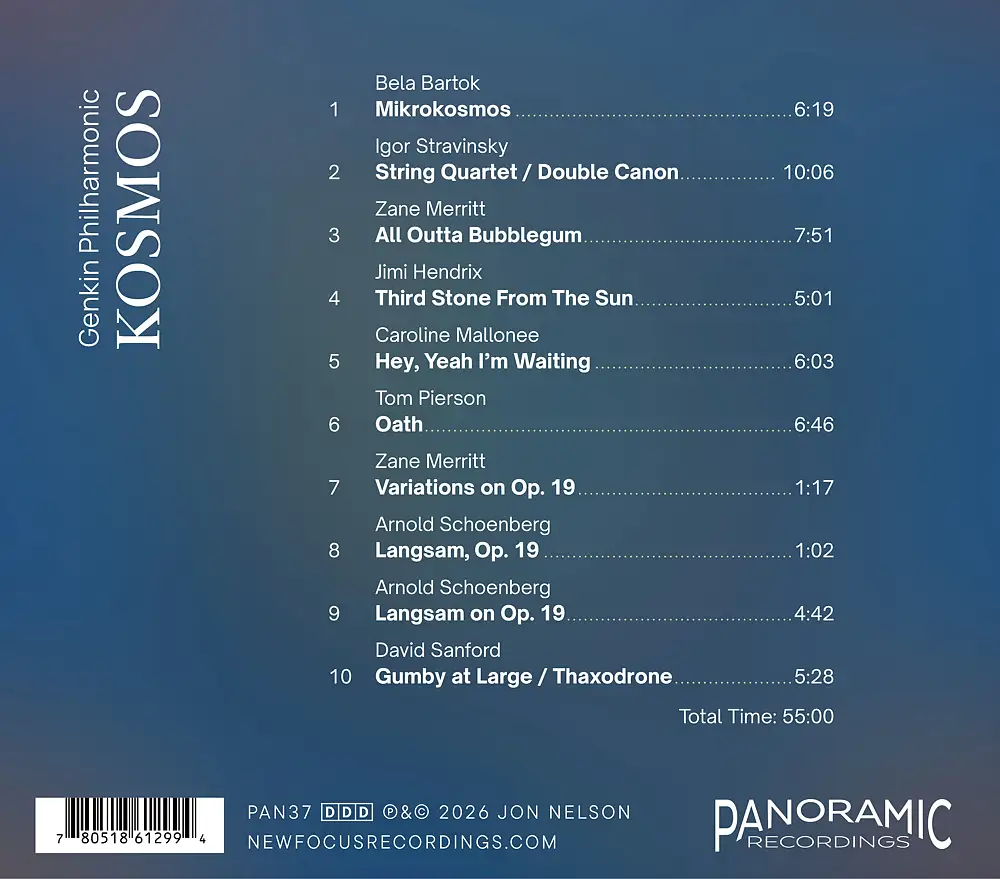


Kosmos is the third and final installment of the Genkin Philharmonic, a band I formed shortly after arriving at University at Buffalo in 1998. The original idea was to fuse a variety of musical genres for a student ensemble that exposed classical musicians to non-classical idioms and provide improvising musicians a context in which to improve their reading skills. Over time, the band became a mix of professional players and students, various assemblages of musicians who would not likely collaborate under “normal” circumstances. Genkin repertoire is three-fold; music of living American composers, tricked out versions of early 20th century music, and landmark rock pieces.
Kosmos as a title encapsulates the Genkin idea of constellations existing in their own universe, occasionally making connections with parallel entities as they travel in space. This Genkin is comprised of classically trained players, pure improvisers and musicians who fall in the middle. Many of these players would not have the chance to play together if not for Genkin. While existing in our own atmospheres, we come together for the common goal of this music.
– Jon Nelson
The spirit of Frank Zappa looms large over this genre trampling project from Jon Nelson’s Genkin Philharmonic. In these exuberant big band performances of everything from arrangements of iconic classical repertoire to newly composed compositions to classic rock anthems, musical material is the great equalizer and the fundamental building block, while style is malleable putty, twisted and shaped to fit Genkin’s liberated vision. Nelson created Genkin in 1998, first as a stylistically hybrid student ensemble meant to bring players from different backgrounds together and give them an opportunity to hone their skills in material that they had less experience playing. Over time, Genkin Philharmonic integrated professional musicians from the improvised and classical worlds together. Genkin expands upon the amorphous area that elite big bands have always inhabited, a cultivated balance between through-composed and spontaneous, and between collective ensemble playing and featured solos.
Béla Bartók’s Mikrokosmos opens the album, set as an off-kilter Dixieland romp. Tubas and snare drum propel the band forward in the introduction before a seminal Balkan seven beat groove is outlined by sweeping scalar figures that are traded through the band. Later the texture heats up with a simmering texture in four, providing a backdrop for fiery solos by trumpeter Tim Clarke and guitarist Zane Merritt.
Igor Stravinsky’s String Quartet / Double Canon begins with an explosive sax solo by Steve Baczkowski that leads into a section that has echoes of Miles Davis’ searing “Red” movement on Aura, with funky slapped bass and jagged drum set work. Stravinsky’s characteristically ambiguous rhythmic cells distort the perception of downbeat, while Merritt’s angular solo leads into an elastic, floating ostinato figure in the piano underneath haunting wind sustains. Disembodied lines in the violins emerge from the haze as Clarke's trumpet wails to the cosmos in an intergalactic blues. The track continues with a charged shuffle feel before shifting back to straight eighth notes for a driving conclusion.
All Outta Bubblegum by the group’s guitarist Zane Merritt introduces raucous irregular, additive rhythmic figures, destabilizing the pulse before it has established itself. Raw, polyrhythmic motives dart across the ensemble with glee, while a quirky, futuristic transitional figure in guitar and keyboard provides the connective tissue between sections of the structure. Later on, intricate, angular passagework is intertwined through the ensemble, with a particularly notable thorny passage for electric guitar and violin. The piece closes with a weightless antiphonal chordal passage between guitar and electric keyboard.
Jimi Hendrix’s classic Third Stone from the Sun epitomized his otherworldly vision. In Genkin’s version, we hear a voice-over conjuring Hendrix’s mellowed out baritone, as the main melodic themes are heard in the winds and brass over skating grooves. The group leaves room for the orbit to get loose, as the middle of the arrangement is a psychedelic group improvisation over percolating accompaniment.
Caroline Mallonée’s Hey, Yeah I’m Waiting takes advantage of the long tradition of adding vocalizations to the instrumentalists parts in a big band (Salt Peanuts perhaps representing one of the most famous instances). After an introduction where exclamations of “Hey” punctuate the ends of short scalar figures, Mallonée steadily develops the truncated motives into a complex web of contrapuntal activity, harmonizing the passagework with dissonant intervals before the vocals return, adding sustained sung lines to the shouted declamations. The texture turns somewhat ominous with hollowed out harmonies in voices and guitar as Mallonée brings fragments of the opening material back for a tutti stretto of multiple ideas before the piece closes with a reprise and compression of the opening material.
Tom Pierson’s Oath is vigorous and muscular, opening with towering chords and athletic drum fills. Electric keyboard and guitar introduce a syncopated melody over a backbeat before the melody is heard again in the full ensemble with the drum set articulating the off-beat syncopations. Later in the track, a long-limbed, rangy melody in the trumpets and flutes unfolds over a rollicking ostinato.
Arnold Schoenberg’s Langsam is given an Eruption à la Eddie Van Halen treatment by Merritt, screeching through tremolo lines before disintegrated into a noise texture. Pianist Eric Huebner contributes a reading of Schoenberg’s “Sehr Langsam” from his Six Little Piano Pieces, op. 19; a repeated figure evokes neutral, ruminative deliberation, interrupted by sighing chordal gestures. Genkin Philharmonic assigns the deliberative figure to the rhythm section while the brass play the expressive interjections. Schoenberg’s pas de deux between terse figures and imploring legato phrases is preserved as Genkin develops the material into a full blown band texture featuring drummer Matthew Felski and Merritt.
David Sanford’s Gumby at Large / Thaxodrone leads with two virtuosic duos in unison, first in the violins, and then in the trumpets. Dense contrapuntal writing leads into brief, funk laden solos passed around the band. Throughout the through-composed and improvised textures, Sanford preserves an edge of the seat energy and unchained character, painting a portrait of Gumby as a figure in full.
– Dan Lippel
Published date
2026-11-13
Number of discs
1
Channels
stereo:24:2.0
Made in Sweden since 1999. In collaboration with Textalk.
Cart
| Artikel | Antal | Beskrivning | a pris | Totalt |
Env.session:
NULL


Env.order NULL


string(2) "en"


collector.CheckoutUrl


collector.OrderItemCount
0

collector.CartUrl
NULL


collector.Order
NULL