
Aus Westphalia
Catalog Number: 7291
Aus Westphalia
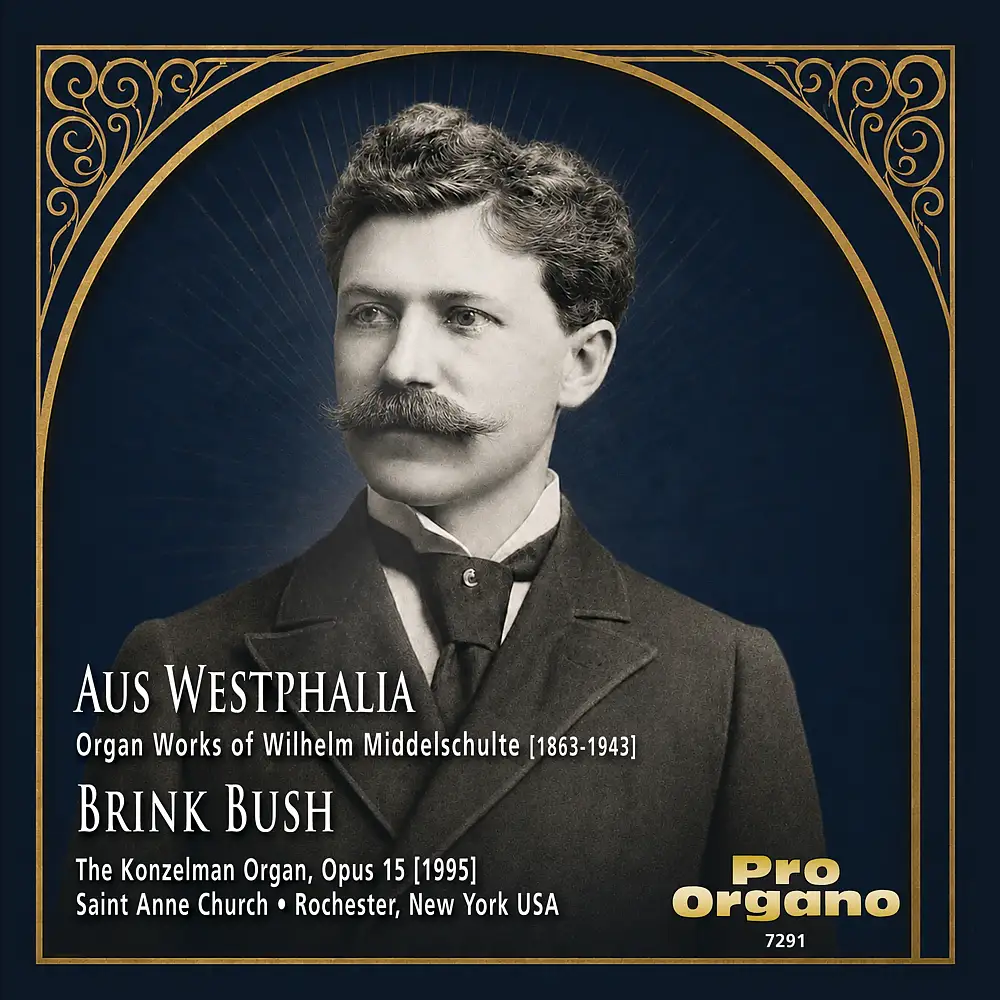
Aus Westphalia
Organ Works of Wilhelm Middelschulte
Brink Bush
The Konzelman Organ, Opus 15 [1995]
Saint Anne Church, Rochester, New York USA
Pro Organo 7291
*******
TRACK LIST:
01 Konzert für Orgel über Thema von Johann Sebastian Bach: Perpetuum Mobile [1903] • 2:16
02 Passacaglia [1896] • 14:27
Chromatische Fantasie und Fuge für Orgel [1922]
03 Fantasie • 6:33
04 Fuge • 7:01
Drei Studien über den Chorale: Vater unser im Himmelreich [1913]:
05 Pedal Solo • 1:05
06 Basso Ostinato • 1:48
07 Canon • 2:58
Kanonische Fantasie über B-A-C-H und Fuge über Themen von Johann Sebastian Bach [1906]
08 Fantasie • 9:30
09 Einleitung und Fuge • 13:02
TOTAL PROGRAM TIME: 58 minutes, 40 seconds
*******
© 2026 Zarex Corporation.
All rights reserved.
Printed & manufactured in the U.S.A.
All musical works in this album are in the public domain in the USA.
UPC # 63607 77291 2 6
*******
2026 Audio Remastering: Frederick Hohman, ProOrgano.com
Recorded on 1, 2, and 3 December 1999
Originally produced and distributed by
Saint Anne Church, Rochester, New York
*******
About the composer
Wilhelm Middelschulte was born in Heeren Werve, Westphalia, Germany on 3 April 1863 and died in Oespel, Germany on 4 May 1943. He was the third of ten children. At age 17 he entered the teacher training college in Soest and began organ studies with August Knabe. In 1886, Wilhelm entered the Royal Academy of Church Music in Berlin, where he studied with Albert Löschhorn (piano), Karl August Haupt (organ and theory), Julius Alsleben (history and conducting), and Franz Commer and Herman Schroeder (composition).
From 1888 to 1891, Middelschulte was Organist and Choirmaster of St. Lucas Church in Berlin. He played for the memorial service of the German Emperor Friedrich III, in Bornstedt, near Potsdam. As assistant to Karl August Haupt at the Royal Academy of Church Music, Middelschulte met the American, Annette Musser, who became his student. In 1891, Annette returned to the United States, settling in Memphis, Tennessee. Wilhelm went to Chicago, Illinois, where he began his American career. Annette and Wilhelm were married in Memphis on 29 June 1896 and lived in Chicago. Annette died in 1928; one year later, Wilhelm married Florence Knox Michael of Eaton, Ohio.
In Chicago, Middelschulte’s first position was Organist of the People’s Church. Shortly thereafter, he was named Organist and Choirmaster of Holy Name Cathedral. At the Colombian Exposition in Chicago in 1893, Middelschulte gave three recitals entirely from memory, the success of which resulted in his being invited to be Organist of the Theodore Thomas Orchestra, the future Chicago Symphony Orchestra.
That same year, Middelschulte performed Guilmant’s First Symphony for Organ and Orchestra at the re-opening of Holy Name Cathedral. From 1896 to 1899, he was Organist and Choirmaster of the University Congregational Church and, from 1899 to 1918, was concurrently Organist of the Chicago Symphony Orchestra, St. James Roman Catholic Church and K.A.M. Temple.
In 1900, he was appointed Organist of the Cincinnati May Festival and, in 1904, he performed at the St. Louis Exposition.
Middelschulte was Director of the Wisconsin Conservatory in Milwaukee, Professor of Organ and Theory at the Detroit Conservatory, and Professor of Organ at the American Conservatory in Chicago. He was also Visiting Professor at Rosary College and at University of Notre Dame. Notre Dame conferred on him an honorary doctorate in 1922. In addition to lecturing at the University of Chicago and Northwestern University, he was Visiting Post-Graduate Chair in Organ and Theory at the State College for Church Music in Berlin from 1925 to 1927.
Middelschulte was widely acclaimed by contemporary critics such as Ferruccio Busoni, who described Middelschulte as equal to Bach, Franck and Reger. Busoni also proclaimed Middelschulte “Master of Counterpoint.” Middelschulte studied with the theorist Bernhard Ziehn (1845-1912), who had emigrated from Erfurt to Chicago in 1868. From Ziehn’s theories Middelschulte learned the principle of symmertrical inversion, which leads to unusual harmonies that arise from strict inversion of the chromatic line. Middel-schulte’s compositions represent the most important embodiment of the theories of Bernhard Ziehn.
In 1939 Middelschulte and his wife, Florence, went to Europe for his annual concert tour and an extended vacation, living in Switzerland and then in Sorrento, Italy. In 1942, his health failing, Wilhelm returned to Germany and lived on the farm of his nephew. Because of her American citizenship and the involvement of the United States in World War II, Florence returned to the United States. Wilhelm died in 1943. Eventually Florence Knox Michael Middelschulte married Stephen Tsiapis, a professional singer, and they settled in Rapallo, Italy. Florence died in 1979.
Notes on the music
TRACK 1
Konzert für Orgel über ein Thema von Joh. Seb. Bach
This work was completed on 3 April 1903 and was published by C. F. Kahnt in 1906. Dedicated to Friedrich Stock, it received its premiere with the Chicago Symphony Orchestra at Orchestra Hall in 1906, with Middelschulte at the organ and Frederick Stock as conductor. This Concerto, based on the “Wedge” Fugue theme (Prelude and Fugue in E minor, BWV 548) of J. S. Bach, consists of five movements: Praeludium, Scherzo, Adagio, Intermezzo, Finale.
In this recording we hear the Intermezzo movement, commonly known as Perpetuum Mobile. This work was made famous by Middelschulte’s pupil, Virgin Fox. This movement had been scored originally for organ and kettledrums.
The theme is presented in four different keys, modulates directly into its symmetrical inversion (the theme, seen as upside down on the page), returns to the original theme transformed into a cadenza, and concludes with chords that spell B-A-C-H. Finally, it resolves into the key of A minor.
TRACK 2
Passacaglia für die Orgel
This work was published by C.F.W. Siegel in Leipzig in 1901 and is dedicated to Bernhard Ziehn, with whom Middelschulte had studied. The work was written in 1896 and it received its formal premiere on 17 September 1897 at the University Congregational Church in Chicago.
The work was entered in a composition competition at the Annual Convention of the National Association of Music Teachers in June 1897 in New York City. It shared a second prize with with a work by Charles Davis Carter.
This first published work of Middelschulte consists of 62 variations on a descending and ascending chromatic theme, which is derived from the coda in the first movement of Beethoven’s Ninth Symphony. The notes B-A-C-H are introduced into the second variation and in other subsequent variations as the work unrolds. The work builds to a brilliant toccata, where the chorale “Ein’ Feste Burg” is imposed on the chromatic theme. The work concludes with a Coda comprised of the repetition of B-A-C-H with the chromatic theme.
TRACKS 3 and 4
Chromatische Fantasie und Fuge für Orgel
Published by C.F. Kahnt in Leipzig in 1922, this work was written for a contest held by the National Association of Music Teachers and by the St. Cecilia Club of Grand Rapids, Mighican. The composition won first prize. It is one of only two works by Middelschulte based on an original theme. The Fantasy is a set of variations, built on a descending chromatic bass. The fugue theme is built on the same theme with a dancing counter subject.
TRACKS 5, 6, and 7
Drei Studien über den Choral Vater unser im Himmelriech
This trio of works were written for the Otto Gauss Collection Orgelkompositionen as alter un neuer Zeit, and may have originated as discarded variations from a larger work entitled “Canons and Fugue.” The first two studies were published in 1913 by the Verlagsgenossenschaaft in Zurich; the third study remains unpublished.
The first study, a Pedal Solo, emphasizes legato pedaling for the right foot accompanied by the left foot. The second study, Basso Ostinato, presents the choral theme in the soprano voice; the basso orstinato is in the pedal. The third study, Canon, is canon at the octave, making use of the chorale melody in the outer voices, three measures apart; the harmony is chromatic.
TRACKS 8 and 9
Kanonische Fantasie über B-A-C-H und Fuge über Themen von Joh. Seb. Bach
This work was published in 1906 by C. F. Kahnt in Leipzig, and is dedicated to August Knabe. The composition was first performed by Middel-schulte at the University of Notre Dame in the early 1920s. The Fantasy has 43 variations in canon based on B-A-C-H and its symmetrical inversions. The main characteristics of the variations are canon and symmetrical inversion.
The introduction to the fugue contains four themes by J. S. Bach. The first three themes are each developed as a fugue, while the fourth theme is used as a “fabric” that holds the other three fugues together. All four themes are woven together in the last measures of the fugue.
Origins of the four themes follow:
First theme: from “Musical Offering” BWV 1079
Second theme: “Confiteor”
from the B minor Mass , BWV 232
Third theme: from “The Art of the Fugue
on B-A-C-H, BWV 1080
Fourth theme: from Fugue in D minor BWV 565
*******
About the organist
BRINK BUSH, an internationally traveled concert organist, is regarded as a leading interpreter of German Romantic organ music. He specializes in the organ works of Wilhelm Middelschulte. He has appeared in performance throughout the United States, and in England, France, Austria, Israel and Germany. He made his American debut at the Kennedy Center for the Performing Arts at age 19.
His European debute was at the Berliner Dom in August 2001. His New York City debut was at Trinity Church,
Wall Street, in October 2005 at the “Virgil Fox Legacy: Twenty-fifth Anniversary Concert Weekend.” In September 2005, he appeared on the widely celebrated radio program Pipedreams (American Public Media) in an episode entitled “Bach, Bush and Middelschulte.” His most recent Compact disc, entitled Heavy Pedal, was released on the Novena label and has been heard on BBC Radio 3.
Brank has lectured at Yale University on “The Life and Works of Wilhelm Middelschulte.” He authored an article on Middelschulte which appears in the New Grove Dictionary of Music and Musicians. He served as editor of Ernest Nichols’ book“The Innermost Secrets,” which is an analysis of organ playing technique of the legendary concert organist Virgil Fox. He is also cited as a contributor to a recent Bärenreiter publication of Wilhelm Middelschulte’s Complete Organ Works.
Brink Bush’s website is found at: www.brinkbush.us
*******
About the organ
The organ heard in this recording was built by Konzelman Organs of Hoboken, New Jersey. It is the company’s Opus 15. The console has three manuals and pedal, over which is distributed 42 ranks of pipes and 6 electronic voices. In the original release of this album, Mr. James Konzelman of Konzelman organs wrote the following:
The new organ grew out of the concept for a large two-manual organ with almost every desirable stop, then adding a third keyboard for ease of playing and exploiting modern solid-state control systems to provide yet additional flexibility. The physical placement, size of the church building, the nature of the choral program and the desire to play organ literature from many periods all informed the tonal design. As with all of our organs, the desired end result is an instrument that not only does its job, but one in which, as one listener put it, “you can hear the love that went into it.”
– James Konzelman
Konzelman Organs
Hoboken, New Jersey
*******
Artist Acknowledgments
Brink Bush extends his sincere thanks to many individuals who contributed gracious support for this recording, including the following:
Fr. Frank E. Lioi, Pastor, Saint Anne Church
Mr. Achim Middelschulte, Grand Nephew of the Composer, Essen, Germany
Thelma Olava Michelson [1901-1998], who contributed the Introduction to the Passacaglia, written in Wilhelm Middelschulte’s hand.
Professor David E. Craighead for coaching in preparation for the recording session.
*******
Organ Specification
GREAT - Manual II
Quintaton 16 Choir
Principal 8 61 pipes
Rohrflöte 8 61 pipes
Flute harmonique 8 Choir
Gemshorn 8 Choir
Quintaton 8 Choir
Octave 4 61 pipes
Koppelflöte 4 61 pipes
Nasat 2-2/3 61 pipes
Octave 2 61 pipes
Koppelflöte 2 12 pipes
Tierce 1-3/5 61 pipes
Mixture IV 1-1/3 244 pipes
Trompete 8 Pedal
Trompete 8 Choir
Bombarde 8 (Ant.) 61 pipes
Chimes Walker Digital
Tremulant
SWELL - Manual III
Bourdon 16 Walker Digital
Viola 8 61 pipes
Viola Celeste 8 61 pipes
Gedackt 8 61 pipes
Flauto Dolce & Celeste
(Ant.) 110 pipes
Principal 4 61 pipes
Nachthorn 4 61 pipes
Quint 2-2/3 61 pipes
Octave 2 61 pipes
Nachthorn 2 12 pipes
Terz 1-3/5 61 pipes
Quint 1-1/3 12 pipes
Scharff IV 1 244 pipes
Basson 16 61 pipes
Trompette 8 61 pipes
Hautbois 8 12 pipes
Voix humaine 8 (Ant.) 61 pipes
Clairon 4 12 pipes
CHOIR - Manual I
Quintaton 16 61 pipes
Montre 8 (Ant.)
Flute harmonique 8 61 pipes
Gemshorn 8 61 pipes
Quintaton 8 12 pipes
Rohrflöte 8 Great
Gedackt 8 Swell
Holzgedackt 8 (Ant.)
Viola 8 Swell
Viola Celeste Swell
Koppelflöte 4 Great
Nachthorn 4 Swell
Nasat 2-2/3 Great
Koppelflöte 2 Great
Tierce 1-3/5 Great
Trompete 8 Pedal
Cromorne 8 61 pipes
Voix humaine 8 (Ant.)
Bombarde 8 (Ant.)
PEDAL
Subbass 32 Walker Digital
Resultant 32
Principal 16 Great 8 12 pipes
Subbass 16 32 pipes
Gedackt 8 (Ant. 8) 12 pipes
Quintaton Choir
Octave 8 12 pipes
Bourdon 8 12 pipes
Gemshorn 8 Choir
Choralbass 4 32 pipes
Flute harmonique 4 Choir
Mixture IV 2-2/3 128 pipes
Kontra Posaune 32 Walker Digital
Contra Basson 32 Walker Digital
Posaune 16 32 pipes
Basson 16 Swell
Trompete 8 12 pipes
Hautbois 8 Swell
Klarine 4 12 pipes
Cromorne 4 Choir
Chimes Walker Digital
Swell and Antiphonal Divisions are expressive.
*******
Published date
2026-09-26
Number of discs
1
Channels
stereo:24:2.0
Made in Sweden since 1999. In collaboration with Textalk.
Cart
| Artikel | Antal | Beskrivning | a pris | Totalt |
Env.session:
NULL


Env.order NULL


string(2) "en"


collector.CheckoutUrl


collector.OrderItemCount
0

collector.CartUrl
NULL


collector.Order
NULL