
On Impulse
Catalog Number: 7308
On Impulse
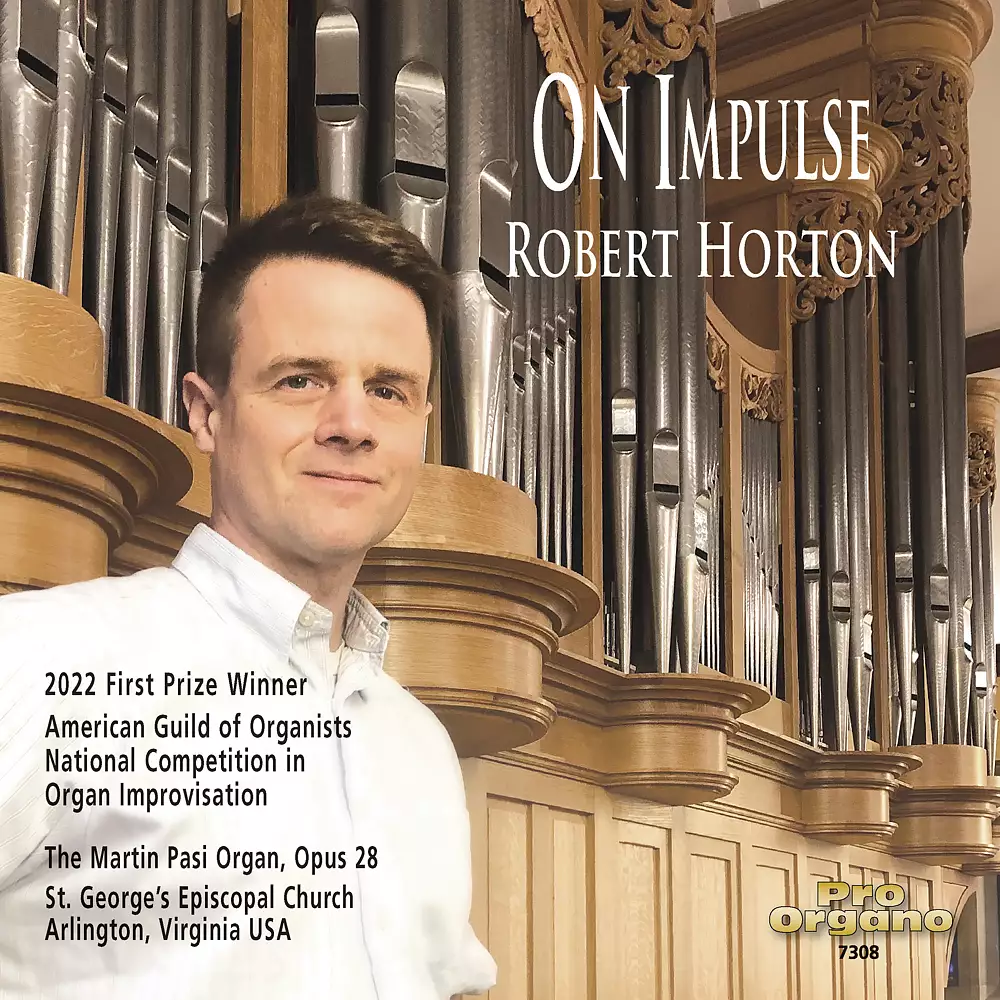


On Impulse
Robert Horton
2022 First Prize Winner
American Guild of Organists National Competition in Organ Improvisation
The Martin Pasi Organ, Opus 28
St. George’s Episcopal Church, Arlington, Virginia USA
*****
Program Notes
Johann Sebastian Bach
Fantasia in D Minor
Johann Sebastian Bach’s cantata “Nach dir, Herr, verlanget mich,” BWV 150 dates perhaps from his first official church posting in Arnstadt and is plausibly his earliest surviving effort in the genre. The present arrangement comprises the cantata’s first two movements: The opening Sinfonia for strings and bassoon is transformed from a sober harmonic exercise into a rhapsodic showpiece fit for a solo violinist. Bach’s writing in the subsequent chorus, however, is as rich a study in texture and contrast as one could ever desire and required only a literal transcription. Taken together, the two movements now read as a lovely keyboard vignette in the North German stylus phantasticus.
Improvisation
*****
Chorale Partita upon “Es flog ein kleins Waldvögelein”
“There flew a little forest bird”
This improvisation is based upon a lovesick ballad from 17th century Bavaria. The tune has since been adopted into several English hymnals, most
commonly associated with James Montgomery’s 19th century text, “Hail to the Lord’s Anointed.” Chorale partitas such as this have been a staple form for centuries. Andreas Werckmeister prescribed such forms as an essential test for any congregation seeking to hire an organist in his Orgelprobe of 1698 and they remain a worthy exercise for any improvising organist today. The melody is dressed in varied garb and — true to tradition — treated finally in a “merry fugue.”
*****
Improvisation
“When Daphne from fair Phoebus did Fly”
The ancient myth of Daphne inspired a beautiful melody that appears in Dutch, German, and English song collections throughout the 17th century. Variation settings of the tune are found in the Fitzwilliam Virginal Book as well as in Jan van Eyck’s Der Fluyten Lust-hof. And, in the 19th century, the melody ultimately found its way into John Collier’s collection “A Book of Roxburghe Ballads.” The text is credited to Thomas Deloney:
“When Daphne from fair Phoebus did fly,
the west wind most sweetly did blow in her face.
Her silken scarf scarce sheltered her eyes.
The god cried, ‘O pity!’ And held her in chase.
‘Stay, nymph,’ cried Apollo,
‘tarry and turn thee, sweet nymph stay.’”
*****
Improvisation “Come Pretty Wag and Sing”
Martin Peerson (ca.1571-1651) sang as a boy at St. Paul’s Cathedral in London and later studied at Oxford. In 1620 and during his time at Canterbury Cathedral, he published a collection of secular songs, the title of which merits citation in full:
Private Musicke. Or the First Booke of Ayres and Dialogues: Contayning Songs of 4. 5. and 6. Parts, of Seuerall Sorts, and being Verse and Chorus, is Fit for Voyces and Viols. And for Want of Viols, they may be Performed to either the Virginall or Lute, where the Proficient can Play vpon the Ground, or for a Shift to the Base Viol alone. All Made and Composed According to the Rules of Art. By M. P. Batchelar of Musicke.
...and so we shall “play upon the ground” of a bawdy little tune: “Come, pretty wag, and sing, the sun’s all-ripening wing fans upon the wanton spring.”
*****
Pamela Decker
Fantasy on the Name of Roy Andrew Johnson
The untimely death of University of Arizona Professor Roy Andrew Johnson shocked the Tucson community in 1995. The local chapter of the AGO now sponsors an annual scholarship in his memory. Prof. Johnson’s successor at the U of A, composer and organist Pamela Decker (b.1955), penned a touching tribute by transforming a portion of the name “Roy Andrew Johnson” into the melody for a Fantasy and Fugue. Grounding her work in the basic cipher used by French composers such as Maurice Duruflé, Professor Decker recounts: '
“In my work with this system, I allow ‘B’ to be either B-flat or B-natural; I also allow myself to use B-flat or B-natural for letters that line up with ‘H.’ I take liberties in this one way in orderto have the best chance to design a melodic line that will be good.”
*****
Improvisation (in alternatim)
Gloria in excelsis Deo from Missa lux et origo
The grand tradition of alternatim singing was practiced throughout Catholic Europe for centuries until it was banned by Pius X in 1903. Per the name, an extended liturgical chant is divided into short versets which are then rendered in alternation by varied groups of voices or instruments. For the present recording, we have divided up the “Glory to God in the Highest” chant from the Missa lux et origo, with members of St. George’s parish choir singing odd numbered versets and the organ playing in place of the even numbered versets. These miniatures follow the standard idioms of the 18th century French organ, most specifically those used by François Couperin in his Messe pour les Paroisses (1690). In this recording, the Gloria occupies nine choral-organ pairs, and are placed on nine audio tracks. Detailed texts and descriptions of the improvised organ forms follow:
I. Choir: Gloria in excelsis Deo
II. Organ: Plein jeu en taille:
Et in terra pax hominibus bonae voluntátis
III. Choir: Laudamus te
IV. Organ: Fugue sur les jeux d’anches:
Benedicimus te
V. Choir: Adoramus te
VI. Organ: Duo sur les tierces: Glorificamus te
VII. Choir: Grátius ágimus tibi propter
magnam glóriam tuam
VIII. Organ: Dialogue de récits:
Dómine Deus, Rex caeléstis,
Deus Pater omnipotens
IX. Choir: Dómine Fili unigénite, Jesu Christe
X. Organ: Basse de trompette: Dómine Deus,
Agnus Dei, Filius Patris.
XI. Choir: Qui tollis peccáta mundi,
miserére nobis
XII. Organ: Tierce en taille: Qui tollis peccáta
mundi, súscipe deprecatiónem nostram
XIII. Choir: Qui sedes ad déxteram Patris,
miserére nobis
XIV. Organ: Trio a deux dessus:
Quoniam tu solus sanctus
XV. Choir: Tu solus Dominus
XVI. Organ: Dessus en vitesses: Tu solus
Altissimus, Jesu Christe
XVII. Choir: Cum Sancto Spíritu:
in glória Dei Patris
XVIII. Organ: Dialogue sur les grands jeux:
Amen.
*****
Felix Mendelssohn
Allegro Brillant, Op. 92
Felix Mendelssohn penned the present work as a piano duet in 1841 for a benefit performance with Clara Schumann. While orchestral music and solo piano repertoire seem so often challenging to arrange and render as organ music, piano duets are refreshingly easy. The music falls so easily into place, one could be forgiven for imagining that piano duets of the 19th century actually represent a tradition of organ music that had gone underground in an age when the organ was no longer at the center of musical fashion.
*****
ABOUT THE ARTIST
Robert Horton, DMA serves as Director of Music at Holy Trinity Lutheran Church in Lancaster, Pennsylvania. Prior to his appointment at Trinity, he served as Interim Chapel Organist at Duke University and as Director of Music at Saint Mark's Episcopal Church in Evanston, Illinois. From 2005 until 2008, Dr. Horton served as Director of Keyboard Studies at Dordt College in Sioux Center, Iowa, where he taught sacred music, history, solfege and directed the college jazz band.
Dr. Horton hails from Lincoln, Rhode Island, and holds degrees from Cornell, Northwestern, and the University of Kansas. As a Fulbright scholar, he studied at the Conservatoire National de Région in Toulouse, France, and visited the finest historic instruments in France. Along the way, he has benefited from the counsel of such renowned pedagogues as James Higdon, David Craighead, Karel Paukert and Michel Bouvard. A relative latecomer to the arts,
Dr. Horton has worked quickly to establish himself as an organist, garnering numerous accolades, including highest honors at the 2007 Mikael Tariverdiev Competition, Kaliningrad, Russia, as well as 1st prize at the 2022 American Guild of Organists’ National Competition in Organ Improvisation.
*****
Location audio engineering, videography, photography, audio & video post-production: Frederick Hohman, Pro Organo, South Bend, Indiana. ProOrgano.com
Recorded in St. George’s Episcopal Church, Arlington, Virginia USA, on May 16 & 17, 2023.
*****
The American Guild of Organists’ (AGO) National Competition in Organ Improvisation (NCOI) advances the art of improvisation by recognizing and rewarding superior performers in the field. Improvisation is the pinnacle of achievement for a musician who can combine the elements of performance and composition simultaneously in the creation of a new work of art. Since 1990, the AGO NCOI has motivated and inspired hundreds of the most talented organists in America. Today, it is the pre-eminent competition in North America dedicated to preserving and advancing improvisation at the organ. The competition is open to all regardless of age or country of citizenship. Details and official rules of the competition are published in The American Organist magazine and may also be found at: www.agohq.org.
*****
Published date
2023-09-04
Number of discs
1
Channels
stereo:24:2.0
Made in Sweden since 1999. In collaboration with Textalk.
Cart
| Artikel | Antal | Beskrivning | a pris | Totalt |
Env.session:
NULL


Env.order NULL


string(2) "en"


collector.CheckoutUrl


collector.OrderItemCount
0

collector.CartUrl
NULL


collector.Order
NULL