
William Albright, Keyboard Music
Catalog Number: 7294
William Albright, Keyboard Music
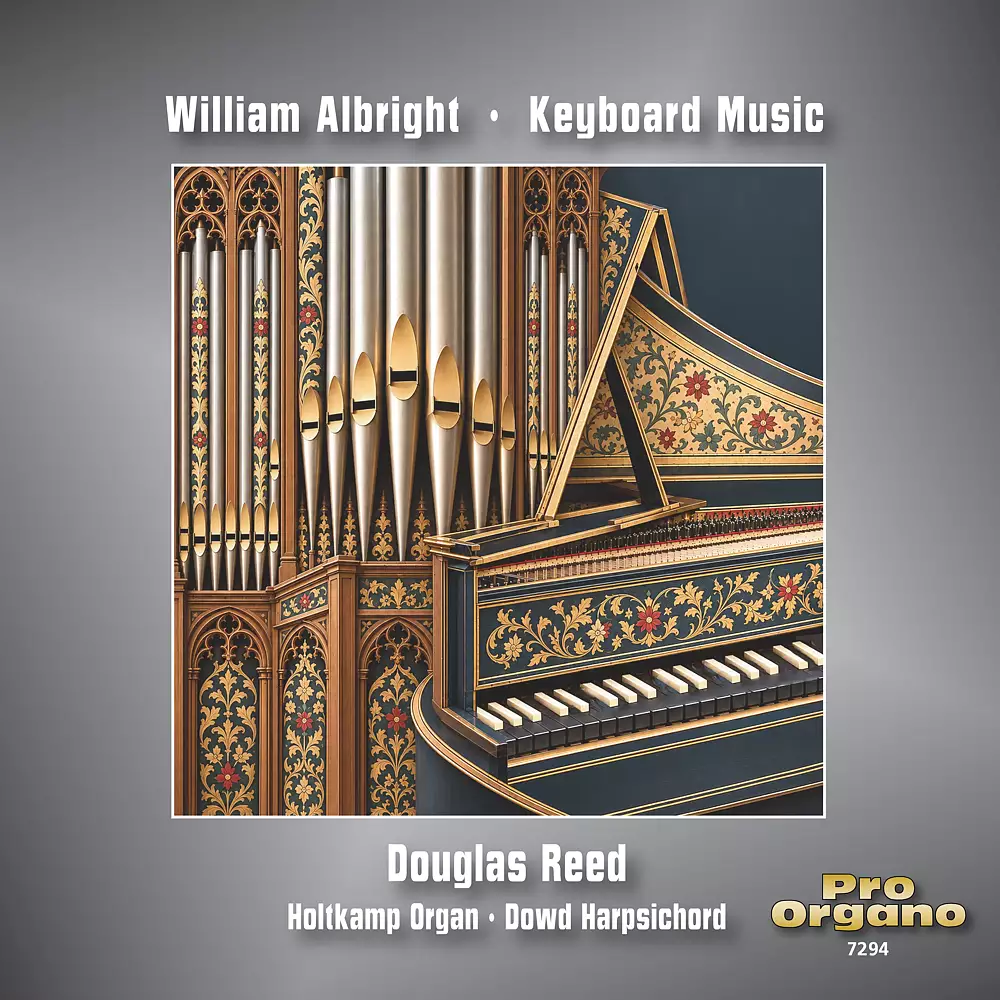
William Albright • Keyboard Music
Douglas Reed
Holtkamp Organ
Dowd Harpsichord
Pro Organo 7294
© Copyright 2026 Zarex Corporation. All rights reserved.
UPC: 63607 77294 2 3
Originally released in 1991 as Arkay AR6112.
Produced and recorded by Richard Krueger.
Digital audio remastering: Frederick Hohman, ProOrgano.com
*******
TRACK LISTING
01 Pneuma for organ [1966] • publ. Elkan-Vogel / Theodore Presser • 8:27
02 Sweet Sixteenths: A Concert Rag for organ [1974/76] • publ. Edward B. Marks • 4:21
03 That Sinking Feeling: Morceau de concourse for organ * [1982] • publ. Henmar Press / C. F. Peters • 5:10
04 In memoriam for organ * [1983] • publ. Universal Edition • 5:31
Four Fancies for harpsichord [1979] • publ. Henmar Press / C. F. Peters
05 Excentrique • 2:49
06 Mirror Bagatelle • 3:14
07 Musette • 1:45
08 Danza ostinata • 4:19
Symphony for organ [1986] * publ. Henmar Press / C. F. Peters
09 Lento, Maestoso, Lento: Molto ritmico; Lento • 11:08
10 Cantilena • 4:44
11 Tarantella macabre • 4:53
12 Ritual • 8:21
John Tafoya and William Albright, percussion
* World Premiere Recording
total playing time: 64' 43"
*******
The Music
Notes by William Albright
Pneuma, composed at the age of twenty-one and only my second work for organ, is one of a number of organ works commissioned by Marilyn Mason, Professor of Organ at the University of Michigan, who was a pioneer in the performance of new music. To a large extent the work explores the relations and points of tangency between a totally chromatic language and a strongly diatonic/ tonal one. For example, in fast passages that seem superficially atonal, the individual elements are quite often familiar tonal devices: major-minor triads, scales, and arpeggios. The notion of what is consonant and what is dissonant is also frequently inverted. The intention of this and other mixing, an obsession of mine at this time, was simply to find a strong dramatic expression in the attempt to resolve apparent oppositions.
Sweet Sixteenths is related to the series of piano “rags” written between 1967 and 1970 as an expression of joy in the discovery of how beautiful this American syncopated style is. The first version of Sweet Sixteenths was composed in 1974 as part of a chamber work Seven Deadly Sins for flute, clarinet, string quartet and piano;
it was expanded the next year as a piano solo on the occasion of a friend’s sixtieth birthday.
In addition to the organ arrangement (made in 1976) there is a version for piano, clarinet, cello and trombone (!) written for the Warsaw New Music Workshop.
That Sinking Feeling was commissioned by the organizers of the first Organ Performance Competition connected to the 22nd Annual Conference on Organ Music at the University of Michigan in 1982. As a piece meant to be learned by the finalists in a short time, it presents few technical difficulties — it is in fact sight-readable. Two elements are prominent here, as they are in many of my works: chromatic descents of chords and bird-like roulades, the former a reflection of the competitor’s infelicity, the latter an attempt to lift his or her spirits.
In Memoriam, a work composed late in the year 1983, was in its content and title a curious premonition of the untimely death in April, 1984, of my dear friend, the composer George Cacioppo. Not only is the mood of the piece somber (most of my music is not), but the material upon which it is based — the third act of Tristan und Isolde — was a ghostly part of Cacioppo’s effects; by coincidence the score of Wagner’s opera lay open on the deceased’s piano. The piece was commissioned at the instigation of Martin Haselböck for a collection of short organ works to be published by Universal Edition, Das Neue Orgelalbum II.
Four Fancies for harpsichord, commissioned by Douglas Reed with a grant from the Mesker Trust Fund of Evansville, Indiana, was written while I was in residence at the American Academy in Rome, 1979. The title of the suite evokes the fancies (fantasies) of 17th-century English keyboard music; and it provides four distinct approaches to idiomatic writing for the instrument. The first movement, Excentrique, is not so much like the character pieces by Romantic composers such as Moskowski and Grieg, as it is like a French overture, complete with extravagant ornaments and obsessive dotted rhythms. The piece is to be played “pompously, on the border of sanity.” The second movement, a Mirror Bagatelle (pun intended), exploits the harpsichord’s two manuals and its ability to provide the same pitches with different colors and timing — in a word, heterophony. Musette is the French word for bagpipes; it is also a typical movement of a Baroque suite. The last movement, Danza ostinata, owes its existence to several predecessors: Near-Eastern music, Boogie-woogie, the Spanish composer Soler, and Terry Riley. The harpsichord is a superb rhythm instrument because of its strongly accented timbre. For this reason, the harpsichord sounds best when it is made to dance. Overall, the key relationships among the four movements — C, G, F, C — form a neatly classical design.
*******
The Music
Notes by Douglas Reed
Symphony for organ (1986) was commissioned by the University of Evansville and the Friends of UE Music with the support of the Indiana Arts Commission and the National Endowment for the Arts. The work grows out of the genre of large multi-movement compositions for solo organ developed primarily by late 19th and early 20th century French composers Charles-Marie Widor and Louis Vierne.
Each movement explores a primary organ timbre: principals (first movement), flutes (second movement), reeds and mixtures (third movement), and foundation stops including strings and celestes (fourth movement). The key scheme of the four movements — D-C-D / C#-B—outlines a pattern of descending half-steps, an idea that generates much of the musical material.
The first movement is the most complex. Following an introduction (Calm, strange; Maestoso, eroico), a large A-B-A form unfolds in which the B section (molto ritmico) features a fast-paced boogie-woogie played on the Great principal chorus. As in a rondo, contrasting sections on Positiv reeds and Swell flutes alternate with the boogie theme.
Sharply contrasting with the B section, the slow-moving A sections (celestial, ecstatic) present a slowly-descending, blues-inspired exploration of principal tone from 2’ to 16’ (32’) pitch. The accompanying three-chord progression is but one of numerous ostinatos in the Symphony.
Cantilena (Andante patetico, con rubato) is a trio for flute stops with a pizzicato bass. The thin trio texture works its way to the highest pitch (C) of the manual keyboards while chordal material descends to the lowest pitch gjiges in the bass. The Pedal line presents a series of four pitches (E-flat, D, D-flat, C) in every possible
order. The rhythmic figure of three-against-two pervades the movement.
Tarantella macabre (misterioso ma brillante) is a quick dance in 6/8 mater. Inspired by a late piano composition by Franz Liszt (Czardas macabre, 1881-82), the primary musical material is the lean sound of the open-fifth interval. Cast in A-B-A form, the piece features a bravura pedal solo that recalls the spirit of Jig for the Feet (“Totentanz”) from the composer’s earlier Organbook III. The crash of a bass drum and pitched gong (C) terminates Tarantella macabre while beginning a series of percussion events that recur throughout the fourth movement Ritual at intervals determined by the sequentially additive Fibonacci series. Albright writes, “The last movement is perhaps the one exception to what we expect from the French organ symphonies. Instead of ending with an Allegro, a Finale, or a Toccata, we have here an unusual Adagio, a slow movement in which I’ve also introduced a foreign element, a ritualistic element: a bass drum and a pitched gong. This is to give a processional or ceremonial feeling to this last movement.”
*******
Acknowledgements
Holtkamp organ (1987) Christian Theological Seminary, Indianapolis, Indiana
Dowd Harpsichord after Taskin (1974),
The University of Evansville
Recording assistant: Laura Colfer
Artistic advisor: William Albright
Registration assistant: Vernon Stover
Special thanks to Christian Theological Seminary,
Stuart Mill, Business Manager;
Gayle Sarber, Director of Music;
Walter Holtkamp, the Holtkamp Organ Company;
John Goulding, organ technician;
Marc C. Bellassai, harpsichord technician;
Michael Udow and the University of Michigan School of Music for the loan of percussion instruments.
Recorded and produced with financial assistance from The Friends of UE Music,
the University of Evansville Department of Music; Alumni Research and Scholarly Activities Fund; Arts, Research, and Teaching Fund.
*******
DOUGLAS REED’s doctoral dissertation The Organ Works of William Albright: 1965-1975 has led to performing Albright’s music across America, Europe, and the Far East. In addition to commissioning two of the compositions featured on this recording — Four Fancies for harpsichord and Symphony for organ with percussion — Reed’s recording premieres include Four Fancies for harpsichord on the Eastman School of Music’s American Music Series (Albany Records) and De Spiritum for organ solo and two assistants on the historic E.M. Skinner / Aeolian-Skinner organ at the University of Michigan, a BlockM Records digital release. Reed’s edition of Albright’s Whistler (1834-1903): Three Nocturnes for organ solo and assistants was published by E.B. Marks. Other Reed publications appear in The Cambridge Companion to the Organ; Music, a Connected Art: A Festschrift for Jürgen Thym; and various journals including Music and Musical Perform-ance, Choir and Organ, The Diapason, and The American Organist. After retiring as a professor emeritus of music from the University of Evansville, Reed held visiting professorships at Indiana University Jacobs School of Music and at the University of Notre Dame. He currently resides
in New York City.
*******
WILLIAM ALBRIGHT (1944-1998) was one of America’s most influential and distinguished composers. Although probably best known for his keyboard works, he produced music for almost every medium, some of which involve electronic, visual and theatrical elements. Born in Gary, Indiana, Albright became internationally known for his concerts of new music for organ and piano. He commissioned and premiered many new works for organ. His recital programs also reflected his interest in classic and modern rag-time. Albright’s principal composition teachers were Ross Lee Finney, Olivier Messiaen, George Rochberg, and Aaron Copland. He earned three degrees from the University of Michigan where he studied organ with Marilyn Mason. After joining the composition faculty in 1970, he served as
professor of composition at Michigan until his untimely death in 1998. As Associate Director of the University’s Electronic Music Studio, he was also active in the Contemporary Directions Ensemble, both as performer and administrator.
*******
The elegant acoustics of Christian Theological Seminary Chapel are the result of designs by architect Edward Larrabee Barnes and
acoustician David L. Klepper.
*******
Christian Theological Seminary • Sweeney Chapel • Indianapolis, Indiana
Holtkamp Organ, Job 1919 (1987)
44 ranks • 2370 pipes
Specification
Great
Quintadena 16
Principal 8
Rohrgedact 8
Octave 4
Openflute 4
Doublette 2
Cornet II
Mixture IV 1-1/3
Trumpet 8
Swell
Gamba 8
Voix Celeste 8
Bourdon 8
Geigen Principal 4
Harmonic Flute 4
Nazard 2-2/3
Octavin 2
Fourniture III 1
Dulzian 16
Oboe 8
Tremolo
Positiv
Copula 8
Praestant 4
Rohrflöte 4
Blockflöte 2
Larigot 1-1/3
Scharff III 1/2
Cromorne 8
Pedal
Principal 16
Subbass 16
Octave 8
Flute 8
Choralbass 4
Raschbass III 2
Posaune 16
Trumpet 8
Couplers
Great to Pedal
Swell to Pedal
Positiv to Pedal
Swell to Great
Positiv to Great
*******
Published date
2026-11-23
Number of discs
1
Channels
stereo:24:2.0
Made in Sweden since 1999. In collaboration with Textalk.
Cart
| Artikel | Antal | Beskrivning | a pris | Totalt |
Env.session:
NULL


Env.order NULL


string(2) "en"


collector.CheckoutUrl


collector.OrderItemCount
0

collector.CartUrl
NULL


collector.Order
NULL