
Omnia Beneficia
Catalog Number: 0078
Sample rate
96000 Hz
Omnia Beneficia
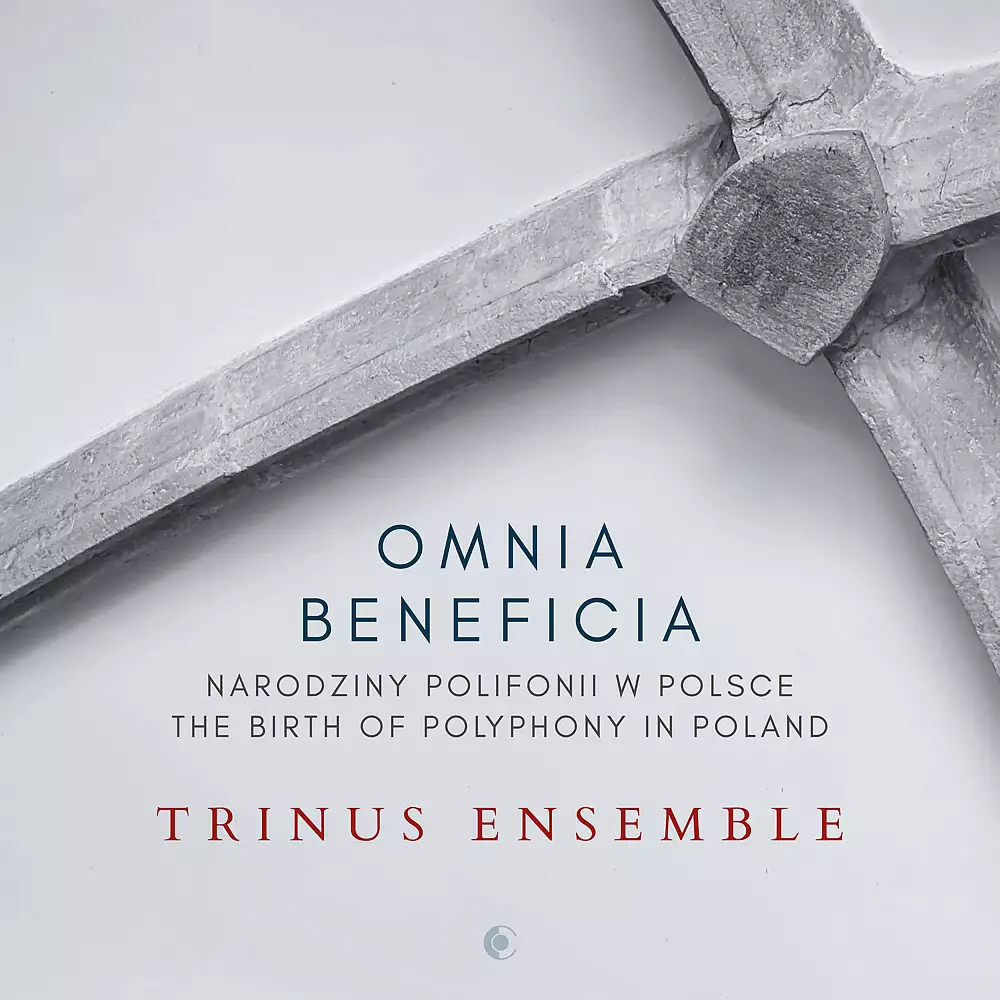
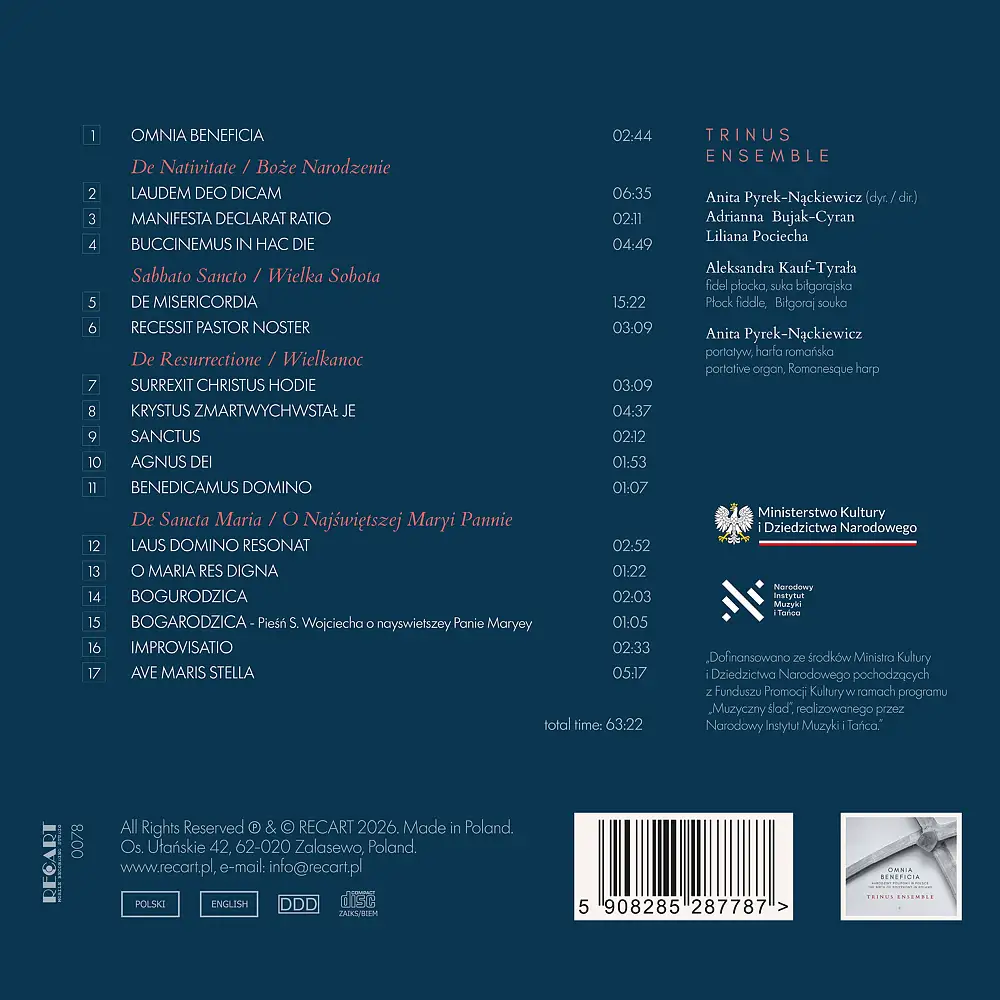


The Trinus Ensemble was founded in 2019. It consists of three singers associated with the Krakow artistic community: Adrianna Bujak Cyran, Liliana Pociecha, Anita Pyrek-Nąckiewicz (artistic direction, portative, Romanesque harp).
The Trinus Ensemble specializes in performing music of the Middle Ages and the Renaissance, with a particular emphasis on Polish music. The ensemble combines artistic activity with scientific and research work, basing its performances on source materials.
We present to you the debut album from the Trinus Ensemble: Omnia Beneficia.
The program is based on the earliest liturgical music preserved in manuscripts from Polish monasteries and dioceses. It showcases works characteristic of various stages in the evolution of medieval liturgical music: ranging from the universal Gregorian repertoire and post-Gregorian monophony (featuring both standard and Polish texts) to various forms of organum and polyphony echoing the style of the Parisian Notre Dame school.
The instrumental performances are original interpretations by the Trinus Ensemble, grounded in source research by Anita Pyrek-Nąckiewicz and informed by historical performance practice. The ensemble’s goal is not merely to faithfully reproduce what is found in the manuscripts; conveying the music’s living spirit and speaking to the contemporary listener are equally important.
The repertoire is organized thematically. The album opens with Omnia Beneficia—a four-voice conductus recognized as the oldest known Polish polyphonic work. Subsequent sections feature music for Christmas, the Paschal Triduum, and Easter, while the collection is rounded out by pieces dedicated to the Virgin Mary. Brief details regarding the works and their source manuscripts follow below.
OMNIA BENEFICIA PL-SS Muz 7 (c. 1300)
The earliest example of native polyphony. A unique four-voice conductus consisting of two stanzas, stylistically reminiscent of the Parisian Notre Dame school.
LAUDEM DEO DICAM WrU R 505 (1426)
A reading with tropes for the First Mass of Christmas; monophonic sections alternate with two-voice passages (featuring parallel organum at the fifth). The second voice was written in the manuscript using red ink.
MANIFESTA DECLARAT RATIO (WrU R 505, 1426)
A two-voice conclusion to the reading Laudem Deo dicam, composed in the style of free organum. The voices are notated successively using neumatic notation, with vertical strokes separating successive segments to allow for proper alignment of the voices.
BUCCINEMUS IN HAC DIE, Bartłomiej of Jasło; BJ 2192 and BJ 2210, (13th century)
A monophonic piece—the oldest known Latin carol by a Polish composer. The work was discovered in two manuscripts dating from the late 14th century: BJ 2192 (text only) and BJ 2210 (including the melody). It was composed by Bartłomiej of Jasło, a distinguished professor and reformer at the Kraków Academy. The carol’s text contains an acrostic: the initial letters of successive stanzas spell out the author’s signature: BARTHOLOMEUS DE IASSEL.
The composition is recorded in neumatic notation. Three of the twenty stanzas found in the manuscript were selected for this recording. The melody has been rhythmized based on the rhymed text, drawing upon the practice—common at the time—of applying rhythm to plainchant melodies (reflecting the influence of dance music and, indirectly, the spirituality of St. Francis of Assisi).
RECESSIT PASTOR NOSTER (PL-Kk 47)
A responsory performed during the Tenebrae of Holy Saturday (Second Nocturn, fourth responsory). Both the melody and text belong to the universal Gregorian chant repertoire. The notation comes from a 15th-century manuscript used at Wawel Cathedral, though both the text and melody predate it by several centuries.
DE MISERICORDIA (PL-Kk 241, PL-PAU 1706)
This piece, a form of liturgical quasi-drama, was performed at Wawel Cathedral in the 15th century during the Tenebrae of Holy Saturday (Third Lesson of the First Nocturn) in place of the Lamentations of Jeremiah. It serves as a fascinating example of the incorporation of liturgical drama elements into the liturgy. The work depicts a trial of the human soul at the Last Judgment, in which the personification of Justice acts as the accuser, while Mercy takes on the role of defender. Dramatic melodic motifs that mirror the text suggest a Late Medieval origin for the melody.
The performance is based on notations from two manuscripts: PL-Kk 241 and PL-PAU 1706. The second source contains polyphonic elements.
SURREXIT CHRISTUS HODIE (PL-Kklar Ms 205, 14th c.)
A three-voice Resurrection trope for the Benedicamus Domino, added in the 14th century to a 13th-century Franciscan antiphonary—a volume Blessed Salomea bequeathed to the Poor Clares in her will. The composition is recorded using mixed notation, combining neumatic and mensural systems. Characteristic of the polyphonic technique of the era are the use of perfect fifths and octaves, as well as contrary motion between the voices.
The rhythmic interpretation of the piece follows the principles of the mensural notation of the time.
KRYSTUS ZMARTWYCHWSTAŁ JE Płock Gradual, MS 32 (1365); The Life of the Lord Jesus Christ (Baltazar Opeć, 1522).
Krystus z martwych wstał je is the oldest known record of a Polish poetic text. It originates from the Płock Gradual of 1365, though its archaic language suggests the song was composed even earlier. It served as a trope for the Easter sequence Victimae paschali laudes and was performed during the Resurrection service. The manuscript of the Płock Gradual was lost during World War II, but the text survived in later copies. The song was sung as a battle hymn; however, this custom changed because the German Teutonic Knights sang the song’s prototype—Christ ist erstanden—in the same capacity.
Only the first stanza of the song was recorded in the Płock Gradual. Subsequent stanzas were added to the recording based on the version found in the printed Żywot Pana Jezu Krysta (The Life of the Lord Jesus Christ) from 1522 (Haller, [city?]).
SANCTUS AGNUS DEI PL-Kklar Ms 205 (13th century).
A monophonic ordinarium missae based on motifs from the song Krystus zmartwychwstał je. It appears on parchment leaves inserted into the manuscript—most likely in the 15th century—bearing the annotation „secular.”
BENEDICAMUS DOMINO PL-SS Muz 4.
A two-voice setting of the Benedicamus, added in the 14th century to an older Franciscan antiphonary intended for use by the Poor Clares of Stary Sącz. It is an intricate composition characterized by contrary motion between the voices and the use of fifths and octaves. The piece has been interpreted according to the principles of modal rhythm.
LAUS DOMINO RESONAT, O MARIA RES DIGNA KiS RL 8 (16th century)
Short three-voice compositions associated with the Christmas season, written in the style of the late-medieval cantio. The voices are notated successively, using a system that combines neumatic and mensural notation. Harmonies based on thirds and sixths predominate.
BOGURODZICA BJ 1619a II (1407)
A monophonic chant—one of the oldest songs with Polish lyrics—dating most likely to the turn of the 12th and 13th centuries. The oldest source upon which this recording of Bogurodzica is based dates to the early 15th century; after 1408, it was recorded in a collection of Latin sermons copied by Maciej of Grochów, a vicar in Kcynia near Gniezno.
The song consists of two stanzas accompanied by neumatic notation—most likely tropes to the Kyrie eleison.
BOGURODZICA – St. Adalbert’s Song to the Most Holy Lady Mary; Dominican Archives in Kraków, MS L12 (1630)
A four-voice song found in a hymnal written in 1630 for the Dominican convent in Piotrków Trybunalski by Father Błażej Derey. Father Błażej was most likely merely the copyist of the arrangement, which had been transcribed from a much older hymnal. The piece is based on a simplified, mensural version of the song. It is notated in score format, without fixed rhythmic patterns, employing strict nota contra notam (note-against-note) technique. According to musicologist H. Feicht, „The piece is the work of a dilettante with not the slightest notion of composition.” While other scholars dispute this claim, it is undeniable that the work contains a number of errors indicative of poor compositional skills or serious mistakes by the scribe.
The first verse of the composition has been recorded, arranged for three female voices and a portative organ.
AVE MARIS STELLA Biblia Carmine Petri de Riga, BJ 320 (14th century)
A unique example of the polyphonic style known as cantus planus multiplex. The hymn is inscribed on a parchment leaf bound into the Biblia Carmine Petri de Riga (BJ 320) codex. The hymn’s melody and text are noted in the right-hand column, while a second voice was added by hand—most likely at a later date—in the upper section of the leaf.
Published date
2026-11-20
Number of discs
1
Sample rate
96000 Hz
Channels
stereo:24:2.0
Made in Sweden since 1999. In collaboration with Textalk.
Cart
| Artikel | Antal | Beskrivning | a pris | Totalt |
Env.session:
NULL


Env.order NULL


string(2) "en"


collector.CheckoutUrl


collector.OrderItemCount
0

collector.CartUrl
NULL


collector.Order
NULL