
Excursions
Catalog Number: Steinway30264
A pianist's debut: seven favourite works sequenced as a single roaming journey through endless imagination. “Excursions” opens with Grainger's Ramble on the Last Love Duet from Der Rosenkavalier and wanders freely from there.
Excursions
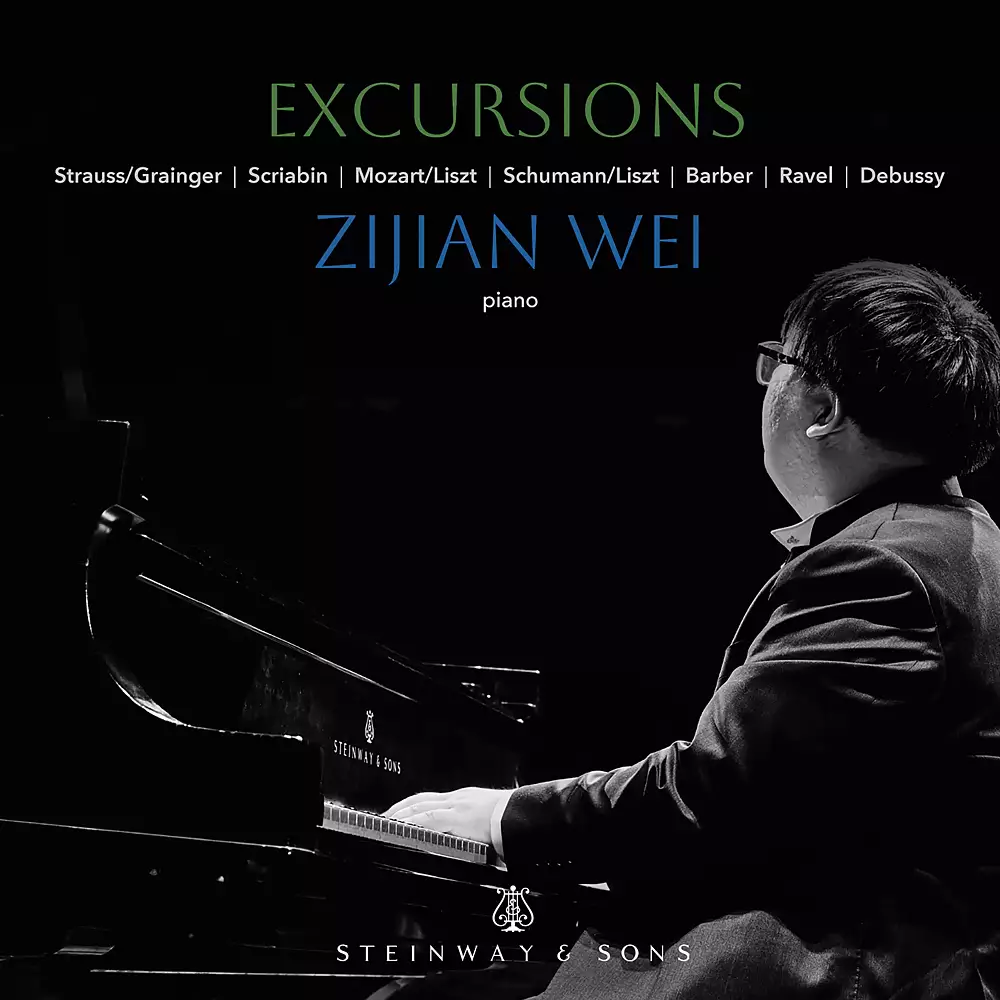
For my debut album I have carefully selected seven of my favorite works, and the sequence of these seven pieces has been deliberately arranged to deliver a more engaging listening experience when followed in order. The theme of this album is “excursions,” which connotes roaming and free traversal—just as the theme suggests, this album allows listeners to wander through endless imagination.
The program begins with Percy Grainger’s Der Rosenkavalier: Ramble on the Last Love Duet, adapted from the closing trio of Richard Strauss' opera Der Rosenkavalier. Though the story it tells is but a dream, the love therein burns with passionate intensity, reminding us to live in the moment without regret.
Alexander Scriabin's Piano Sonata No. 5, Op. 53 is a work characterized by strong symphonic quality. It contains extensive explorations of harmony, expresses uncertainties towards the unknown, and embodies an unstoppable surge of ecstasy. This piece is a highly challenging work favored by pianists for its extreme difficulty; certain passages are even considered unconventional for piano performance. This work perfectly conveys my inclination towards adventurous artistic exploration.
Next, we will listen to an art song arranged by Franz Liszt, which was originally composed by Robert Schumann, titled Des Sennen Abschied (The Shepherd's Farewell.) In common perception, farewells are always imbued with sorrow and reluctance. However, this work brings mostly hope and positivity to the audience.
Samuel Barber's Excursions is a suite composed of four short movements. In my perspective, the first movement resembles 1990s retro video game music, with a consistently repeating bass figuration throughout. Its melody, starting from a simple motif, undergoes continuous development, decays at the climax, and finally fades away. The second movement incorporates blues elements, vividly depicting a drunkard. The middle section is particularly captivating, where the drunkard regains lucidity unconsciously, only to immediately slip back into a muddled, befuddled state. The third movement is light, lively and full of humor; it opens with hemiola between seven sixteenth notes in the right hand against eight in the left, whose off-kilter rhythmic tension conveys a yearning for freedom. The fourth movement is an impassioned allegro, featuring extensive syncopation and complex double stops, integrating both technical virtuosity and emotional expression. A particularly intriguing feature of Excursions is that every performer brings distinct interpretive perspectives to the work. This is the piece I performed at the Cleveland Competition, and I would like to share it with audiences around the world. Samuel Barber is an outstanding composer, and this performance demonstrates that a young Chinese musician can interpret American music with excellence.
Liszt's Fantasie adapted from Mozart's The Marriage of Figaro is a composition of extraordinary technical virtuosity. For me, the most critical prerequisite for delivering a satisfying performance of a highly demanding work is to maintain an appearance of ease, such that the audience remains unaware of the tremendous technical difficulty involved. Although the work showcases virtuosity, it is never technical display for its own sake. This composition incorporates two celebrated vocal excerpts: “Voi che sapete” and “Non più andrai,” both of which become instantly recognizable the moment their melodies begin. Additionally, here is an interesting observation: if one listens to the closing passage of Barber's Piano Sonata fourth movement directly before this Liszt work, the two will sound like a single continuous composition, with the final notes of the Barber flowing seamlessly as a prelude to the Liszt, creating a most intriguing effect.
La Valse by Maurice Ravel is an exceptionally impactful musical work. Ravel himself created three versions of the piece during composition: for symphony orchestra, for two pianos, and for solo piano. Among these, the solo piano version is not only the shortest in duration but also the most technically demanding. In my performance, to expand the dynamic range of the work, I adopt a thicker key-touch approach in fortissimo passages to produce a more cantabile tone, and do not pursue an excessively fast tempo, which allows for richer layered expression between the different voices of the work.
Finally, I have selected Debussy’s Clair de Lune as the closing track of the album, which forms an inverted mirror image of the opening track, creating a circular narrative that bookends the album. Superior pianistic tone is akin to a sung line, and the finest performance resembles natural speech, with emotion emerging spontaneously. As an artist, I hold great ambition: all the works selected for this album pose considerable artistic challenges. I approach this project with complete sincerity: I do not expect every listener to love every track on this album, and I will be perfectly content if even one piece resonates with the audience.
– Zijian Wei
Published date
2026-09-04
Number of discs
1
Channels
stereo:24:2.0
Made in Sweden since 1999. In collaboration with Textalk.
Cart
| Artikel | Antal | Beskrivning | a pris | Totalt |
Env.session:
NULL


Env.order NULL


string(2) "en"


collector.CheckoutUrl


collector.OrderItemCount
0

collector.CartUrl
NULL


collector.Order
NULL