
Heaven & Hell - Mozart, Beethoven
Catalog Number: Steinway_30252
Heaven & Hell - Mozart, Beethoven

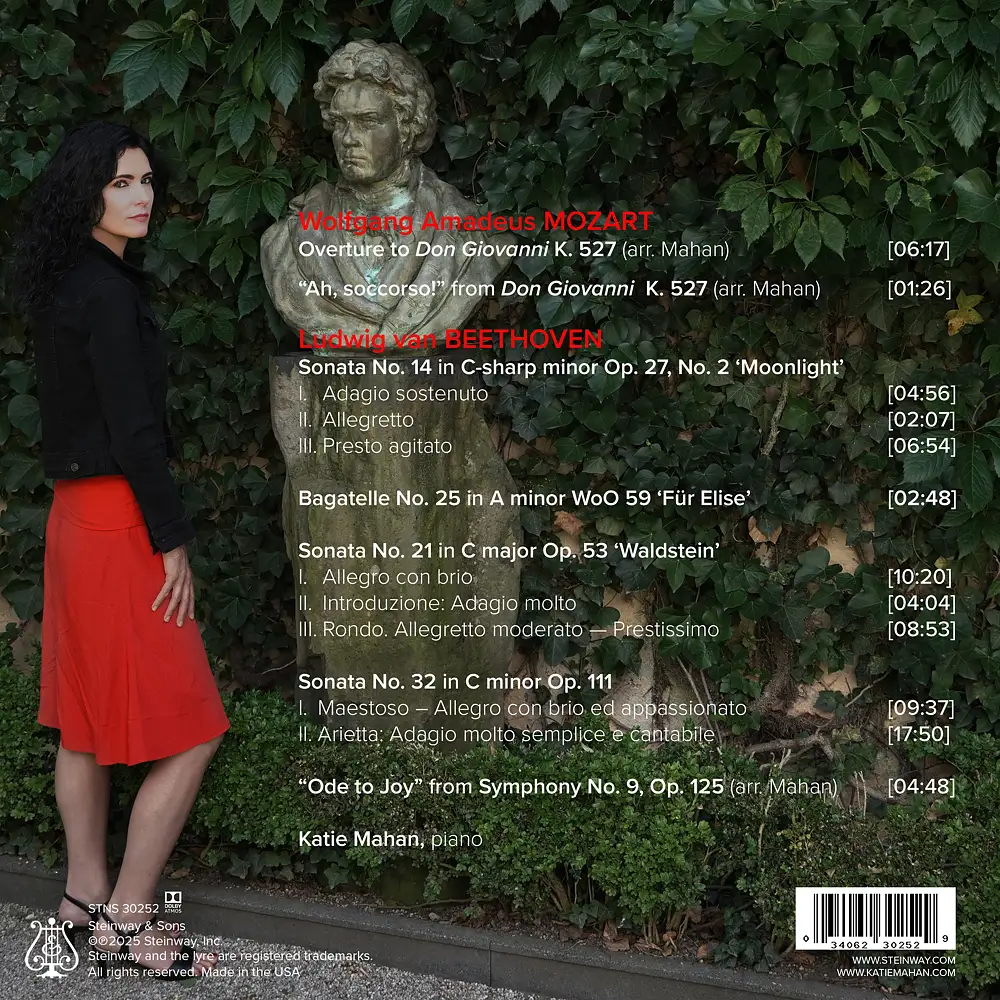


Ludwig van Beethoven was born in 1770 at a time when a young child prodigy named
Wolfgang Amadeus Mozart was enchanting royalty and the nobility across Europe. Word of the
young Mozart’s fame and accomplishments caught the attention of Beethoven’s father, Johann
van Beethoven, himself an accomplished musician, who became obsessed with the idea of his
son becoming the next child prodigy to tour Europe and bring fame and fortune to the family.
Unlike Mozart’s father who, by all accounts, raised, guided and disciplined his children with
love and encouragement, Beethoven’s father was an alcoholic who frequently abused his son
and accused him of being a disgrace to the family when he failed to live up to his lofty
standards. Nevertheless, in Johann van Beethoven’s quest to have his son become the next
Mozart, young Ludwig grew up with a thorough knowledge of Mozart’s works and a profound
admiration for the older composer. One can almost imagine Mozart as the embodiment of the
young Beethoven’s musical conscience. His music was somehow a reflection of divine
inspiration that had the power to capture the full depth of human emotion and the very essence
of heaven and hell.
In his great dramatic masterpiece Don Giovanni K. 527, universally considered to be one of the
greatest operas ever written, Mozart demonstrates this power more convincingly than in
perhaps any other work in his oeuvre. Premiered in Prague in 1787, the opera, which is based
on an old Spanish legend dating back to the early 1600s called “El burlador de Sevilla“ (“The
trickster of Seville”), depicts the downfall of a serial womanizer and the inability of a human
being to change for the better. The final scene of the opera features a confrontation between
Don Giovanni and the ghost of the Commendatore - whom Don Giovanni has murdered in the
opera’s first act - culminating in Don Giovanni’s dramatic descent into hell. Through the
combination of dramatic and musical techniques, Mozart pushes the boundaries of opera
beyond anything that had come before. He takes us a step away from classicism and a step
toward romanticism by putting man, not God, at the center in a struggle between good and
evil, heaven and hell. Beethoven himself struggled with his own morality and the increasing
extremes of his existence - the exaltation of his art and the torment of his physical condition,
the heaven and hell of his life and art. He was clearly not unaffected by the power of Mozart’s
writing in Don Giovanni, as is evidenced by the several sketches in Beethoven’s hand in which
he copied out individual sections from the opera in order to learn from them. On the contrary, it
is worth considering that it was Mozart and the spectre of Don Giovanni that opened the young
Beethoven’s eyes to the infinite possibilities of expression that lay ahead for him.
I have chosen to begin this program with my own solo arrangement of the Overture to Don
Giovanni because my motivating idea for this album is the golden thread of conscience
between Mozart and Beethoven. The extremes of heaven and hell as so brilliantly depicted by
Mozart in Don Giovanni must have dwelt in Beethoven throughout his life and formed a
subconscious basis from which he ascended to unimaginable attainment. It is this evolution
that I seek to depict with this album.
Before discussing the short selection entitled “Ah, soccorso!” that follows the Overture to Don
Giovanni on this album, I would like to segue into Beethoven’s Sonata quasi una fantasia No.
14 in C-sharp minor Op, 27, No. 2 - a work which is certainly among the most popular pieces
of music ever written. For many listeners, this sonata, known around the world simply as the
‘Moonlight’ Sonata, brings to mind the dark and romantic image of a solitary boat floating on
the shimmering moonlit waters of an alluring lake where wooded mountains rise high in the
distance. This depiction of the sonata is attributed to Heinrich Friedrich Ludwig Rellstab,
considered by some to be the first great music critic, from a serialized story he wrote for
publication in the Berliner allgemeine musikalische Zeitung in the summer of 1824. Although
Beethoven and Rellstab met in Vienna in 1825, as is evidenced by written exchanges inBeethoven’s conversation books, it is not clear whether or not Beethoven was aware of Rellstab’s depiction of his Sonata Op. 27, No. 2. What is clear, however, is that Beethoven himself did not give the work the title ‘Moonlight,’ and that the work most likely had a very different genesis.
As I alluded to earlier, there are a number of sketches in existence in which Beethoven copied
out sections of Don Giovanni by hand. Of particular relevance is the fact that in the early 20th
century, the Swiss pianist Edwin Fischer discovered a sketch in the archives of the Musikverein
in Vienna in which Beethoven had copied out the music to “Ah, soccorso!” (“Ah, help!” from
Act I, Scene I), the aria in which Don Giovanni kills the Commendatore. Because the sketch in
Beethoven’s handwriting has not only been dated to shortly before composition of the Sonata
quasi una fantasia Op. 27, No. 2, but also transposed from its original C minor to C# minor,
there is a strong probability that the dark, fiery story of Don Giovanni was more likely the
inspiration behind the famous sonata than a romantic image of a lonely boat floating on a
moonlit lake.
The story of a boat on a lake never convinced me - in fact it left me totally perplexed as to how
the second and third movements worked into the scenario - but the story of the dream and
demise of Don Giovanni does. To my mind, it not only encapsulates the entire spirit of the
work, but also provides an answer to perplexing questions. To begin at the beginning of the
story: in the first movement, Beethoven pays tribute to the memory of Mozart and the ghost of
Don Giovanni, as if in a dark, enigmatic dream. As dreams are often distorted and unclear, this
interpretation further offers a reasonable explanation as to Beethoven’s mysterious - and
unfortunately often disregarded - indication that the entire movement be played senza sordino,
literally with dampers raised in a single, unbroken pedal from beginning to end. The resulting
effect is a sustained blurring of harmonies and resonance, as in the subconscious world of
dreams. Moving on to the second movement, we can imagine waking from the dream, and
attempting, with a now clear and fully conscious mind, to make sense of the story we just
dreamed, before finally allowing ourselves to be drawn back once again, now in the third
movement, into the fantasy of Don Giovanni to complete the tale of his dramatic fall into the
raging flames of hell.
In order to illustrate this scenario in the clearest possible way, I have included my own solo
arrangement of “Ah, soccorso!” from Mozart’s Don Giovanni - transcribed to C-sharp minor as Beethoven did in his hand-copied sketch of Mozart’s original - as a prelude to the ‘Moonlight’
Sonata. I invite each my listeners to sit back, listen and contemplate the connection between
the music of the two composers and decide for yourself whether it captures your imagination
the way it captured mine.
Moving onwards in the program, we veer away from the drama of Don Giovanni to the ever
popular Bagatelle in A minor WoO (“Work without opus number”) 59, known as Für Elise. The
original manuscript for this miniature has been lost without a trace, and although likely
composed in 1810, it was first published in 1867 by the Beethoven scholar Ludwig Nohl who
claimed to have seen the original autograph score. There is unfortunately only a single
remaining sketch leaf for Für Elise which also contains sketches for other works and is part of a
larger collection known as the “Sauer” sketchbook. Furthermore, there is no title or dedication
whatsoever on the leaf; it is simply marked “No 12.” We therefore have to take Nohl’s word for
it that the manuscript included the dedication "Für Elise am 27. April zur Erinnerung von L. v.
Bthvn.” In any case, the question remains, who exactly was Elise? As there does not appear to
have been any women with that name among Beethoven’s circle of friends or acquaintances,
many scholars believe that Nohl may have misread the dedication, and that the work was
intended to read “Für Therese”, not “Für Elise.”A plausible explanation for this theory is that, as
Beethoven only attended grammar school through the age of 10 - at which point his fatherforced him to withdraw to focus solely on his musical education - his handwriting was notoriously messy and challenging to read throughout his life. Furthermore, the person who best fits as the dedicatee is a woman name Therese Malfatti, who was a friend and student of Beethoven, and to whom it is believed that Beethoven may have proposed in 1810.
We now come in the program to one of the crowning achievements of Beethoven’s middle
period and a milestone in the piano repertoire, the Sonata No. 21 in C Major ‘Waldstein’ Op.
53, dedicated to Beethoven’s early friend and mentor Ferdinand Ernst Joseph Gabriel, Count
von Waldstein und Wartenberg. The ‘Waldstein’ Sonata, also known as “L’Aurore” (The Dawn),
is a revolutionary and technically brilliant work. Beethoven takes the sound world of the earlier
‘Moonlight’ Sonata a step farther, using trills, shifts of register and further development of
special pedal effects in the pursuit of a new way of achieving effects of tone color, washes of
sound, orchestral effects and expressive possibilities on the piano. Where in the ‘Moonlight’
Sonata, Beethoven takes us on a journey into the depths of darkness and the raging fires of
hell, in the ‘Waldstein’ Sonata, he takes us on a journey into the ethereal lightness of dawn and
the vision of heaven.
But who was Count Waldstein, to whom Beethoven dedicated such a work, and do we
perhaps encounter another connection to Mozart? Born in Vienna to a family of the highest
Viennese aristocracy, Count Waldstein was appointed knight of the Teutonic Order and in 1788
moved to Bonn where he would become Geheimrat (high advising official) to the Elector of
Cologne, Archduke Maximilian Francis of Austria. In addition to his official duties, Count
Waldstein was an accomplished amateur musician and passionate supporter of young artistic
talent. By the time Waldstein came to Bonn, Beethoven’s talents had already attracted the
attention of Maximilian Francis who not only appointed Beethoven court organist but also was
persuaded to allow the sixteen year old to travel to Vienna to meet Mozart, whom the Archduke
knew personally. Unfortunately, shortly after arriving in Vienna in 1787, Beethoven received
word that his mother had become very ill. This necessitated a swift return to Bonn, making a
meeting between Beethoven and Mozart therefore unlikely, although recent scholarship
suggests that Beethoven may have heard Mozart perform.
Nevertheless, Beethoven’s desire to return to Vienna remained strong, and it was due to Count
Waldstein, who had subsequently become a devoted admirer and supporter of the young
composer, that Beethoven would have a second chance, in 1792, to travel to Vienna. With
Mozart’s premature death in December of 1791, Beethoven would never be able to realize his
dream of studying with Mozart but, following an invitation from Joseph Haydn whom
Beethoven had met and played for in Bonn when the older composer was en route to London
for a series of performances, Beethoven was finally able, with the help of Count Waldstein, to
return to Vienna. On the day of his departure, Waldstein wrote the following words to
Beethoven: "Dear Beethoven, you are now traveling to Vienna to fulfill your so long-denied
wishes. Mozart's genius still mourns and weeps over the death of his pupil. He found refuge in
the inexhaustible Haydn, but no occupation. Through him, he wishes to be united with
someone once more. Through unceasing diligence, you will receive: Mozart's spirit from
Haydn's hands.- Bonn, October 29, 1792 - Your true friend, Waldstein”
Beethoven would never again return to Bonn, and there is little record of continued contact
between Beethoven and Count Waldstein. In the years following Beethoven’s departure from
Bonn, Count Waldstein fell out of favor with the Elector of Cologne and developed an
obsession with the idea of defeating Napoleon’s revolutionary army. He spent all of his money
raising an army to fight Napoleon, and following years spent in London and Germany, finally
returned to Vienna where he married the wealthy countess Isabella Rzewuska. After
squandering all of her money as well, he spent his final days at a poor house outside of Vienna.
On the day of his death, Waldstein received a letter informing him that his elder brother haddied and the entire family fortune now belonged to him. In spite of the unfortunate path that
Count Waldstein’s life took, Beethoven honored him with one of his greatest masterpieces for
piano.
We now move forward in time to 1821 and the Sonata No. 32 in C minor Op. 111, a work which
was dedicated to Beethoven’s great friend, patron and student Archduke Rudolph of Austria.
The youngest brother of Emperor Francis I of Austria, Archduke Rudolph was a clergyman and
a highly accomplished musician whom Beethoven met in the winter of 1803-04, likely at one of
the musical soirees of Prince Franz Joseph Maximilian Lobkowitz, a passionate music lover
who maintained a private orchestra and in whose palace in Vienna Beethoven premiered a
number of works including the “Eroica” Symphony and fourth piano concerto, among others.
Although Beethoven received a number of scholarships and stipends to support him financially
during his early years in Vienna, he constantly sought a permanent position which would
provide him with a regular income. In 1809, Beethoven was finally offered a suitable position,
as Kapellmeister in the the German city of Kassel. Word traveled around Vienna that Beethoven
was prepared to accept the position, and so in order to dissuade Beethoven from accepting,
Archduke Rudolph convinced the Princes Lobkowitz and Kinsky to join him in an agreement
that would pay Beethoven a salary of 4000 florins per year for the rest of his life - provided that
Beethoven agree to remain in Vienna. This gave Beethoven complete artistic freedom and
financial stability to follow his own creative vision, and in essence made him the first freelance
musician with a regular salary though patronage. Even when a series of unfortunate events
including a major devaluation of the Austrian currency in 1811, the sudden death of Prince
Kinsky in 1812 and the bankruptcy of Prince Lobkowitz in 1813 threatened the subsistence of
the agreement, Archduke Rudolph continuously increased his payments to Beethoven to
ensure that Beethoven would not suffer financially. In return, Beethoven dedicated more works
to Archduke Rudolph than to any other patron.
Perhaps due, in part, to the artistic freedom which financial stability enabled and, in part, to the
near complete loss of hearing which isolated him from the world but allowed him to traverse
the deep inner soundscapes of his imagination, Beethoven’s late works transcend the
compositional and technical constraints of his time and explore previously uncharted avenues
of sonic creation. The Sonata No. 32 in C minor Op. 111, Beethoven’s final sonata for the
piano, is a miracle of human expression. It is a mirror of Beethoven’s own life, and the
culmination of his artistic vision and evolution. It is a work of visceral emotion and an intensely
personal reflection of his morality. It is as revolutionary as Don Giovanni; it transcends mere
musical composition and offers us a glimpse into his very soul. As Georges Braque said, “with
age, art and life become one,” and in this work, we can feel the now inseparable bond between
artistic creation and its creator's life experiences. It is, on the one hand, profoundly human and,
on the other, intensely transcendent. It is a seamless integration of wildly different styles and
techniques which pay homage to the past through the use of Bachian counterpoint while
simultaneously pushing the limits of modernity through the use of syncopation and elements of
jazz that would develop an ocean away and a century later. In it, we feel the polar extremes
that defined Beethoven’s existence - the profound despair and the enduring hope, the
throbbing pain and the irrepressible joy, the raging fight against fate and the serene acceptance
of that fate, the unwavering dedication to the exploration of the human condition and the
visionary grasp of universal truths, the light and the dark. The heaven and hell.
Beethoven often expressed frustration with the piano’s capabilities in relation to his musical
vision, and upon completing his final piano sonata, exclaimed that the piano is “after all an
unsatisfactory instrument.” It is therefore not difficult to imagine that Beethoven composed this
and other late works for a piano that only existed in his imagination. Although undeniably one
of the greatest tragedies in the history of music, Beethoven’s progressive loss of hearing - forhim a life of hell - provided a window of opportunity for him to compose for an instrument of
the future that was capable of far greater power, dynamic range and capacity for expression.
The world of pianistic sound that Beethoven envisioned and the technical innovation that he
gradually developed over the course of the nearly three decades spanning composition of his
piano sonatas achieved its ultimate glory in the final piano sonata, his magnum opus in the
genre.
The final work on this album, the “Ode to Joy” from Beethoven’s revolutionary Symphony No. 9
in D minor, Op. 125, is one of the most revered and beloved compositions in the history of
western music, and an affirmation of the power of the human spirit to overcome adversity even
in the face of darkness. With text based on an ode written in 1785 (and later revised) by the
German poet Friedrich Schiller, it is a celebration of the unity of humanity and a testament to
Beethoven’s own journey from chaos to serenity, from hell to heaven: “Joy! A spark of fire from
heaven / daughter from Elysium / drunk with fire we dare to enter / Holy One, inside your
shrine.”
Throughout his life, Beethoven embraced the ideals of the Enlightenment, as Mozart before him
had done, and Schiller’s message of a world united in joy, freedom, hope and universal
brotherhood resonated with Beethoven’s personal beliefs. In this work, the golden thread of
conscience between Mozart and Beethoven - two men whose artistic creations can hardly be
seen as anything other than the reflection of divine inspiration that has the power to capture
the full depth of human emotion and the very essence of heaven and hell - has reached its
resting place. Like millions of people around the world, the profound depth and emotional
power of Beethoven’s simple melody in his “Ode to Joy” never ceases to move me, and it is
my hope that the version for solo piano presented here to conclude this album may do justice
to the indomitable spirit of Ludwig van Beethoven.
— Katie Mahan
Published date
2025-10-03
Number of discs
1
Channels
stereo:24:2.0
Made in Sweden since 1999. In collaboration with Textalk.
Cart
| Artikel | Antal | Beskrivning | a pris | Totalt |
Env.session:
NULL


Env.order NULL


string(2) "en"


collector.CheckoutUrl


collector.OrderItemCount
0

collector.CartUrl
NULL


collector.Order
NULL