
Legend of the Phoenix Queen and Other Tales
Catalog Number: Steinway30175
Legend of the Phoenix Queen and Other Tales
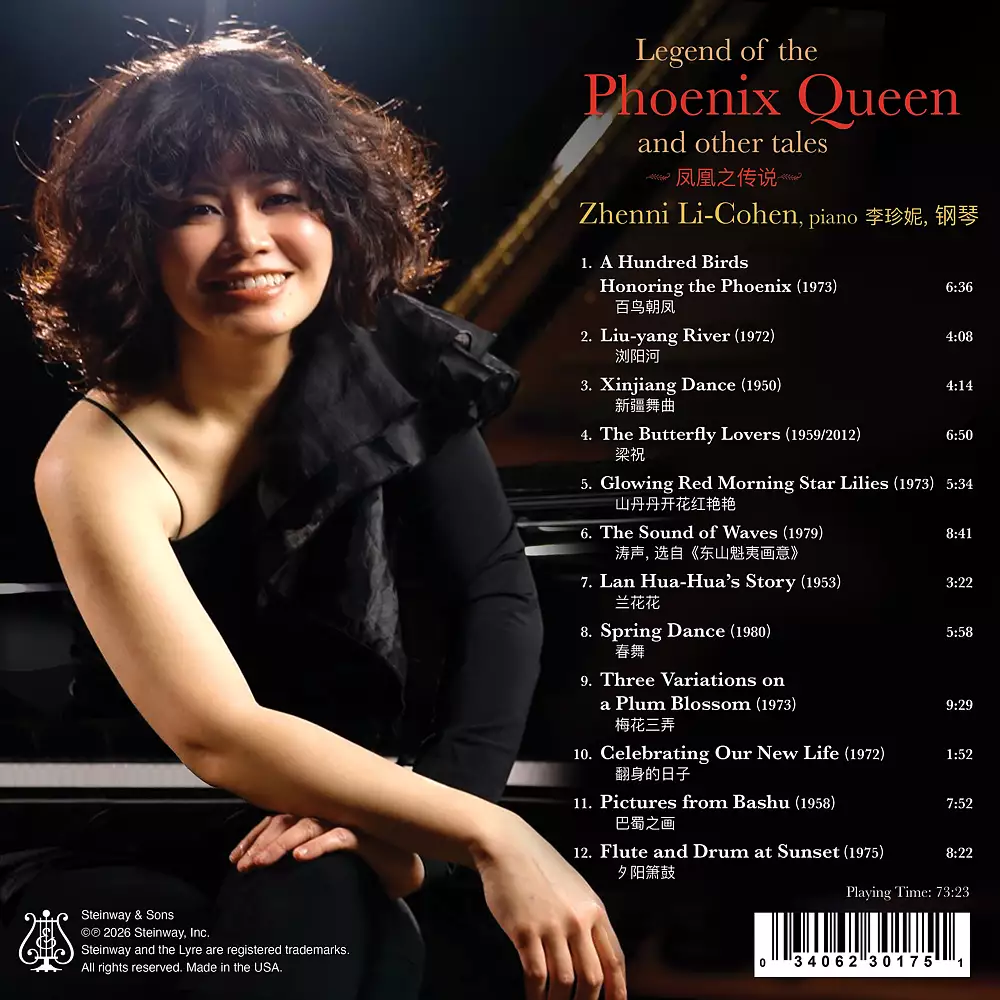


I grew up with my father singing traditional songs and playing his erhu around the house, deeply influencing my nascent ears. He had learned to play a variety of traditional Chinese instruments, such as the Chinese flute, xun, and hulusi, during his school years while leading the school’s orchestra. Although I eventually chose to play the piano, the sound of those beautiful yet unique instruments was a big part of my childhood, making this a very meaningful and intimate project for me. During the pandemic, I finally delved into this repertoire that was familiar yet distant to me; I combed through all the music I could find as my parents laboriously scanned everything from their library, page by page, and emailed it to me--often woefully out of order. It was incredibly difficult to choose from so many great works of art, but we finally settled on twelve pieces that represented a rich tapestry of genres and categories, including music containing traditional folk melodies, ancient tales and stories, folk tunes or rituals, and music inspired by historic artworks or reactions to traditional instrumental works.
- Zhenni Li-Cohen
A Hundred Birds Honoring the Phoenix
One popular Chinese legend tells the story of the phoenix long before she became the mythical Queen of Birds. Once an ordinary bird with plain plumage, she was overlooked by the rest of the flock. Through unwavering diligence, however, she gathered and stored an abundance of fruit. When a devastating drought brought famine to the forest, she selflessly shared her provisions with the other animals. In gratitude, every bird contributed its most beautiful feather to fashion a magnificent robe for their benefactor, crowning her the Phoenix—the Queen of Birds. Thereafter, birds from around the world gathered to pay homage, creating a spectacular scene of music, dance and celebration.
This solo piano work is Jian-Zhong Wang's (1933–2016) transcription of the celebrated traditional suona (Chinese double-reed horn) piece of the same name. One of the landmark works in the twentieth-century Chinese piano repertoire, it unites the expressive language of Chinese folk music with techniques from the Western classical piano tradition. Through inventive pianistic writing, richly layered textures, and a wide spectrum of tonal color, Wang translates the suona's distinctive sonority and its vivid imitation of birdsong into a richly evocative musical landscape. The result is a vibrant musical portrayal of nature and a fitting musical tribute to the majesty of the phoenix.
Liu-yang River
The beautiful Liu-yang River of mainland China is celebrated for its crystal-clear waters and picturesque banks. The people of this region, renowned for their diligence and joyful spirit, frequently sing in praise of their homeland—a tradition that gave birth to the famous folk song "Liu-yang River."
Deeply inspired by this lyrical melody, composer Jian-Zhong Wang (1933–2016) transcribed it into a brilliant work for solo piano. The piece is structured in a traditional two-part form, heightened by a dazzling, cadenza-like passage that vividly imitates the movement of flowing water. While preserving the expressive character of the original folk song, Wang seamlessly integrates the virtuosic techniques of the Western classical piano tradition, creating a work that is both deeply rooted in Chinese folk music and idiomatic to the piano.
Xinjiang Dance
Located in northwest China, Xinjiang is a land of striking natural beauty, home to vibrant communities with rich traditions of song and dance. The inspiration for this work came when a young composer named Zhi-Hong Guo (1932-2024) visited the region to collect folk material and witnessed a grand Kazakh wedding celebration. Set against vast green grasslands under a brilliant blue sky, the celebration was filled with blazing bonfires, traditional Kazakh milk tea, and joyful dancing. Deeply inspired by the festive atmosphere, Guo composed Xinjiang Dance.
Cast in a three-part form, Xinjiang Dance opens with an energetic dance section driven by continuous syncopated rhythms and percussive gestures that evoke local instruments. The contrasting middle section unfolds like an expressive folk song, with a freely flowing, improvisatory quality that allows the melody to breathe with expressive spontaneity. As the opening material returns, the music builds to an exhilarating conclusion, capturing the vitality, warmth, and celebratory spirit of Xinjiang’s musical heritage.
The Butterfly Lovers
The tragic romance of Liang Shanbo and Zhu Yingtai is one of China's most beloved folktales. In 1959, composers He Zhanhao (b. 1933) and Chen Gang (b. 1935) transformed this timeless legend into the Butterfly Lovers Violin Concerto, a landmark work in the Chinese concert repertoire. Cast as a single continuous movement, the concerto unfolds through a series of interconnected episodes that trace the lovers' journey from their first meeting and blossoming romance, through separation and tragedy, to their final spiritual transformation.
This solo piano transcription by De-Ben Yin and Hong Jiang preserves both the narrative sweep and emotional depth of the original score. The opening section employs crisp staccato articulation to evoke the bright, singing tone of the traditional Chinese flute before unfolding into a tender exchange between the two protagonists. The central dramatic episode captures the story's peak drama, tracing the narrative arc of the lovers' elopement and resistance against an arranged marriage, their bittersweet reunion in an attic, and their eventual despair and heartrending lament that ultimately leads to their deaths. The music then resolves into the serene final transformation, where the lovers are reborn as butterflies, united forever in one of the most enduring images of Chinese literature and folklore.
Glowing Red Morning Star Lilies
On the ancient Chinese Loess Plateau, the vibrant shandandan (morningstar lily) blooms in brilliant red, bringing renewed life to the landscape and symbolizing hope for its people. This work portrays a festive gathering in which the local community welcomes honored guests with warmth and celebration. Elders offer traditional sorghum wine, young men sing the soaring melodies of xintianyou (northern Shaanxi folk songs), and young women perform the spirited yangko dance, filling the hillsides of blooming lilies with music and joy.
This solo piano work is adapted by composer Jian-Zhong Wang (1933–2016) from the celebrated Shaanxi folk song of the same name. Characterized by an expansive melody and heartfelt lyricism, the work evokes the passionate, high-register vocal style of northern Shaanxi folk singing. Through its rich pianistic textures, the arrangement captures the sincere, unadorned emotions and joyous spirit of the plateau’s people.
The Sound of Waves
Possessing a deep passion for the visual arts, composer Li-San Wang (1933–2013) was profoundly inspired by a Beijing exhibition of Japanese painter Kaii Higashiyama’s work, which depicted the historical eastward journey of the revered monk Master Jianzhen to Japan. This encounter gave birth to Wang’s piano suite, Paintings by Kaii Higashiyama, a sublime fusion of art and music. Reflecting the artistic concepts of the original paintings, the suite comprises four movements: Winter Blossom, Autumn Woods, The Lake, and The Sound of Waves.
The concluding movement, The Sound of Waves, forms the emotional and spiritual culmination of the suite. It narrates the eighth-century story of Master Jianzhen, who famously endured six perilous attempts to cross the sea to Japan to spread Buddhist teachings, undeterred even after losing his sight to the hardships of the journey. In this evocative piano work, Wang seamlessly blends Chinese and Japanese musical idioms. Richly varied textures and expansive sonorities mirror both the physical turbulence of the ocean waves and the unyielding spiritual dedication of the legendary monk.
Lan Hua-Hua’s Story
Born out of the ancient musical traditions of the Yellow River basin, the legendary folk ballad Lan Hua-Hua tells the poignant story of a beautiful and spirited young woman. According to the traditional narrative, her beloved departed to defend his homeland, and in his absence she was forced into an arranged marriage by a ruthless local landlord. After fiercely resisting her fate, she ultimately succumbed to heartbreak and an unyielding longing for her true love. Upon his return, her grief-stricken lover gives voice to his sorrow through the song Lan Hua-Hua, whose deeply expressive and melancholic melody has since become one of northern China’s best-known folk songs.
In this evocative solo piano transcription, Li-San Wang (1933–2016) preserves the emotional depth and dramatic sweep of the original ballad while expanding its expressive possibilities through the piano. Unfolding like an operatic scene, the work moves from a tender, lyrical beginning to a heightened dramatic climax before returning to its opening theme, where the gentle rhythmic pulse once again supports the melancholic melody. This return completes the emotional arc of the work, revealing both the tragedy of Lan Hua-Hua’s fate and the strength of her unwavering spirit.
Spring Dance
Along the ancient Silk Road, the arrival of spring represents the long-awaited revival of nature, growth, and vitality after a harsh winter. This solo piano work uses the physical awakening of the season as a direct metaphor for human joy, hope, and community celebration. Renowned for their infectious style of song and dance, the local people leave an unforgettable impression on all who encounter them. It was this spirited energy that inspired composer Yi-Qiang Sun (b.1945) to create Spring Dance in 1980 after witnessing youth gathering the summer grape harvests under a twilight sky.
The composition masterfully mirrors this festive scene through its distinct structural design. It opens with a mysterious, fantasy-like introduction before settling into a robust, driving accompaniment pattern in the left hand. These percussive, syncopated patterns are purposefully written to emulate traditional Uyghur hand drums, particularly the dap. Over this driving rhythmic pulse, the principal theme features striking modal and minor harmonies that evoke the unique cultural tapestry of the region.
Three Variations on a Plum Blossom
One of China's most celebrated classical melodies, Three Variations on a Plum Blossom originated as a flute piece traditionally attributed to Huan Yi (d. 384) of the Eastern Jin Dynasty. Revered for its elegant lyricism, the work was later transcribed for solo piano by Jian-Zhong Wang, who preserved its poetic spirit while enriching it with the expressive possibilities of the modern piano.
According to a well-known legend, Huan Yi and the scholar Wang Huizhi (338–386), son of the renowned calligrapher Wang Xizhi, encountered one another by chance at a riverside pier. Although the two men had never met, Wang Huizhi had heard of Huan Yi's extraordinary flute playing and requested a performance. Huan Yi played Three Variations on a Plum Blossom before quietly departing, and the two never exchanged a single word. Their silent yet profound musical encounter has since become a symbol of the unspoken understanding shared between true kindred spirits.
In Chinese culture, the plum blossom symbolizes resilience, integrity, and unwavering strength, blooming amidst the cold of winter when few other flowers can survive. Its enduring beauty has long been associated with noble character and moral fortitude. The title refers to the work's principal theme, which returns in three successive variations, each offering a fresh perspective on the plum blossom's quiet elegance and enduring spirit.
Celebrating Our New Life
Originally composed in 1953 by Jian-Er Zhu (1922–2017) as a cinematic score, Celebrating Our New Life was later arranged for solo piano by Wang-Hua Chu (b. 1941). Evoking a radiant portrait of a rural community embracing a new era of freedom, the work draws upon the high-pitched, theatrical style of northern Bangzi Opera and the vibrant sounds of village chuida folk percussion (吹打乐). Filled with sweeping energy and a festive, driving rhythmic pulse, the composition unfolds as a vibrant celebration of village life.
A distinctive hallmark of the work is its use of minor-second intervals to replicate traditional Chinese instrumental techniques on a Western piano. In the main theme, clashing minor seconds mimic the piercing sliding tones (hua yin) of the banhu fiddle and the nasal pitch-bends of the guanzi reed pipe, characteristic of northern Bangzi Opera Style. In the middle section, these intervals shift to the left hand as sharply accented clusters. By employing irregular, shifting accents, Chu overcomes the piano's acoustic limitations to evoke the interlocking rhythms and metallic sonorities of chuida percussion—cymbals (bo), gongs (luo), and drums (gu)—capturing the dense, ringing clatter of a traditional village ensemble.
Pictures from Bashu
In southwestern China, the historic region of Bashu (modern-day Sichuan Province) is a land of breathtaking natural beauty shaped by towering mountains, winding rivers, and rich cultural traditions. Deeply inspired by the region’s landscapes and heritage, composer Hu-Wei Huang (1932–2022) captured these impressions in 1958 through his celebrated six-movement piano suite, Pictures from Bashu. Through vivid musical imagery, the suite unfolds as an evocative journey through the region:
I. Morning Song: Vividly paints a serene morning landscape, depicting verdant mountains, trickling creeks, and ancient forests veiled in a soft mist.
II. Echo in a Deep Valley: Captures the profound stillness of a secluded valley, where the rhythmic call of a cicada reverberates against the surrounding cliffs.
III. Lyrical Tune: Portrays a tender, romantic scene of mountain youth singing heartfelt love songs to praise and bless their chosen partners.
IV. Xuanzi Dance: Native to the high plateau of western Sichuan, the ancient Tibetan Xuanzi (弦子) dance is named after the traditional two-stringed bowed instrument that guides the performers in a large collective circle. Characterized by elegant, sweeping movements with long, flowing sleeves, the music vividly depicts a festive mountain harvest scene, celebrating seasonal abundance through joyous song and dance.
V. Spring in Chengdu: Presents a bright, pastoral panorama of the plains just outside the city walls as the landscape rejuvenates under the warm spring sun.
VI. Evening Dance at Aba: Aba is a high-altitude region in the mountainous northwest of Sichuan Province, home to vibrant Tibetan and Qiang communities. Folk dancing is central to local life, with people gathering around bonfires to form large circles, rhythmically stamping their boots and chanting in unison. Built upon an accompaniment of alternating open fifths, the piano captures the weight and regularity of the dancers' collective foot-stamping.
Flute and Drum at Sunset
Widely regarded as one of China’s Ten Great Traditional Masterpieces, Flute and Drum at Sunset draws its poetic inspiration from the celebrated Tang dynasty poem A Moonlit Night on the Spring River by Zhang Ruoxu. In 1972, composer Ying-Hai Li (1927–2007) transcribed this ancient melody for solo piano, capturing a tranquil spring evening where sky and water seamlessly blur. As dusk falls, the alternating sounds of evening bells and distant drums bid farewell to the setting sun, welcoming a brilliant full moon. The narrative sweeps from flower-lined riverbanks to the open sea, blending reality and illusion into a luminous, meditative soundscape.
Li’s transcription preserves the antique elegance of traditional pentatonic modes while expanding the expressive palette of the modern piano. A hallmark of the arrangement is its use of the traditional yu yao wei (“fish-biting-tail”) technique, in which the final note of one phrase flows seamlessly into the beginning of the next, creating an unbroken melodic line. Throughout the work, Li employs specialized keyboard techniques to evoke the sonorities of traditional Chinese instruments. In the opening introduction, crisp repeated notes, finger-alternating tremolos, and sweeping runs evoke resonant evening drums and the brilliant plucking of the pipa (lute). The main theme then emerges in the warm middle register, using a lyrical, breathing legato and subtle pauses to mimic the vocal-like intonation of a xiao (bamboo flute). Later, in the flowing transitions and ornamental variations, cascading pentatonic arpeggios recreate the sweeping, wave-like sonorities of the guzheng (zither).
- Yongming Li and Jian Liu
Published date
2026-10-02
Number of discs
1
Channels
stereo:24:2.0
Made in Sweden since 1999. In collaboration with Textalk.
Cart
| Artikel | Antal | Beskrivning | a pris | Totalt |
Env.session:
NULL


Env.order NULL


string(2) "en"


collector.CheckoutUrl


collector.OrderItemCount
0

collector.CartUrl
NULL


collector.Order
NULL