
Masques and Marionettes
Catalog Number: Steinway30254
Masques and Marionettes
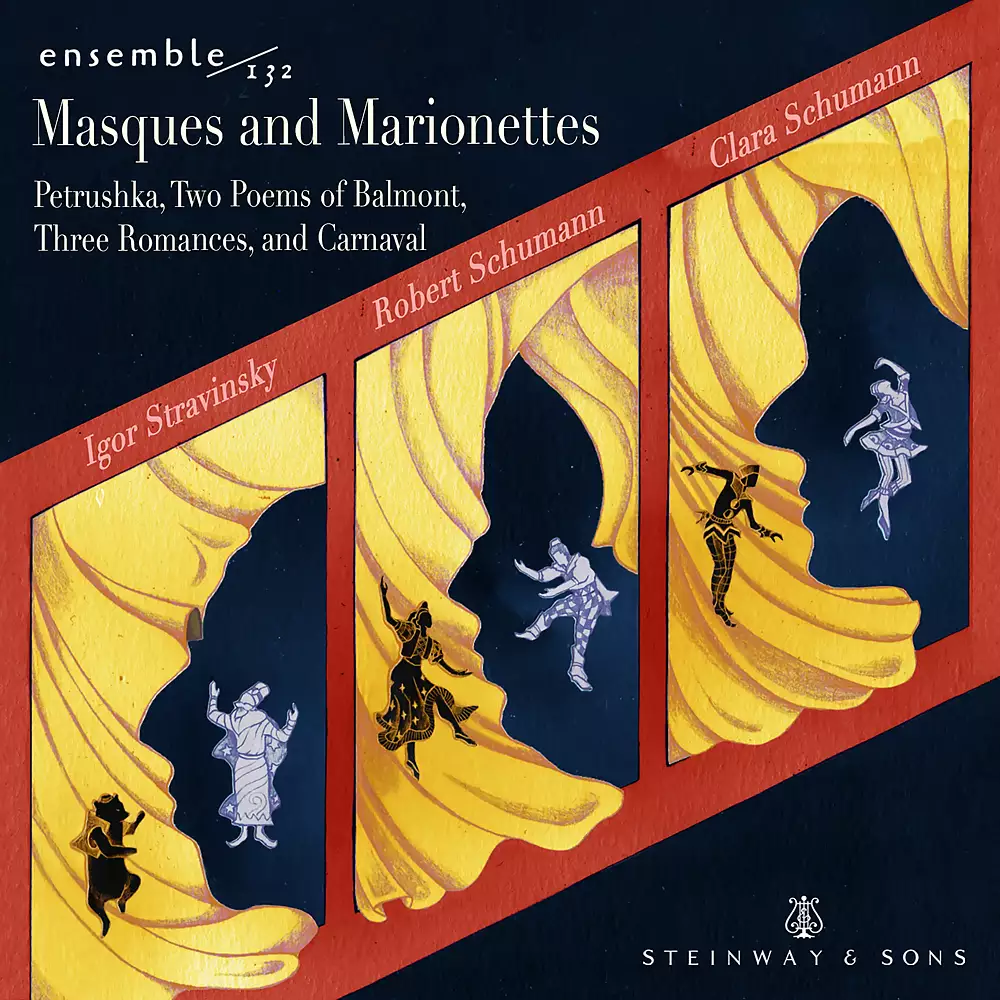


“Great music transcends the confines of instrumentation”
This guiding principle shaped my work in the early days of ensemble132’s founding in Fall 2019, as I excitedly sketched out the first drafts of my very first chamber music arrangements for ensemble132: Schumann’s Carnaval and Stravinsky’s Petrushka. During those unpredictable early days of the pandemic, our close-knit musical family, then based in Boston, used our music-making as a means of connecting with one another, channeling our collective emotions and anxieties of a world in flux.
The music featured on this album is a truly collaborative creation through and through. By design, ensemble132 is a fluid collective; every rehearsal and performance is a fresh inquiry into a composer’s intent, our own evolving sonic landscape, and the nature of musical inevitability. My hope is that these virtuosic arrangements not only expand the chamber repertoire but push both the players and the listener to rethink the relationship between the artist and their instrument.
Two Poems of Konstantin Balmont (arr. Sahun Hong)
Konstantin Balmont’s poetry is steeped in the sensory, the fleeting, and the ethereal qualities that translate naturally into the intimate textures of a piano quintet. In these two arrangements, the ensemble becomes a storyteller, with the original vocal lines of the two songs given to the violin and cello, respectively. We included these on the album for their distinctive storytelling qualities, reflecting Stravinsky’s vision of storytelling in 1911 when he composed both these songs and Petrushka.
In Nezabudochka-tsvetochek (“Forget-me-not blossom”), the violin takes the lead with its wandering, questioning lyrical line capturing the delicate and botanical tenderness of the verse. It serves as a gentle invocation, calling out to the listener with the faint, persistent voice of the flower itself. In contrast, Golub (“The Dove”) is rendered through the denser, vocal resonance of the cello - here, the murmuring syncopations of the accompanying parts highlight the second poem’s shift from playful courtship to a pulsing, melancholic sense of longing and abandonment.
Carnaval, Op. 9 for Piano Quartet (arr. Sahun Hong)
Robert Schuman composed Carnaval Op. 9, one of the most well-loved piano pieces in the canon, when he was twenty-four years old. Already building his reputation for colorful and imaginative short character pieces, the young Schumann manifested a unique vision: a musical exhibition of scenes depicting both real-life and imaginary characters, transformed as revelers at the Carnival festivities before Lent. With an extremely clever wordplay, Carnaval - Scènes mignonnes sur quatre notes (Little Scenes on Four Notes) draws from the Leitmotif of the notes A-S-C-H (A-Eb-C-B), which both spells the hometown Asch of his then-fiancee Ernestine von Fricken and is the German word for Ash, as in Ash Wednesday during Lent.
In these colorful and animated short pieces, Schumann features musical representations of himself and his closest friends and colleagues – such as Clara (Chiarina), Ernestine (Estrella), Chopin, Paganini – as well as trope characters from the Italian comedia del’arte: the clown Pierrot, Arlecchino (Harlequin), the flirtatious Coquette, and the wealthy Pantalon and his servant-mistress Colombine. The concluding scene of the work is a boisterous group dance, entitled Marche des Davidsbündler contre les Philistins (March of the League of David against the Philistines), depicting Schumann’s imaginary music society of the Davidsbündler, led by his extroverted and introverted alter-egos Florestan and Eusebius. This League of David, the righteous musicians’ family, joins together in a triumphant and celebratory dance to celebrate their victory over the music critics of Schumann’s time, represented as the Philistines.
In this new chamber music arrangement of Schumann’s masterwork, the original piano solo part has been expanded to the ensemble of piano quartet. With the support of three string instruments, the piece gains a newfound humor, sparkle, and by the nature of having multiple performers, a literal personification of the various characters in these quickly changing musical snapshots. Sad, love-forlorn characters become even more mournful with the resonance and texturing of the strings, while the fiery emotions of jealousy and passion are emboldened by the possibilities of sustaining lines and vibrato. The larger movements such as Preambule, Promenade, and Marche des Davidsbündler contre les Philistins take on the richness of orchestral scope, and the emotional peaks and valleys reach a completely new scale of intensity with the energetic and expressive power of an ensemble of four.
– Sahun Hong
Petrushka for Piano Quintet (arr. Sahun Hong)
Originally performed as a large-scale ballet, Igor Stravinsky’s Petrushka tells the story of a puppet magically brought to life by a mysterious sorcerer at the Shrovetide Fair in 1830s St. Petersburg. Stravinsky wrote it on the heels of his immensely successful Firebird, also for Diaghilev’s Ballet Russe, and like in his earlier masterwork, Petrushka revels in Russian folk melodies and stories. (Petrushka was a popular Russian hand puppet character deriving from the Commedia dell’arte’s Pulcinella.) However, this piece is anything but retrospective, strongly signaling the experimental direction that Stravinsky was headed. After all, just the next year he would write his riot-provoking Rite of Spring.
Stravinsky initially imagined Petrushka as a quasi-concerto for piano and orchestra, which he intended to build out of images of a puppet frolicking along the keyboard of a piano, "exasperating the patience of the orchestra with diabolical cascades of arpeggios,” in Stravinsky’s own words. This concept would soon evolve into the ballet we now know, with its protagonist plunged into the intensely human experiences of love, rejection, and fury as he falls in love – and into brawls – with the sorcerer’s other puppets. It would also usher in the beginning of Stravinsky’s now iconic exploration of what we call bitonality.
The combination of two seemingly incompatible chords – C Major and F-sharp major – to create the “Petrushka Chord” is a central structural and expressive force throughout this work. We can hear this bitonality at the opening of the Second Tableau when we are transported to Petrushka’s Room. The clarinets (or in our case, the violins) arpeggiate both F# and C chords simultaneously, signaling the moment when Petrushka starts to truly go down his emotional rabbit hole, while we in the audience are plunged deeper into Stravinsky’s strange and fascinating world. The resulting harmonic tension may have mirrored Stravinsky’s own conflicts at the time: his dual penchant for folk-inspired lyricism and tonal experimentation, his swiftly growing renown as a great writer of ballet music rubbing up against his urge to push the boundaries in provocative ways. Like its bitonal chords, Petrushka is filled with wonderful contrasts – its complex rhythms, beautifully simple tunes, enchanting textures, jarring distortions – making it a uniquely evocative piece that easily grips listeners even without a full cast of dancers or symphony orchestra.
Three Romances for Violin and Piano, Op. 22
One of the most notable performing artists in the history of Western music, Clara Wieck-Schumann is usually overlooked when considering the great Romantic composers. In her time, her reputation as a magnificent concert pianist was known throughout Europe and was rivalled only by the likes of Franz Liszt. However, she also composed intermittently throughout the first half of her life, putting forth a number of works that have recently made their way into the core repertoire—and rightfully so.
Clara Schumann wrote her Three Romances Op. 22 in 1853 in Düsseldorf, dedicating the work to her close friend, violinist Joseph Joachim. She and Joachim took it on tour shortly thereafter, meeting with great success. The following year, however, her husband would attempt suicide and eventually die of hunger in a mental hospital in 1856, essentially ending her composing career. Most of the rest of her life was spent taking care of their seven surviving children and maintaining a rich performing career – mostly as a way to make ends meet.
Each Romance offers a different shade of Clara’s unique artistry, which our members inhabit in each of their interpretations. The first movement – recorded by e132 co-artistic directors Zachary Mowitz and Sahun Hong – unfolds in tender conversation between cello and piano, blooming into a freely ornamented and multi-hued song. The second moves between wistful melancholy and playful charm, closing with a gentle smile (and knowing wink from violist Luther Warren). The tempo marking of the last romance, rendered by Maria Ioudenitch and Sahun, perfectly captures its essence: Leidenschaftlich schnell – passionately quick. Ecstatic from the first note, the movement moves through a series of transformations, signified by textural and often virtuosic piano writing, while the violin sings throughout. The piece comes to a close as the piano takes the violin’s opening melody to soaring heights, only to end with a newfound calm.
– Zachary Mowitz
Published date
2026-10-02
Number of discs
1
Channels
stereo:24:2.0
Made in Sweden since 1999. In collaboration with Textalk.
Cart
| Artikel | Antal | Beskrivning | a pris | Totalt |
Env.session:
NULL


Env.order NULL


string(2) "en"


collector.CheckoutUrl


collector.OrderItemCount
0

collector.CartUrl
NULL


collector.Order
NULL