
Rhine Journey
Catalog Number: 7325
Rhine Journey
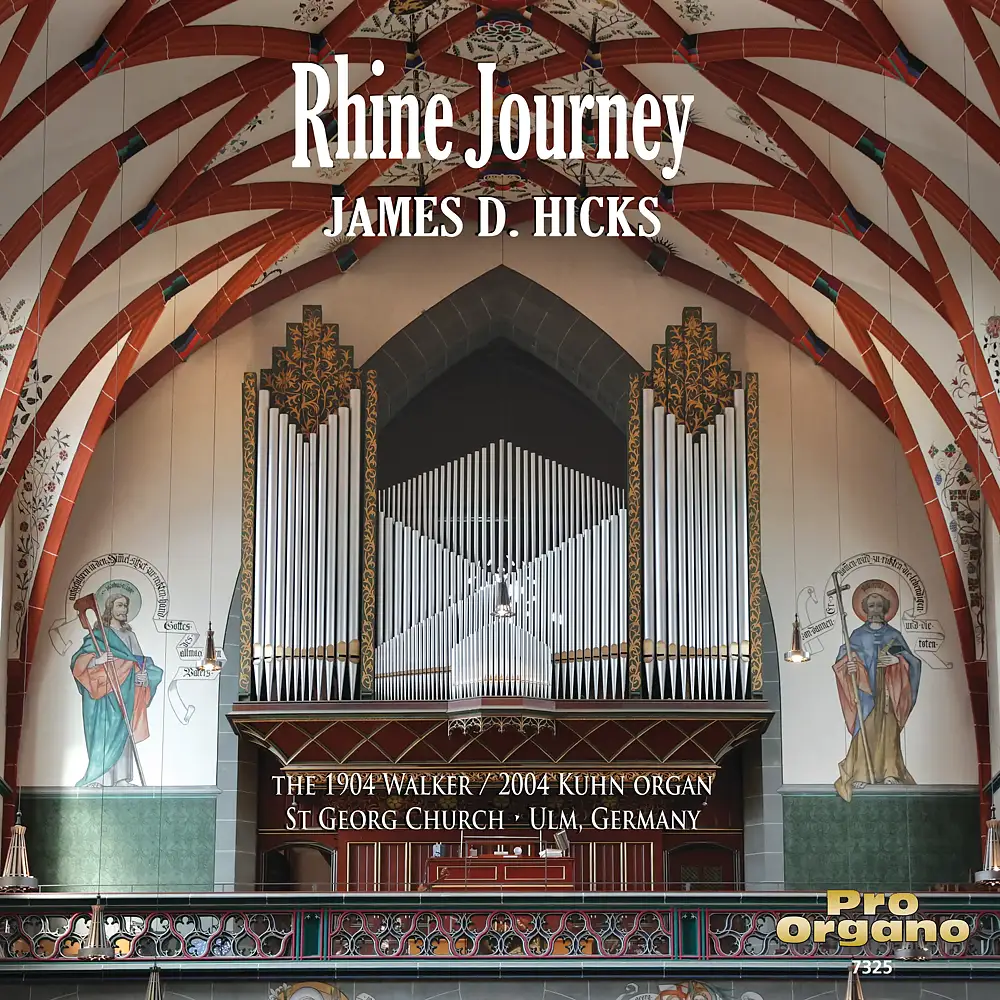


Rhine Journey
James D. Hicks
The 1904 Walker / 2004 Kuhn Organ
St Georg Church, Ulm, Germany
Pro Organo 7325
UPC 63607 77325 22
© Copyright 2026 Zarex Corporation.
All rights reserved.
Location audio engineering, videography, and photos: Jean-Philippe Apel
Audio & Video post-producer: Frederick Hohman,
Pro Organo, South Bend, Indiana.
ProOrgano.com
Recorded in St Georg Church, Ulm, Germany on June 1, 2 and 3, 2026
********
Playlist
01 Johann Gottlob Töpfer • Concertstück • 4:59
02 Richard Wagner, arr. Sigfrid Karg-Elert • Huldigungsmarsch • 7:33
03 Sigfrid Karg-Elert • Portraits nach Palestrina bis Schönberg, Op. 101:
La source mystique: Alla Debussy • 3:13
04 Max Gulbins • Trauerzug, Op. 17, Nr. 2 • 3:21
05 Theodor Veidl • Phantasie, Fuge und Passacaglia • 14:06
06 Albert Becker • Präludium und Fugue, d-moll, Op. 9 • 4:51
07 Sigfrid Karg-Elert • Portraits nach Palestrina bis Schönberg, Op. 101: Abstraction-Alla Schönberg • 1:31
08 Gerard Bunk • Einleitung, Variationen und Fuge über ein altneidersländisches Volkslied, Op. 31 • 18:48
09 Franz Wagner • Trionfo della vita / Phantasiestück, Op. 76 • 5:35
10 Herman Schellenberg • Fantasie, Op. 10 • 14:15
total program time: 78 minutes, 12 seconds
********
Program Notes
Bach, Buxtehude, Brahms.
Reger, Karg-Elert, Distler.
Schnitger, Silbermann, Walker.
Every organist knows these names and all organists are aware of the centuries-old accomplishments of legendary composers and organ builders, the existence of famed organ installations and the unique organ culture that has been decisively rendered throughout the German-speaking lands over the course of centuries. This musical heritage is readily apparent as it cuts a wide swath into central Europe, throughout countless churches, cathedrals, castles and other public edifices throughout Germany, Austria, Switzerland, the Baltic states and portions of the Polish and Czech republics. If there is a true home for the organ, perhaps the German-speaking peoples can claim it as theirs to own.
And yet….
After considerable thought, I have concluded that there is still a vast treasury within this particular venerable organ tradition that is little-known, seldom-played and existing on the margins of recognition. With this recording, my goal is to implement a new series designated as Rhine Journey and initiate a new body of work that strives to illuminate further the legacy of the Germanic organ repertoire. In a mode of operation somewhat akin to my still ongoing Nordic Journey now nineteen volumes in number, this an attempt to find overlooked musical riches from the past as well as recognizing contemporary developments while occasionally commissioning a new work.
Rhine Journey I begins intentionally with a clearly defined focus as it concentrates solely on only one period of time, that of the late-German Romantic movement that flourished during the latter part of the nineteenth-century through the first third of the twentieth-century. As such, the project employs the tonal resources of the superbly renovated 1904/2004 Walker organ
Op. 1146 residing in historic St. Georg Kirche, Ulm. While this is a presentation of German Romanticism, music that has been around for over a century, it is my hope that Volume I will offer surprises to even the most expert cognoscenti of the organ.
I wish to thank my wonderful host for this recording, Mr. Thomas Stang, who has extended the warmest hospitality to me throughout the entire process. In addition, I extend my heartfelt gratitude to Mr. Frederick Hohman of Pro Organo for his inspired leadership and comradery throughout these recording sessions from his Indiana studio, and to my onsite recording engineer Mr. Jean-Philippe Apel for his attention to detail, technical expertise and friendship. And of course, an essential member of my team is my wonderful wife now of thirty years, Ms. Elisabeth Ann Hicks who continues to not only assist me so ably at the console but always provides such loving support consistently within these experiences.
********
St. Georg Church, located in the eastern part of downtown Ulm, was built between 1901 and 1904 by Max Meckel in the Neo-Gothic style as a Catholic Garrison Church. The church’s paintings and interior furnishings have been preserved in their original condition, a rarity in the course of German history. As a result, it holds as much historical significance as, for example, Ulm Minster. Following the period-appropriate renovations of the church’s interior and extensive roof work of the 1990s, the congregation determined that a full restoration of the historic Walker organ was in order.
Installed by Oscar Walker (grandson of E.F. Walker), the original organ was constructed with cone chests and pneumatic pipe action over the course of three manuals with forty-seven stops. Subsequent developments concerning this organ included a 1917 removal of the tin façade pipes in support of the effort on behalf of World War I. By the 1960s, the instrument was in need of repair. Experts of the time replaced the pneumatic system with an electric one and, in addition, tonal revoicing of much of the pipework occurred in accordance with the fashions of the time. By the end of the 1970s, much of the pipework was again repaired and cleaned. There evidently was some discussion of undertaking another rebuilding project or even a complete replacement of the organ in the 1980s that would provide for a more versatile, “universal” instrument that could adequately manage most styles of organ repertoire as well as being a flexible leader of the
liturgy of the church.
By the mid 1990s, however, organ builders and experts from the diocese and the state certified that the original Walker organ had very important historical value and should be restored as close as possible to its original condition. The Kuhn organ company of Switzerland was chosen to do the work beginning in 1996, a process which eventually required almost a decade to complete.
The 2004 rebuild went somewhat beyond this goal, preserving a lot of the original pipework and constructing a mechanical-pneumatic tracker enabling a mechanical transmission from the key to the windchest and adding some stops of similar vintage from other locations. With the aid of specifically constructed equipment, the mechanical action was transformed into a pneumatic system, providing for accessible repairs and an absence of wind noise at the console. The console is now located at the center of the rear gallery with a view into the nave.
The organ specification and notes follow:
I MAIN WORK
Principal 16
Principal 8
Fugrar 8
Hohlflöte 8
Bourdon 8
Dulciana 8
Octave 4
Rohrflöte 4
Octave 2
Mixture 4 ranks, 2-2/3’
Cornet 3-5 ranks, 4’
Trumpet 8
Clairon 4
II MANUAL
Quintatön 16
Flute principal 8
Concert flute 8
Lovely Covered 8
Viola di Gamba 8
Salicional 8
Principal 4
Flauto amabile 4
Piccolo
Mixture 4 ranks, 2’
Oboe 8
III SWELL
Sweetly Dappled 16
Violin principal 8
Gemshorn 8
Flauto amabile 8
Bourdon 8
Quintatön 8
Aeoline 8
Vox Celeste 8
Fugara 4
Transverse flute 4’
Flautino 2
Cymbel 3 ranks, 2-2/3’
Clarinet 8
PEDAL
Principal 16
Violonbass 16
Subbas 16
Covered bass 16
Quintbass 10-2/3
Octave bass 8
Violin 8
Soft bass 8
Octave 4
Trombone bass 16
NOTES:
• The facade and the large pipes of the pedal registers stand on pocket shutters.
• The organ's action is mechanical in that the trackers extend to the windchests, but the valves are opened pneumatically by a relay. This type of control is extremely rare.
• Another special feature of the organ is that all mixtures contain a third chorus.
• From g 0 double-labided
• Overblowing from c 1
• Opening
• Transmission from the swell (III); Lovely thought 16'
• Transmission from the swell box (III); Flauto amabile 8'
Paddocks (1904-1964): II/I, III/I, III/II, I/P, II/P, III/P
Playing aids (1904-1964): 3 free combinations, tutti, automatic piano pedal for II and III, crescendo roller, Ab roller, Ab hand registration, calcant
********
Notes about the music by James D. Hicks.
Johann Gottlob Töpfer (1791-1870)
Concertstück
A native of the village of Apolda located in the Weimar region and the son of a weaver, farmer and musician, Johann Gottlob Töpfer enjoyed a multifaceted career as an organist, organ builder, theorist and composer. He overcame the relatively modest conditions of his youth with applied studies at the teacher training college in Weimar during which his skill in improvisation and excellence in organ performance were noted by
his contemporaries. He later taught at the Weimar Seminary and was appointed city organist in 1830. Töpfer was highly regarded as a teacher of organ, producing a large number of skilled students.
As his career progressed, Töpfer became increasingly interested in the art of organ building. As his specialized musical training lacked any sort of instruction in this area of knowledge, Töpfer pursued an independent study of mathematics, mechanics and acoustics. He was particularly enamored of Bedo de Celle’s L’art du facteur d’orgues of 1766 which became the foundation of his work. He later became a noted organ inspector and traveled extensively in this role.
Töpfer’s career path reflected a fascination with older styles of composition, and he edited collections containing compositions from previous generations, contributing to his era’s discernment of some of the major historical stylistic developments from the past. In contrast, Töpfer’s dramatic original music, here the circa 1855 Concertstück is an ideal composition to begin our program, a work thoroughly reflecting a modern mid-nineteenth-century impulse. The composition initially appeared in the collection assembled by A.G. Ritter, Kunst des Orgelspiels III. The piece allows the performer a chance to display the “lungs of the organ” as J.S. Bach used to say as well as showcase one’s own technique. Conceived within the mainstream of German Romanticism, the composer places expressive contrasts within the body of the score and opportunities for varied registrations fall within the full tutti to other settings for softer stops. The fiery, Sturm und Drang essence of Concertstück gives the work a compelling aspect of urgency, a musical trait ideally suited for the opening of any performance.
Richard Wagner (1813-1883)
Huldigungsmarsch
Arranged for organ by Sigfrid Karg-Elert (1877-1933)
Composed in 1864 as a ceremonial work for military wind band, Huldigungsmarsch (Homage March) is a musical act of gratitude by Richard Wagner to King Ludwig II of Bavaria. It would not be an exaggeration that King Ludwig II did as much as anyone to support Wagner’s artistic aspirations, supplying the necessary conditions for the creation and completion of the composer’s magnum opus Der Ring des Nibelungen. Ludwig II not only enthusiastically promoted Wagner’s art, but rescued the musician from certain financial and professional ruin. The high esteem the king held for Wagner is made manifest in the royal residences that he constructed, such as Neuschwanstein. To this day, Ludwig’s castles are filled with artwork inspired by scenes from Wagner’s dramatic productions.
By the turn of the twentieth-century, Wagner’s status as a composer was at its zenith, and a number of transcriptions of his music for organ began to be produced. Some of the most virtuosic and dramatic of these arrangements were penned by Edwin Lemare (1865-1934), an English concert organist of international reputation, but other artists contributed their own interpretations of Wagner’s art. The German composer Sigfrid Karg-Elert produced a Richard Wagner Album, 18 Konzertbearbeitungen für Orgel, including original arrangements from Rienzi, Tannhäuser, Lohengrin, Die Meistersinger, Der Ring des Nibelungen, Zwei Gesänge, and Parsifal. Karg-Elert’s interpretation of Huldigungsmarsch allows the performer a somewhat more idiomatic, straightforward path to the realization of this music as compared to the symphonic style found in Lemare. This smoothly evolving work gives an organist plenty to choose from in a registrational sense during the gradual buildup from piano to full organ, while allowing for varied choices in solo voices. Toward the end of the piece, I was able to use the Walker’s Romantic Era Walze (a kind of crescendo pedal which is a rotating cylinder operated by the performer’s foot) in order to make a smooth, gradual decrescendo before the work brings itself to a triumphant conclusion.
Sigfrid Karg-Elert (1877-1933)
Portraits nach Palestrina bis Schönberg,
Op. 101, Heft II:
La source mystique-Alla Debussy
Karg-Elert’s Portraits nach Palestrina bis Schönberg is a monumental collection of thirty-three brief musical vignettes composed for harmonium or organ during the 1920s. Beginning in the sixteenth-century with Palestrina, Karg-Elert consistently demonstrates his highly developed gift as a pasticheur, effectively exhibiting his encyclopedic knowledge of over four hundred years of music. Karg-Elert does not merely imitate his forbearers and, toward the conclusion of the opus, his contemporaries, but advances his own unique understanding of harmonic theory. As was often the case in his more traditional works for organ, Karg-Elert demanded an extensive “kaleidoscope” of colors to achieve the most effective performance. His homage to Claude Debussy,
La source mystique, is a typical example of this approach. Within the short space of two pages, all grounded by a single bass C pedal point, Karg-Elert summons forth the cloudy, sultry spirit of the impressionists in a long arc of pianissimo to full organ and closing the circle in the end in the spirit in which the piece began. Karg-Elert affords the performer a number of opportunities to explore the tonal resources of a Romantic Era organ, and here I chose to highlight some of the lighter principals and silky smooth orchestral flute stops of the Walker organ.
Max Gulbins (1862-1932)
Trauerzug (Funeral Procession),
Op. 17, Nr. 2
The region of Kummetschen, East Prussia, was the homeland of Max Gulbins, a mainstream organist, cantor and composer who eventually studied at the Berlin Academy of Music with Heinrich von Herzogenberg. He eventually held music positions in Stallupönen, Insterburg, Elbing, and was finally awarded the post of chief organist at St. Elisabeth, Breslau in 1908.
Gulbins was a prolific composer of choral chamber and organ works, and in the latter category left numerous compositions including five solo sonatas, pieces for other instruments, voice and organ, fantasy works, and preludes for the liturgical year. The Trauerzug is a relatively early work dating from 1901, and the composer creates an appropriately lugubrious atmosphere, replete with mournful, thick chords, dotted rhythms and a suitably tragic climax, all leading to a quiet, almost desolate conclusion on an open C sharp minor chord.
Theodor Veidl (1885-1946)
Phantasie, Fuge und Passacaglia
Theodor Veidl was a German-Bohemian composer whose works have largely been lost due to the chaotic conditions existing in the final years of World War II. This composer hailed from Wissotschan, located during the late nineteenth-century within the borders of the Austro-Hungarian Empire. Veidl attended a local Jesuit Gymnasium during his youth, and he evidently demonstrated enough natural talent to serve as an organist there for school services, and later in his studies he helped to found a student orchestra. He went on to study German philology and musicology at the Prague Conservatory, receiving a Doctorate. Veidl held a quite varied portfolio of musical positions including working as a repetiteur at the Vienna Volksoper, then as Kapellmeister in Bad Hall and Teplitz-Schönau where he also served as a private music teacher, organist, pianist and critic. He directed the German Singverein in Prague and in 1920 cofounded the German Academy of Music and Performing Arts in Prague. By 1927, he accepted a professorship of music at the German University in Prague where was he music director and a lecturer in music theory, becoming a full professor in 1936. Veidl was primarily known for his works for stage. He wrote many operas, works that he designated as folk operas and was a recognized representative of German culture in the Czech Republic. Other compositions include an orchestral Symphony in E Major, Cello Concerto and numerous choral settings.
After this remarkable life of service to his art, Theodor Veidl was stripped of his position during the Second World War by the German Protectorate administration, due to his alleged membership in a Freemason Lodge. By the end of the war in 1945, he was deported to the Terezin internment camp where it is believed he died of malnutrition in February 1946. A large portion of his output was evidently lost during this tragic final period of his life.
The work under consideration for this recording, Phantasie, Fuge und Passacaglia, is probably the only organ composition to have survived the events of the composer’s last period. The original manuscript is believed to be lost, but it was published by Breitkopf und Härtel. This edition, however, has been out of print for decades. The composition itself is a remarkable late-Romantic essay, notable for combining three highly contrasting musical forms into a compelling, cohesive virtuosic work. The opening section maintains a free, rhapsodic spirit, establishing the primary theme within rapidly changing dramatic moods. The second movement utilizes dense, interlacing counterpoint that builds considerable tension. The concluding movement builds variations over a bass line in many of the usual ways associated with this form, but initially commences in common time as opposed to the usual three-quarter meter. Veidl thickens the textures as well as escalates the complexity and pace of the movement as it concludes with emphatic half note chords during its final variation.
I wish to thank the Hamburg-based composer Andreas Willscher for introducing me to this splendid and rare composition. Mr. Willscher, whose fascinating original works appear on several of my other recordings, has provided a new edition of Veidl’s opus, and extends his important research into little-known areas of the organ repertoire. Thank you, Andreas!
Albert Becker (1834-1946)
Präludium und Fuge, d-moll, Op. 9
Born in Quedlinburg, Albert Becker studied music in Berlin under Siegfried Dehn and continued his career in the capital city as a composition teacher and conductor of the Berlin Cathedral Choir. He was evidently a widely respected figure with the Berlin music society given that he elected to refuse an offer to take the position of Kantor at the Thomaskirche, Leipzig (the post most closely associated with Johann Sebastian Bach) upon the request of Emperor Wilhelm II.
Becker’s Präludium und Fugue, e-moll begins with a gradual, orchestrally-conceived crescendo which effectively sets the stage for a fugue whose subject is taken from Johann Sebastian Bach’s Fantasy und Fugue, c-moll, BWV 537.
Sigfrid Karg-Elert (1877-1933)
Portraits nach Palestrina bis Schönberg,
Op. 101, Heft II:
Abstraction-Alla Schönberg
Rather than employing a strictly twelve-tone system, Karg-Elert turns to Schönberg’s early expressionistic style for his point of departure. The ninety-second piece is anchored by three held notes
(F natural, B natural and E natural in the treble) for its duration while underneath the melodic lines engage in wildly jagged lines moving in unpredictable directions. The saturated dissonance of the work is brought to an unexpected conclusion within the final measure of the piece as Karg-Elert completes the final cadence by inserting his own personal late-Romantic harmonic voice.
Gerard Bunk (1888-1958)
Einleitung, Variationen und Fuge über ein altniederländisches Volkslied, Op. 31
Gerard Bunk was a Dutch-born German composer, organist and pedagogue, whose extensive and imaginative organ works represent a body of the literature that deserves to be explored further. The youngest of a musical family of seven children, Bunk’s gifts were recognized at an early age. He was found to have absolute pitch at the age of five and received his initial training from his father. He later pursued formal studies at the Rotterdam and Hamburg Conservatories with further study in England. Bunk relocated to Germany, spending the duration of his life in that country where he eventually met Max Reger in 1906. Reger was impressed by Bunk’s musicianship and the younger man’s interpretation of Reger’s music to such an extent that he formally recommended Bunk to the Dortmund Conservatory where he taught piano and theory. Bunk eventually earned an appointment as organist at the Dortmund’s St. Reinold’s Church, a venue famed for its Walker organ. During his prolific career in Dortmund, Bunk founded the Dortmund Trio, conducted numerous choral societies, introduced his own compositions, performed countless solo recitals, and seamlessly combined these roles into a notable artistic contribution to his community. During the disruptive years of National Socialism, Bunk became Kirkenmusikdirektor, a position that formalized his oversight of church music initiatives in other locations, but the onslaught of war adversely affected his activities as St. Reinold’s and its organ endured considerable damage and eventual destruction. Bunk’s post war musical endeavors continued, albeit on a more modest basis.
Gerard Bunk’s works for organ reflected his affinity for the late Romantic tradition, championing the music of Max Reger, César Franck and Felix Mendelssohn. He preferred clarity of form and working within a refined, calm sense of order. While his music can often be quite dramatic, Bunk avoided the sudden explosions of sounds so often a part of the Reger aesthetic. While he clearly had a gift for exploring the possibilities of late Romanticism, there always seems to be an assertive counterweight in his music, eschewing cheap sensationalism for balance. In addition to the Romantic heritage of his youth, Bunk came to be increasingly drawn to the emerging Orgelbewegung, and this influence saw him incorporate aspects of the Baroque revival within the foundation of his work. His works for organ number around one hundred pieces: free forms, variations, sonatas, and chorale-based compositions. He also produced largescale compositions for organ and orchestra.
Einleitung, Variationen und Fuge opens with a massive, choral introduction followed by an ever-quickening series of progressions concluding on an A-based dominant seventh chord, effectively setting up the transition to the variations. The first variation of primarily quarter notes begins at the very lowest notes of the keyboard, and the emerging variations gradually raise the tessitura and accelerate the tempi. The second variation features parallel chords in the right hand over a tenor cantus firmus, while variation three juxtaposed swiftly moving triplets in the manuals over persistent eighths in the pedals. This is gives way to an explosive Vivace whose chromaticism and dotted chords create a dramatic effect over perpetually moving pedals. A dotted fanfare-like variation is followed by a pastorale Andantino, setting up an Allegro replete with moto perpetuo cascading figurations. Variation eight is a chordal march in the manuals, complemented by pulsing rhythms in the pedals which eventually leads the composition back where it started with a reprise of the material that began the opening measures. Bunk continues with a fugue based upon the old Netherlandish theme and the counterpoint leads the piece with stretto entrances of the theme piled into each other over a dominant pedal point A. The tension is finally relieved with a full chordal treatment of the main theme on full organ.
Franz Wagner (1870-1929)
Trionfo della vita / Phantasiestück, Op. 76
Wagner spent the bulk of his career in Berlin, studying at the Royal Academic Institute of Church Music, eventually becoming organist of the Grunewaldkirche in 1903 where he presided over the Wilhelm Sauer organ. Wagner also worked as a vocal instructor, conducted the Berlin Liedertafel and toured on an international basis throughout the Far East, Sweden and Finland.
Wagner’s Op. 76 is thought to have been inspired by the allegorical and didactic poems of Francesco Petrarch (1304-1374), the Trionfi, or by the cycles of novels by Gabriele D’Annunzio (1863-1938). The first section of the piece alternates bold, expressive unison lines with powerful manual chords set over expressive pedal figurations. The piece moves into more improvisatory gestures before completing its course with the power chords. The second section is a calm, almost Mendelssohnian “song without words” whose lyricism supplies the requisite contrast with the drama of the preceding section. This tranquility quickly gives way to a concluding Risoluto whose triplets lead the composition to a final resolution of some of the principal initially heard in the opening section of Phantasiestück.
Herman Schellenberg (1816-1862)
Fantasie, Op. 10
Our program concludes with an exciting composition from the pen of Herman Schellenberg, a native of Leipzig and composer, organist and educator who was also employed by the Johanneskirche and later at the St. Nicholas Church. On the occasion of the centenary of the death of Johann Sebastian Bach in July 1850, the Neue Zeitschrift für Musik launched the first complete edition of Bach’s works. As a part of this centenary commemoration, the society announced an additional release, one by the local Herman Schellenberg, in honor of the memory of Bach. Schellenberg by his heritage and location was firmly and expertly rooted in the post-Bach Leipzig organist tradition. He often performed the major works of Bach alongside his own pieces. Schellenberg was nevertheless not content to merely continue a past tradition, but in his own works embrace the spirit of the Romanticism. He abandoned the formal rigor of the Baroque Era in favor of giving free rein to the “fantastic” properties of the time in which he lived. As a result, his Op. 10 Fantasie is more of a freely conceived, romantically- oriented, symphonic movement. Although written at a time when Bach’s music was being specifically honored, there is no B-A-C-H quote in this work or any compulsion to display contrapuntal artistry. Instead, Schellenberg embraced the Romantic world of emotion, a Wagnerian musical language that was long on dramatic effect and short on learned counterpoint. As a result, this initially intended Bach salute became one of the most effective examples of an emerging Romanticism, a dramatic piece deserving our attention today.
The work in d minor begins with an alteration of chords in quarter notes over a pedal point on A with scale-like passages in both manuals and pedals. The interplay between the hands and feet becomes more intense, all leading to the first iteration of the second theme set in the parallel key of D major. This leads to a restatement of the opening material, but this time in g minor, progressing to a piano chorale harmonic progression in the upper range of the manuals. The composer expertly guides the music through the development of all of these ideas propelling the work to a riveting cadenza. The stage is now set for a final return to the principal themes of the beginning, and the Fantasie concludes in a blaze of glory with rapid fire pedal scales and punctuating chords resolving to a glorious D major resolution.
********
The Artist
James D. Hicks is a concert organist living and working out of Califon, New Jersey, USA. A graduate of the Peabody Conservatory of Music, Yale University, and the University of Cincinnati, Hicks has also studied at the Royal School of Church Music in the UK. James held liturgical positions throughout the USA over the course of thirty-five years and now devotes himself to concert, publishing, and recording projects.
Over the past fifteen years, James has researched the music of the Nordic lands and the result is an ongoing venture entitled Nordic Journey. The endeavor places emphasis on new music. He has commissioned over seventy-five compositions from Nordic composers and other musicians in northern Europe, and he has researched repertoire from the past that has hitherto never been recorded or published. With the Autumn 2025 release of Nordic Journey Volume XIX / Nordic Organ Book by Fredrik Sixten, the series now comprises thirty-one discs, all produced for the American label Pro Organo with distribution digitally worldwide by Naxos of America LLC, accessible through the usual digital streaming platforms.
A parallel aspect of the Nordic Journey project is the production of hardbound editions that include premiere publications of many of the works James has commissioned as well as several previously unavailable compositions from earlier eras. The Norwegian firm Cantando released the Nordic Journey Series Volume I in 2018 (now available at www.musikkforlagene.no) and Norsk Musikkforlag published The Nordic Journey Series Volume II in 2020). Norsk Musikkforlag has most recently produced the third volume in October 2022. A fourth volume was released in September 2025.
During the COVID-19 pandemic, James wrote the first full-length book devoted to the complete works for organ by Norwegian composer Kjell Mørk Karlsen on the occasion of the artist’s seventy-fifth birthday.
In addition to his endeavors concerning the organ and its literature, James is an enthusiastic exponent of traditional music from the British Isles, performing on a number of instruments associated with these traditions. James is an avid hiker and has walked the historic Hadrian’s Wall trail in Northern England as well as traversing numerous sections of the Appalachian Trail in the USA.
To learn more about James D. Hicks, you are invited to visit his website at www.jamesdhicks.com.
********
Published date
2026-10-10
Number of discs
1
Channels
stereo:24:2.0
Made in Sweden since 1999. In collaboration with Textalk.
Cart
| Artikel | Antal | Beskrivning | a pris | Totalt |
Env.session:
NULL


Env.order NULL


string(2) "en"


collector.CheckoutUrl


collector.OrderItemCount
0

collector.CartUrl
NULL


collector.Order
NULL